How to Find Grief Support That Actually Works When Therapy Felt Wrong

The Dead Dads Podcast

Most men who try grief counseling don't quit because they're not ready to heal. They quit because the format assumes they grieve like someone who has never once been told to just push through it.
That's not a character flaw. That's a design problem.
If you sat in a counselor's office after your dad died and left feeling worse than when you walked in — or, more likely, just deeply uncomfortable and weirdly judged for not crying — you're not broken. You probably just ran into a framework built for a different kind of griever.
What "Instrumental Grief" Means — and Why No One Told You About It
There are two recognized patterns in how people process loss. Psychologists call them intuitive grief and instrumental grief, and the distinction matters enormously if you've ever felt like therapy was designed for someone else.
Intuitive grievers feel their way through loss. They talk, cry, express, and process out loud. This is the pattern most clinical frameworks default to — the open-ended session, the guided emotional reflection, the careful unpacking of feelings. It works well for many people.
Instrumental grievers — a style that research consistently shows skews toward men — process through action. They fix things. They plan. They need something to do with the weight of what happened. They might mow the lawn the day after the funeral, not because they're avoiding grief, but because movement and purpose are how they metabolize it. As Australian grief researcher David Layton describes, these expressions deserve recognition, not correction.
This isn't avoidance. It's a legitimate grief style. And misidentifying it as emotional shutdown — treating it like a wall that needs to be broken down rather than a door that opens differently — is where a lot of clinical settings go wrong. When you show up to a grief session as an instrumental griever and you're handed a prompt designed for an intuitive one, the session doesn't fail because you won't engage. It fails because the question wasn't built for you.
Why the Standard Session Format Backfires
Picture the setup: fifty minutes, a quiet room, a professional across from you, and a prompt along the lines of "How are you feeling about your dad's death?" For some people, this unlocks something. For a lot of men, it produces a very specific kind of blank stare.
The open-ended emotional prompt is a tool designed around the assumption that the barrier to grief processing is access — that the feelings are there and just need an invitation. But for men who've spent a lifetime being rewarded for competence, action, and not visibly falling apart, the barrier isn't access. It's format.
As Psychology Today notes, men often mask grief due to societal pressure to remain stoic. That pressure doesn't disappear the moment they walk into a therapist's office. If anything, the clinical silence amplifies it — because now there's someone watching, and the implicit message of the format is: something should be happening here.
The 50-minute hour with no clear deliverable is a problem for problem-solvers. The expectation of tears as evidence of progress is a problem for men who process in their bodies and their hands. A format that treats stillness as strength and verbal expression as the only valid output leaves most instrumental grievers feeling like they're failing at something they're already bad enough at.
According to Guy Counseling's analysis of male grief, men frequently channel grief into work, physical activity, or caretaking. Not because they care less. Because they've been socialized to equate stillness with weakness. A clinical hour of guided emotional disclosure runs directly against that grain — and then, when the man disengages, the interpretation becomes "he's not ready," when the real answer is that he was never given a format that fit.
The Gap Between "I'm Fine" and Actually Being Fine
Here's what happens after a man walks away from therapy convinced it wasn't for him: life keeps moving. He goes back to work. He handles the estate paperwork. He tells people he's doing okay. And for a while, that's mostly true — or at least it feels that way.
Unexpressed or misdirected grief doesn't dissolve on its own. It relocates. Psychology Today's research on male loss is consistent on this: cultural pressure to "be strong" doesn't eliminate grief, it drives it underground. What surfaces instead is irritability that seems disproportionate, numbness that flattens everything, increased drinking that gradually becomes the third drink that was supposed to be the second.
The guide on navigating male grief from Mentoring Through The Maze puts it directly: "Unspoken grief doesn't disappear; it lodges in the body and shapes identity." It shows up as chest tightness. Sleeplessness. A shorter fuse with your kids. A quiet distance from your partner that neither of you quite knows how to name.
The man who says "I'm fine" two months after his dad died and means it is rare. The man who says "I'm fine" and has genuinely moved grief through rather than around it is rarer still. Most of them are in the third category: the one where they've gotten very good at performing fine without anything having actually shifted.
The goal here isn't to shame men back into a clinical setting that already didn't work. It's to be honest about the stakes. Two years of overworking and quiet numbness isn't grief "taking its course." It's grief finding the path of least resistance — which is usually the one that does the most long-term damage.
What Actually Works: Formats Built Around Honesty, Not Performance
The good news is that instrumental grief responds well to support. Just not the kind that was built for a different grief style.
Storytelling and peer conversation are fundamentally different from one-sided disclosure to a professional. When a man sits across from someone who's been through the same thing — not a therapist who's studied loss, but someone who's lived it — the dynamic shifts. There's no performance required. Nobody's evaluating whether you're grieving correctly. The conversation can start with the practical, ridiculous, infuriating reality of what it's like after a dad dies, and the emotional weight finds its own way into the room.
This is the specific gap that Roger Nairn and Scott Cunningham describe when they explain why they built Dead Dads. "We started it because we couldn't find the conversation we were looking for." Not a clinical framework. Not a grief stages checklist. A real conversation, between men who actually lost their dads, about the stuff nobody else was willing to talk about.
Humor is a legitimate processing tool. This bears saying plainly, because men who laugh at the absurdity of grief are often made to feel guilty about it, as though finding dark comedy in the situation means they didn't love their father enough. The research says otherwise. Humor has been documented as a genuine coping mechanism for grief — it creates psychological distance, regulates emotion, and allows people to approach painful material without being overwhelmed by it. If you've ever laughed at something your dad would have found hilarious and then felt immediately terrible about it, read How to Use Dark Humor When Your Dad Dies — and Stop Feeling Guilty About It. The short version: the laugh and the grief can coexist. They're not in competition.
The tagline of Dead Dads is "Death. Jokes. Closure. Not always in that order." That's not a marketing decision. It's an accurate description of how the process actually moves for most men.
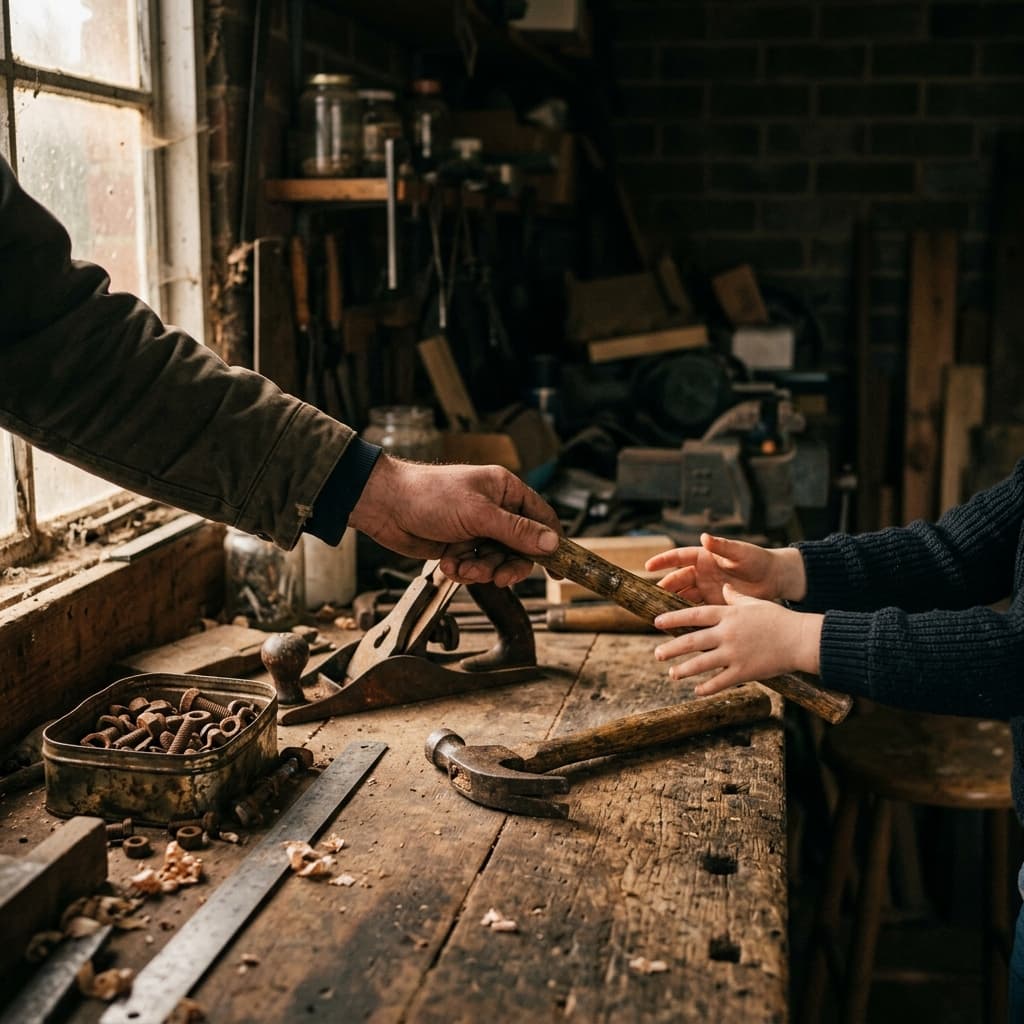
Practical framing matters more than most clinical settings acknowledge. Losing a dad isn't only an emotional event — it's a logistical one. The paperwork marathon. The garage full of tools that nobody knows what to do with. The password-protected iPad that nobody can unlock. The moment, weeks later, when you reach for your phone to ask him something and the reality lands again, harder than it did at the funeral.
Grief support that makes room for the concrete, practical aftermath of loss — and treats it as a legitimate entry point, not a deflection from the "real" emotional work — is grief support that reaches men where they actually are. The hardware store isn't a metaphor. It's just the hardware store, and the grief hits there because that's where it hits.
Peer community and shared narrative work for men in a way that structured group therapy sometimes doesn't. Group therapy carries the same performance anxiety as individual sessions: who cries first, who's further along in their stages, who's doing it right. Unstructured peer conversation — the kind built around a shared experience and a willingness to be honest — removes the clinical audience from the equation. What replaces it is something closer to the conversations men used to have at the back of a funeral that lasted three hours past when anyone planned to stay.
Listeners have described the Dead Dads podcast as providing genuine pain relief — not because the hosts offer clinical insight, but because hearing someone else describe the experience without sanitizing it confirms that you're not uniquely broken. One listener wrote that they'd bottled up the pain for years after their dad died, and that finally hearing it talked about honestly gave them something they hadn't been able to find elsewhere.
That's what finding the right format does. It doesn't fix grief. But it lets grief move, instead of just staying where it is, waiting.
If this resonates, Dead Dads is available on Spotify, Apple Podcasts, YouTube, and every major platform. You can also leave a message about your own dad, suggest a guest, or just listen to someone else talk honestly about a thing that most people skip past.
That's where it starts.
Get the latest from The Fatherless Manual delivered to your inbox each week
More from The Fatherless Manual

How to Navigate Social Situations When You Grieve With Humor, Not Tears
You made a joke about your dad at the family dinner — a good one, actually — and the room went quiet like you'd said something terrible. That silence is its own

Why Grief Support Groups Fail Men — And What Is Quietly Replacing Them
Nearly a quarter of men say they would never consider professional therapy for mental health struggles, even when they're in crisis. Not because they don't need
How to Introduce Your Kids to the Grandfather They'll Never Meet
Your kid is going to ask about him. Maybe they already have — the casual, devastating "What was Grandpa like?" lobbed from the backseat on the way to soccer pra