How to Make Your Branded Podcast Actually Work on YouTube

Claude
meta_description: "Learn how YouTube's recommendation algorithm actually works for branded podcasts — and how to design for clicks, retention, and discovery instead of just uploading."
tags: "how-to", "video-podcasts", "youtube-strategy", "branded-podcasts", "content-strategy"
A video with 10,000 views and eight minutes of average watch time will outperform a video with 50,000 views and 30 seconds of average watch time in YouTube's recommendation system. That's not an edge case — that's how the algorithm is built. John Isaacson documented this clearly in March 2026: the platform rewards depth of engagement, not breadth. And yet most branded podcast teams are still measuring downloads, tracking subscriber counts, and calling upload consistency a strategy.
If your branded podcast is getting ignored on YouTube, the upload isn't the problem. The strategy is.
And more specifically, the strategy usually fails one simple test: does the episode have a clear Job, for a defined Audience, that leads to a measurable Result.
What YouTube Is Actually Doing With Your Episodes
The foundational mistake is treating YouTube as a hosting platform. It isn't. Per the InfluencerDB YouTube Algorithm Guide 2026, YouTube doesn't promote videos — it matches viewers to content that satisfies them. Two people searching the same keyword see different results because the algorithm is personalizing around predicted satisfaction, not rewarding whoever uploaded most recently.
This distinction matters for branded podcasts more than almost any other content category. Most brand teams inherited a distribution mindset from audio podcasting: record the episode, publish the RSS feed, let the platforms do the rest. That works well enough on Spotify and Apple Podcasts, where the feed model is built for passive listeners. YouTube is a different system entirely. Its recommendation engine is evaluating your content on four signals: click-through rate, average view duration, audience retention curve, and satisfaction signals. None of those overlap with download counts.
The pattern that plays out is predictable. A brand team uploads full episodes with titles like "Episode 42: Leadership in a Changing World with Guest Name." No custom thumbnail. A 90-second intro before anything interesting happens. Zero review of analytics after the fact. Six months later, the internal verdict is "YouTube doesn't work for podcasts." Wrong diagnosis. YouTube works fine. The approach didn't.
In most cases, the real issue is upstream: the episode was never designed with a clear Job for a specific Audience, so the Result is weak no matter how well it’s distributed.
Packaging: Would a Stranger Actually Click This?
Every branded podcast episode on YouTube lives or dies on a single question before anyone watches a second of it: would someone click this title and thumbnail with no prior knowledge of your brand?
If the honest answer is no, the algorithm won't push it either. Isaacson's benchmark puts healthy click-through rate at 4–10%, depending on niche and audience size. Below 4% means the packaging isn't compelling. Most brand podcast channels don't know their CTR at all, which tells you something about how seriously the packaging question is being taken.
The comparison that clarifies this fastest: "Episode 42: Leadership with Sarah Chen" versus "Why Most Leadership Advice Fails in a Downturn — And What Actually Works." The first title tells you who was on the show. The second tells you what you'll get out of watching it. A stranger in your target audience — a VP of Marketing scrolling YouTube at 7pm — has no reason to click the first one. The second one is competing for her attention on its own merits.
This is also where brand podcast teams run into a structural problem that has nothing to do with YouTube mechanics. Legal review cycles, brand guidelines, exec approval loops — they all push titles and thumbnails toward the safe and bland. The result isn't a YouTube problem. It's an internal process problem that shows up as poor distribution. Naming this is uncomfortable, but it's the right diagnosis. The packaging question has to get answered before anything else, and answering it well usually requires protecting some creative latitude from the approval chain.
If the Job is unclear, the packaging gets vague. If the Audience is broad, the title gets generic. And if neither is tight, the Result shows up as low CTR.
The 30-Second Problem Your Intro Is Creating
Once someone clicks, you have roughly 30 seconds to convince YouTube — and your viewer — that the rest of the episode is worth their time. According to TubeAnalytics' March 2026 analysis, which cites Backlinko's YouTube ranking factor research, average view duration is the single strongest algorithmic ranking signal on YouTube. It outweighs total view count, like-to-dislike ratio, and comment volume. Scripts engineered for retention are, in their words, "the primary mechanism through which the algorithm distributes a channel."
Two drop-off points kill most branded podcast episodes: the 30-second mark and the video midpoint. These are where retention curves collapse when the content isn't structured for the platform. If your intro is 90 seconds of welcome-backs, host introductions, and sponsor reads before the actual conversation starts, you've handed YouTube a retention curve that signals the video isn't worth recommending. The platform sees viewers leaving. It stops pushing the episode.
The benchmark worth internalizing: Isaacson puts the target at viewers watching at least 50–60% of total video length. A 20-minute episode with three minutes of average view duration has a retention crisis, not a distribution problem. The fix isn't cutting the episode to five minutes. Long-form content is fine on YouTube — the platform actively supports it. What doesn't work is unearned long-form. Every minute has to justify the next one.
The practical implication for how you open an episode is straightforward: the first 60 seconds have to earn the next 60. That means leading with the most interesting claim, tension, or question the episode will resolve — not the setup. Not the pleasantries. The thing the viewer came to find out.
And that only works if the episode’s Job is clear enough to state immediately, to the right Audience, in a way that promises a Result worth staying for.
Momentum: The Signal Most Brand Channels Completely Ignore
Packaging gets clicks. Retention keeps viewers watching. But there's a third signal that brand channels almost universally ignore, and ignoring it caps how far the algorithm will take you: does your video lead to more watching?
YouTube rewards content that extends a viewing session, not just content that holds attention within one video. When someone finishes your episode and the platform surfaces another video from your channel — and they watch it — that's a strong signal. A channel architecture that makes the next watch obvious (organized playlists, end screens with related episodes, a clear content taxonomy) sends that signal consistently. A channel that's a flat dump of RSS-mirrored uploads sends nothing.
This is where the compounding argument becomes real. Ausha's November 2025 guide notes that YouTube has established itself as a key player in the podcasting world — listeners consume both video-style podcasts and audio-only episodes, depending on their habits and context. The audience is already on the platform. The question is whether your channel is architected to reach them, or whether it's just occupying space.
When Packaging, Retention, and Momentum are all working together, YouTube's recommendation engine starts surfacing older episodes to new audiences automatically. Episodes that went up six months ago get new views because they're getting queued into recommendation streams. That's the difference between YouTube as a distribution channel and YouTube as a growth engine. The former requires constant effort for incremental reach. The latter compounds.
And at that point, the system is working the way it should: each episode has a clear Job, serves a defined Audience, and contributes to a Result that compounds across the channel.
Designing for YouTube Instead of Just Distributing to It
There's a gap between "we produce video podcasts" and "we design video podcasts for how YouTube's algorithm actually works," and most branded podcast production relationships fall on the wrong side of it. Standard production companies focus on recording and editing. That's a craft outcome, not a performance outcome.
What YouTube actually requires is editorial direction built around click behavior, format design built around watch behavior, and distribution architecture built around platform behavior. These aren't post-production considerations. They shape how the episode is structured before the first question is asked.
This is where The JAR System becomes practical, not theoretical. Define the Job before recording. Be precise about the Audience before scripting. Decide the Result before publishing. Then build the episode, packaging, and channel around those three constraints.
JAR Replay fits into this framework directly. Repurposing full episodes into short-form video clips and social assets isn't just about reach — it feeds platform-specific behavior. A 60-second clip on YouTube Shorts, for example, introduces a new viewer to the long-form episode through a format that already has favorable click behavior on the platform. The short clip earns the long watch. That's a designed outcome, not a distribution tactic.
If you're navigating internal budget conversations about rebuilding a video podcast strategy rather than just continuing to upload, this piece on shifting marketing budget into long-form audio without losing your CFO is worth reading before you go into that room.
Before You Upload Another Episode
Audit one existing video podcast episode through the framework before you upload the next one. Pull it up in YouTube Studio and answer three questions.
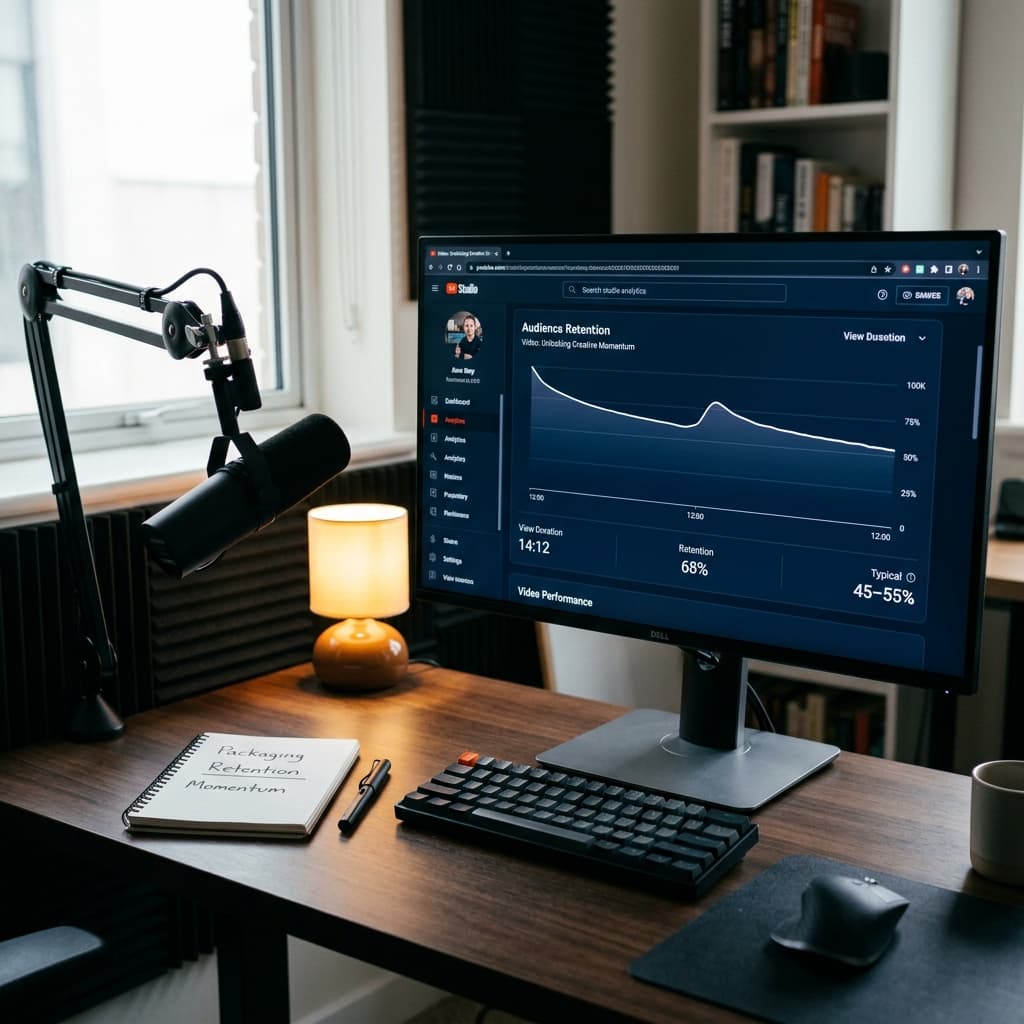
What's the CTR? If you don't know it, or if it's below 4%, the packaging isn't working. What does the retention curve look like at 30 seconds and at the midpoint? If there's a cliff at either point, you have an intro problem or a structural problem — both are fixable, neither is fixed by uploading more. Is there a clear next-watch path from that episode? An end screen with a related episode, a playlist the video belongs to, a reason for YouTube to queue something else from your channel?
Then ask one more question most teams skip: what was the Job, who was the Audience, and what Result was this episode supposed to drive?
If you can't answer those questions, you're distributing. Not designing.
For teams who want to build a video podcast that's architected for YouTube performance from the start — not retrofitted after the fact — visit JAR Podcast Solutions.
