
The reason premium western boots are built with wooden pegs instead of nails

Claude

Flip over a premium handcrafted western boot and look closely at the arch—instead of metal hardware, you will find neat rows of tiny wooden dots holding the outsole together. At the La Puerta Turquesa factory in León, Mexico, Lane Boots artisans use this traditional lemonwood pegging method to secure the leather outsoles of their specialized footwear. This centuries-old engineering choice works because lemonwood pegs expand and contract at nearly the exact same rate as 100% leather, ensuring the sole remains locked tight even when exposed to water, mud, or sweat. Unlike metal nails that rust or work themselves loose over time, these swelling wooden pegs preserve the structural integrity of the boot's hand-lasted instep for years.
The mechanical limits of steel and brass in leather outsoles
To understand why wood remains the superior material for securing a boot's waist, one must first look at how leather behaves in the real world. Leather is a natural, porous material. When you walk through wet grass, muddy fields, or rain, the leather outsole of your boot absorbs water. As it absorbs moisture, the fibers expand, causing the entire sole to swell. When the sole dries, the leather contracts back to its original state.
This constant cycle of expansion and contraction creates a severe mechanical challenge for rigid fasteners. If a bootmaker uses brass or steel nails to secure the sole, the metal remains entirely static. Metal does not absorb water, and it does not swell. When the surrounding leather expands, it pulls away from the rigid metal shaft of the nail. Over time, this movement stretches the hole. As the leather dries and shrinks, the nail no longer fits snugly. The physical force of walking eventually coaxes the metal nail to back out of the sole, causing the layers of the boot to separate.
Furthermore, iron and steel nails are highly susceptible to corrosion. Moisture from the ground, combined with the natural acidity of foot sweat, triggers rust. This rust does not just weaken the nail itself; it actively eats away at the surrounding leather fibers, turning a tight, secure connection into a soft, unstable mush. While brass nails resist rust better than steel, they still lack the ability to adapt to the wet and dry cycles of a working leather boot.
| Sole Attachment Method | Material Used | Behavior in Wet Conditions | Long-Term Durability | Ease of Re-soling |
|---|---|---|---|---|
| Traditional Pegging | Lemonwood | Expands with leather to lock tighter | Extremely high | Excellent (pegs easily replaced) |
| Brass Nail Pegging | Brass alloy | Remains rigid, does not expand | Moderate (may wiggle loose) | Good |
| Cementing / Gluing | Polyurethane / Neoprene glue | Becomes brittle, adhesive fails | Low to moderate | Poor (damages the mid-sole) |
Traditional construction avoids these mechanical failures by matching the physical properties of the fastener to the sole itself. By utilizing a dense, straight-grained wood, artisans build a shoe that works as a unified system rather than a collection of competing materials.
Driving lemonwood pegs at the La Puerta Turquesa workbench
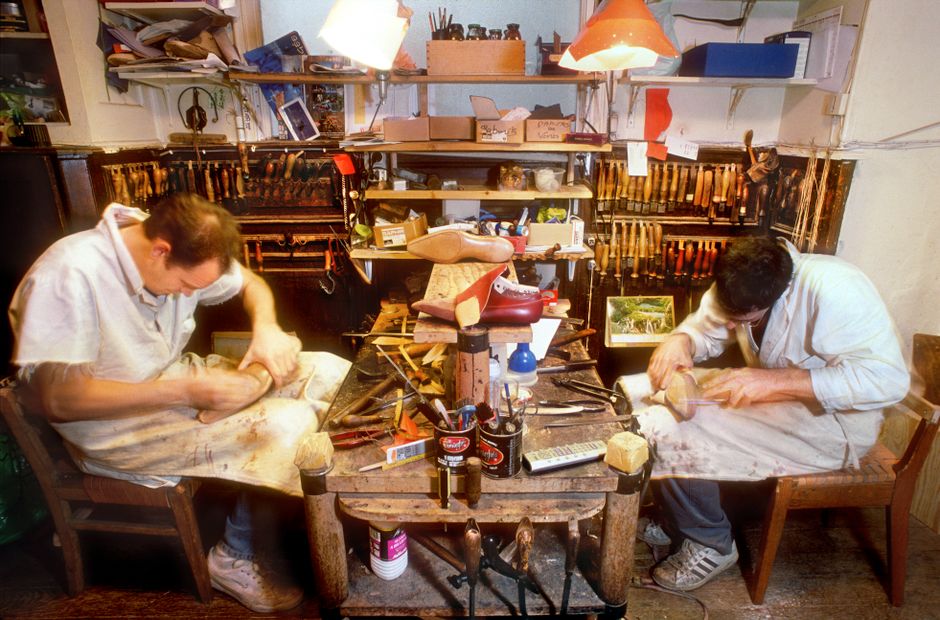
The process of pegging a sole is a physically demanding discipline that requires specialized hand tools and years of practice to master. At the León, Mexico factory where Lane Boots are constructed, artisans complete over 100 individual steps to finish a single pair of boots, with the pegging process serving as the literal foundation of the shoe's structure.
The specialized tools of the cobbler's trade
A bootmaker's bench is defined by highly specific, traditional hand tools. To drive the pegs, an artisan relies on a pegging haft fitted with a sharp, diamond-shaped pegging awl. This tool is designed to punch clean, precise channels through the tough leather outsole, the upper leather, and the thick leather insole.
To drive the pegs home, the artisan uses a specialized pegging hammer. Unlike a standard carpenter's hammer, which has a flat striking face with sharp edges, a professional bootmaking hammer features a slightly convex striking face. This curved face is a deliberate engineering design; it allows the cobbler to strike the wooden pegs flush with the damp leather outsole without leaving deep, crescent-shaped scars in the leather.
Sizing and spacing the awl strikes
Before a single peg is driven, the outsole must be damp to allow the leather fibers to yield to the tools. The artisan uses a stitch marker to imprint evenly spaced guide marks along the waist of the sole. Spacing must be exact; if the pegs are placed too close together, they can split the leather, but if they are too far apart, the sole will lack the necessary structural support.
Holding the boot securely on a metal last, the artisan punches the awl through the leather layers at a slight angle. With the awl removed, they immediately insert a square-sided lemonwood peg into the freshly cut hole and strike it with the convex hammer. This sequence—punch, insert, hammer—is repeated dozens of times around the arch of each boot. Typically, around 45 pegs are used to secure the waist of a standard boot, though double rows are often utilized on styles with higher heels or wider soles to distribute weight more evenly.
Saturating the sole to lock the wood pegs in place
The real magic of lemonwood pegging occurs after the pegs are driven into the leather. When the pegging process is finished, the entire waist of the boot is saturated with water. This step is a critical part of the traditional pegging technique on shoemaking.wiki, which relies on moisture to complete the physical bond.
When the water hits the sole, both the leather and the dry lemonwood pegs absorb the moisture rapidly. Because lemonwood is highly compressed during the manufacturing of the pegs, the introduction of water causes the wood fibers to bloom and swell inside the punched leather channel. This swelling action forces the wood to expand outward, wedging itself tightly against the expanding walls of the leather hole.
[Outsole Surface]
   |   |   <-- Lemonwood Peg (sanded flush)
  /     \  <-- Swollen wood fibers lock inside leather channel
 |=======| <-- Upper Leather Layer
  \     /  <-- Compressed wood wedge
   |   |   <-- Insole anchor point
As the boot dries naturally over several days, the wood and the leather shrink together. This shared shrinkage rate ensures that the mechanical wedge remains perfectly intact. The peg and the leather essentially fuse into a single, cohesive unit. According to a study on lemonwood pegs by Lucchese, this shared expansion rate is the primary reason why high-end bootmakers reject metal nails in favor of traditional wood. If the sole is sanded smooth before this water-saturation process occurs, the pegs will eventually swell unevenly and leave a rough, bumpy texture on the bottom of the finished boot.
How pegging preserves the hand-lasted instep of a premium western boot
The structural benefits of lemonwood pegging go far beyond simply keeping the bottom of the boot attached. The choice of pegging material directly influences how a boot fits your foot and how long it survives under daily wear.

Preserving the hand-lasted instep
Because western boots lack laces or straps, the instep is the most important fit area on the entire shoe. The leather across the arch of your foot must fit snugly to prevent your heel from slipping excessively when you walk. Achieving this fit requires hand-lasting, a process where the wet leather upper is pulled tightly over a foot model, or last, and secured in place until it dries and takes on a permanent shape.
Once the boot is lasted, the lemonwood pegs are driven through the shank area to lock that hand-shaped arch in place. If a manufacturer uses cheap glues or rigid metal nails, the constant upward and downward pressure of your foot will eventually cause the arch to sag or stretch out of shape. The flexing properties of lemonwood allow the boot to yield slightly to your natural stride while maintaining enough structural tension to keep the instep from collapsing. This ensures that styles like the Emma Jane Bootie or the Secret Journey Midi retain their supportive, tailored fit for years. To guarantee you get the maximum benefit from this hand-lasted construction, consulting the Lane Boots size guide is essential to finding a pair that cradles your foot with the correct amount of initial snugness.
Extending the lifespan through re-soling
High-quality western boots are designed to be an investment that lasts for decades rather than a single season. However, even the toughest leather outsoles will eventually wear thin after miles of walking on concrete, gravel, and dirt.
When a boot is constructed using modern adhesives or cement, replacing a worn sole is a destructive process. Peeling a glued outsole away from the shoe often tears and weakens the leather midsole, making subsequent repairs difficult or impossible.
In contrast, a pegged and welted sole is highly serviceable. Because the outsoles of these boots are made of 100% leather, as confirmed on the Lane Boots FAQ page, a professional cobbler can easily pull out the old wooden pegs, remove the worn sole, and lay down a new leather outsole without damaging the underlying structure of the boot. The cobbler simply punches new holes and drives in fresh lemonwood pegs, restoring the shoe to its original strength and extending its lifespan indefinitely.
Choosing quality footwear designed for the long haul
In an industry dominated by mass production and fast fashion, the choice to use hand-driven wooden pegs is not merely a sentimental nod to the past. It is a deliberate engineering decision based on physical science, material compatibility, and a respect for longevity. By using lemonwood pegs that expand and contract in perfect harmony with natural leather, artisan bootmakers create footwear that grows more comfortable with every mile.
If you are ready to experience the comfort and durability of traditional western footwear, explore the diverse collections of handcrafted Lane Boots. From the tall, statement-making Sweet Memories Knee High to classic daily ankle booties, each pair is bench-made with 100% leather soles, complete with the brand's iconic blue bottoms and designed to walk with you for a lifetime.


