How to Be a New Dad When You Can't Call Yours for Advice

The Dead Dads Podcast
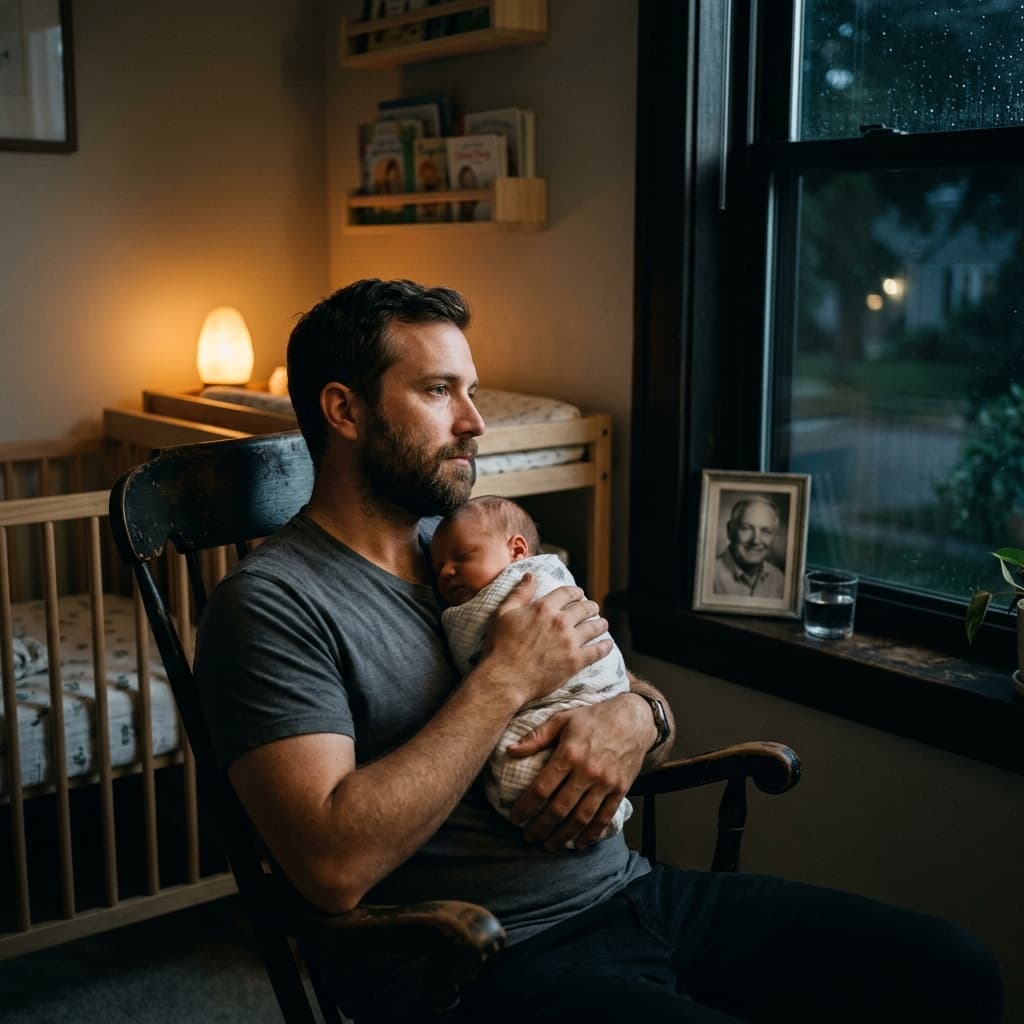
The first time your baby does something that breaks your heart open — first smile, first fever, first time they grab your finger and won't let go — your brain will reach for the phone before you remember you can't make that call. That reflex doesn't mean you're falling apart. That's just what fatherhood after loss feels like.
Nobody briefs you on this part.
The Collision Nobody Warns You About
Becoming a father is already disorienting. Add the loss of your own dad, and you get something that doesn't have a clean name — you're doing something he did, he's not here to see it, and the people handing you casseroles during the first week of your baby's life have no idea any of this is happening inside your head.
The Dead Dads podcast describes grief as "the kind that hits you in the middle of a hardware store" — sudden, mundane, devastating. The first year of fatherhood is basically a hardware store you live in. Every aisle has a trigger. You're installing a crib and you think: my dad built things. You're watching your kid sleep and you think: he watched me do this once. You have no idea what you're doing with this car seat and the one person who would've made fun of you for it while also helping you figure it out is gone.
Roger Nairn, co-host of Dead Dads, wrote about the strange cruelty of how life keeps moving after loss: "Work emails still came in. Kids still needed breakfast. People still asked, 'How are you doing?' in that way where you know they don't actually want the real answer." Fatherhood is that experience amplified by a factor of ten. There is a new human in your house who requires everything from you, every day, while grief quietly demands its cut of the same energy.
This collision — new life and deep loss, simultaneously — is one of the most reliable grief triggers there is. It's also one of the least talked about. Most men are blindsided by it not because they're unprepared for grief but because nobody told them that joy and loss stack on top of each other like this.
What You Actually Lost (Beyond the Obvious)
The obvious part: your dad is gone and you miss him. That's real and it doesn't need elaborating.
The less obvious part, which fatherhood tends to surface, is the specific inventory of what a living father provides that you didn't know you were counting on. A co-pilot through the scary firsts. Someone who knew you as a kid and can mirror your own childhood back to you. The particular comfort of calling someone at 2am who is fully, unconditionally on your side. Permission — spoken or unspoken — to be uncertain.
There's also the knowledge you didn't know you'd need. The Dead Dads show description captures this in a small, perfect detail: the "password-protected iPad." Your dad had information locked away that you can no longer access. Fatherhood reveals the specific shape of that gap. You find yourself wanting to ask him things you never thought to ask — how he handled the fear, whether he cried, what the first year was actually like for him, whether he felt as unqualified as you do right now.
Listener Eiman A., writing on the Dead Dads reviews page, described it plainly: "It's the type of pain that I bottle up and keep to myself." That bottling instinct makes sense. There's nobody to give it to. But the weight doesn't shrink just because you're carrying it quietly.
Here's a useful distinction worth sitting with: finding advice is a solvable problem. Finding your dad is not. These require different responses. If you conflate them — if you spend all your energy trying to find someone who fills the exact shape of what you lost — you'll run yourself into the ground. The practical gap can be patched. The emotional one has to be carried. That's not hopeless. It's just honest.
Building Your Imperfect Advisory Council
The bar here is not "someone who feels like my dad." That bar will disqualify everyone and leave you solving everything alone.
The actual bar: someone who has been here before and will tell you the truth. That's it. An uncle who knew your dad and remembers what kind of father he was. A father-in-law who's willing to talk about the real stuff. A colleague ten years further along in the parenting timeline who'll answer a text about sleep regression at 11pm without making it weird. You are looking for people with experience and candor. They exist in your orbit. You probably haven't asked them directly, which is the only reason this hasn't happened yet.
Research from vibrantdad.com notes that 85% of fathers in high and middle-income countries say they'd do whatever it takes to be hands-on with their newborns. That number is relevant here: there are engaged, experienced fathers all around you. Some of them have navigated exactly what you're navigating. Ask one.
Online communities for men navigating grief are not a soft option or a last resort. For a lot of men, they're the only space where this conversation happens honestly. The Dead Dads podcast — available on Spotify and all major platforms — exists precisely because Roger Nairn and Scott Cunningham "couldn't find the conversation they were looking for" after losing their own dads. They built it. It's there. Using it is practical, not performative.
Sputah.org writes that "seeking support isn't a sign of weakness — it's a step toward healing." Worth saying plainly to the men who are still deciding whether this applies to them: it does. The advisory council you build won't replace your dad. It will, however, get you through the first year without carrying all of it alone.
Using Your Dad's Memory as a Parenting Compass
This is the harder work, and also the most useful.
Your dad's presence doesn't have to be literal to be functional. What did he say that you've never forgotten? What did he do on a random Tuesday that you still think about twenty years later? What do you want your kid to have that you had? What do you want to do differently? These aren't just memories. They're inputs. They are, if you let them be, a parenting philosophy that already exists inside you.
The Dead Dads blog post "What was my dad?" frames this as a real act of articulation — sitting down and actually working out who your dad was, not just as "your dad" but as a person with specific habits, qualities, and flaws. That process is not only emotional. It's clarifying. It gives you something to work with.
If the relationship was complicated — and for a lot of men it was — this section of the work gets harder but doesn't disappear. Parenting in the shadow of an imperfect father is its own navigation problem. You might be working against a template as much as with one. That's worth naming. The goal isn't to canonize your dad; it's to be intentional about what carries forward and what stops with you. Both are legitimate outcomes. Neither requires him to have been a perfect person.
For men who lost their dads before certain conversations happened, there's a particular strain of grief attached to that — the unfinished business, the things that will now never get said. You Keep Putting Off the Talk With Your Dad. Here's What That Costs You. addresses this directly. Acknowledge the gap. Then parent anyway. You have more to work with than you think.
Finding Room for Humor Without Guilt
Fatherhood in year one is objectively chaotic and frequently absurd. Newborns are bizarre. The logistics are insane. You will do things in the first six months that, under any other circumstances, would qualify as comedy. And your dad — specifically your dad — would have had something to say about all of it.
That's the particular ache of this. Not just that he's gone, but that he was probably the person you would've called to laugh about the 3am blowout, the fact that you Googled "baby poop color" seventeen times in one week, the moment you realized you've been putting the diaper on backwards. He was in on the joke. Now you're landing punchlines to an empty room.
But humor and grief coexist. They always have. The Dead Dads tagline — "Death. Jokes. Closure. Not always in that order." — is not a bit. It's the actual thesis. The show covers "the paperwork marathons, the garages full of 'useful' junk, the password-protected iPads" with humor because that's also how you survive them. Laughing at the absurdity of a situation is not a betrayal of the loss underneath it.
If you're carrying guilt about this — if laughing at parenting chaos feels like a violation of some unspoken rule about grief — How to Use Dark Humor When Your Dad Dies and Stop Feeling Guilty About It is worth your time. The short version: you're allowed to let both things be true. You can miss your dad and laugh at the same time. These are not competing states.
The Trap: Performing "Fine" for Everyone Around You
Here is the failure mode that gets a lot of men in this position. You're focused on being steady for your partner, who is also exhausted and recovering. You're focused on being present for your baby, who needs you to function. You're managing work, sleep deprivation, the administrative aftermath of new parenthood, and whatever remains of your social life. Grief gets assigned to the back of the queue because there's no obvious slot for it.
Then people ask how you're doing. And you say fine. And you mean it, mostly, in the moment. And then fine becomes the only available answer, and the grief that doesn't get acknowledged starts finding other places to live.
Research documented by sputah.org puts it plainly: "Grief doesn't go away just because it's unspoken — it simply finds new places to hide, sometimes in anger, isolation, or depression." This is the part most people assume will sort itself out. Some of it does. The part that doesn't tends to get louder the longer you ignore it.
Roger Nairn described the experience of people asking "How are you doing?" in the way where "you know they don't actually want the real answer." New parenthood amplifies this to an absurd degree. Every conversation is about the baby. Everyone is focused on the joy. The expectation — social, cultural, relentless — is that you are happy right now. You are in a good news moment. And you are, in part. But grief doesn't pause for good news moments, and nobody in the room is asking about that part.
The reviewer who found Dead Dads and wrote "I felt some pain relief" from finally having a space that acknowledged what he was carrying — that's not a minor thing. Acknowledgment itself has weight. The act of naming what's actually happening, even to yourself, even by listening to two guys on a podcast talk about the same thing, is not nothing. It's actually the beginning of something.
Most people assume this will sort itself out. Some of it will. The part that doesn't gets heavier the longer it goes unaddressed, and it tends to surface at the worst possible times — during an argument with your partner, on a random afternoon when the baby is finally sleeping and there's nothing to distract you, at the first birthday party when you look around the room and do the math.
You don't have to be falling apart to deserve to talk about it. That's not how it works.
The conversation you're looking for is already happening. Dead Dads — hosted by Roger Nairn and Scott Cunningham, two men who lost their own fathers and built the show because they couldn't find it anywhere else — covers all of this: the logistics, the grief triggers, the unexpected humor, the stuff nobody prepares you for. Start with What Happens After Your Dad Dies That No One Prepares You For, or browse episodes by topic at the website. If you want to share something about your own dad, the site has a space for that too.
You're not the only one navigating this. The conversation just needed somewhere to live.
Get the latest from The Fatherless Manual delivered to your inbox each week
More from The Fatherless Manual
You Keep Putting Off the Talk With Your Dad. Here's What That Costs You.
meta_description: "You keep putting off the hard conversation with your dad. Here's why that delay is costly — and how to actually start the talk before you run

How to Use Dark Humor When Your Dad Dies — and Stop Feeling Guilty About It
You're at your dad's wake and something strikes you as genuinely funny. Maybe it's a joke he would have made. Maybe the casserole someone brought is so aggressi

How to Use Dark Humor When Your Dad Dies — and Stop Feeling Guilty About It
You made a joke at your dad's funeral — or wanted to — and part of you has been quietly deciding what kind of person that makes you ever since. Maybe it was the