You Keep Putting Off the Talk With Your Dad. Here's What That Costs You.

The Dead Dads Podcast
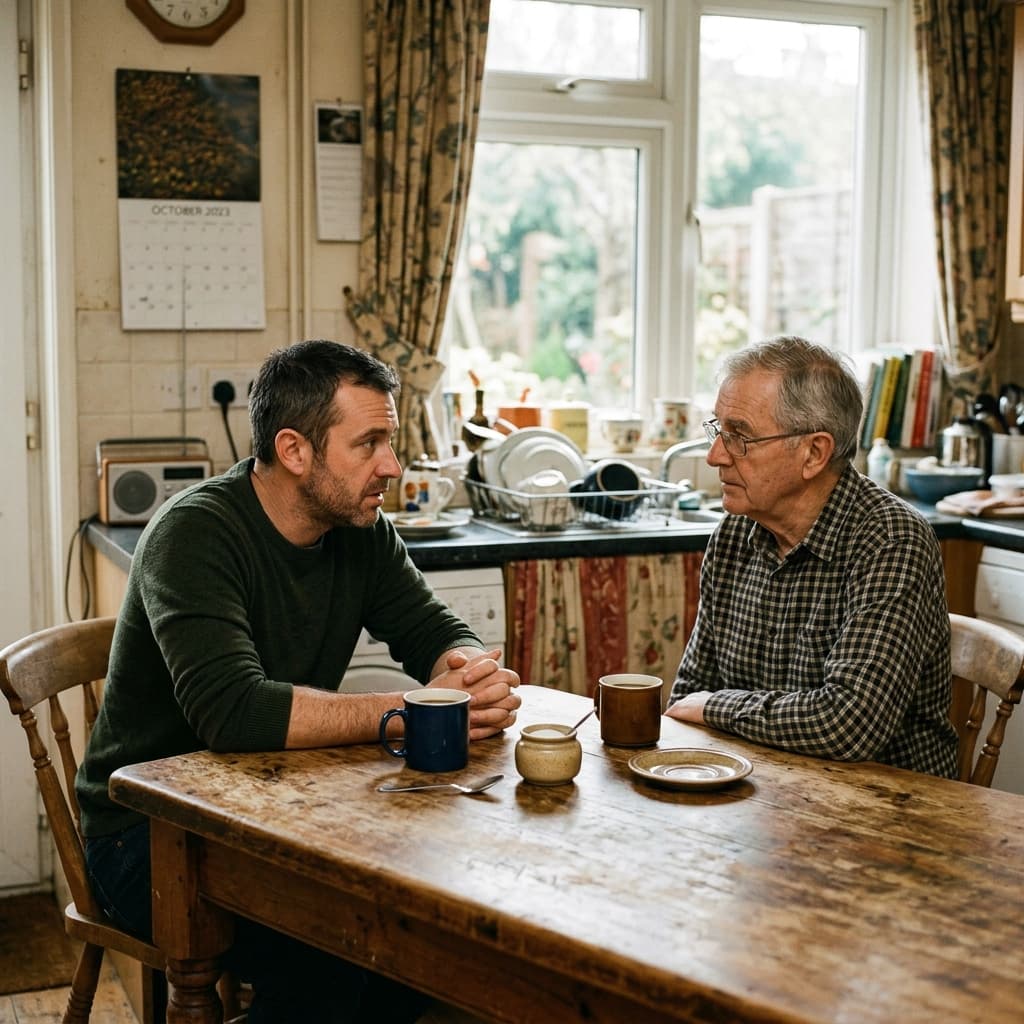
meta_description: "You keep putting off the hard conversation with your dad. Here's why that delay is costly — and how to actually start the talk before you run out of time."
tags: "anticipatory-grief", "end-of-life-planning", "father-son", "family-conversations", "grief-prevention"
Most men who've lost their dads share one regret above all the others. Not the things they said. Not the arguments they had. The conversation they kept putting off — the one about what happens when he can't make decisions anymore, where things are, what he actually wants — until the crisis came first and the conversation never did.
If your dad is still here, you've probably had the thought at least a dozen times. I should probably talk to him about this. And then the moment passed, or dinner got loud, or he started telling that same story about 1987 again and somehow this didn’t feel like the right segue.
So you didn't.
This is that article.
The Conversation Is Never the Right Time Until It's Too Late
Here's the thing most people don't admit: the delay isn't really about timing. There is no right moment. "Waiting for the right moment" is almost always a way of saying you're waiting for a fall, a diagnosis, or a hospital room to force your hand — which is the worst possible moment to have this conversation.
When a medical crisis hits, the healthcare system doesn't pause to ask what your dad would have wanted. As Hospice Scout's family guide on end-of-life conversations puts it plainly: without a clear plan, the default is aggressive medical intervention. Machines, intensive care, decisions made by hospital protocol rather than by the man who had actual preferences about how he wanted to live.
Which is a rough way to find out your dad had very strong opinions about “not being kept alive by a bunch of tubes.”
And even if the medical piece goes okay, the absence of this conversation leaves something else behind: a set of unanswered questions that don't disappear after the loss. What would he have wanted? Did we make the right call? Where is the will? Who has power of attorney?
And the classic: “Why does nobody know the password to anything?”
These aren't questions you want to be figuring out in a grief fog, under pressure, with siblings who suddenly become part-time lawyers.
Why Men Don't Start This Conversation (The Real Reasons)
The most common explanation men give themselves is some version of "we're not that kind of family." Which is usually true. If you and your dad don't talk about feelings over Sunday dinner, asking him about advance directives feels like switching the channel from sports to group therapy.
But one hard conversation doesn’t turn your relationship into a TED Talk.
The deeper reason is the protection myth. The belief that not talking about death somehow keeps it away. Like death is a guy outside your house waiting for you to say the word first.
It’s not.
Your dad is probably already thinking about this stuff. He just doesn’t want to bring it up either. So now you’ve got two grown men quietly waiting for the other one to go first. It’s like a standoff, but with paperwork.
There's also the fear of doing it wrong — saying something clumsy, making it weird, shutting the whole thing down with one bad sentence.
You probably will.
That’s fine.
Every important conversation in a father-son relationship has at least one awkward sentence in it. Usually several. Sometimes a long pause where someone pretends to check their phone.
Finally, there's the feeling that asking about this stuff is the same as conceding your dad is going to die.
It isn’t.
It’s conceding that you don’t want to be Googling “what does dad want” at 2am in a hospital hallway.
What Silence Actually Costs
The practical costs are concrete. No documented wishes means the medical system fills that void with its default settings, which are designed to sustain life, not to honor a person's values.
Which sounds great until you realize “default settings” were not designed with your dad’s personality in mind.
Power of attorney. Healthcare proxy. Advance directive. These documents only exist if someone talked about them first.
Beyond the medical piece, there's the practical chaos that follows when no plan exists. No one knows where the will is. Accounts are discovered one at a time over months. The password to the iPad nobody can unlock becomes a weeks-long project.
And at some point, someone says: “He definitely wrote it down somewhere.”
He didn’t.
Roger Nairn and Scott Cunningham started the Dead Dads podcast — a show specifically for men navigating life after losing their fathers — because, as Nairn put it in January 2026, "we couldn't find the conversation we were looking for."
What they found instead:
Paperwork marathons. Password scavenger hunts. And a garage that suddenly becomes your emotional and logistical problem.
You inherit grief. And a box labeled “misc cables.”
The emotional cost is harder to quantify but just as real. The men carrying the weight of a conversation that never happened don’t just grieve their dad — they grieve the guesswork.
What would he have wanted?
That question doesn’t go away. It just gets louder.
How to Actually Start (Without It Feeling Like a Death Sentence)
Step 1: Stop treating it as one big talk.
This is the first mistake. It’s not a summit. It’s a series.
If you try to cover everything at once, you’ll both mentally leave the room halfway through. Start small. A story. Something you read. Something that happened to a friend.
Not: “So… let’s go through your entire death plan.”
Step 2: Frame it around him, not your anxiety.
"I want to understand how you're thinking about things" works.
"I need you to fill out these forms" sounds like you’ve joined a government agency.
Most dads don’t want to feel like a task list. They’ll engage if it feels like a conversation, not an audit.
Step 3: Pick the right setting, and give him a heads-up.
Not Christmas dinner.
Not five minutes before you leave.
Not right after he’s yelled at the TV.
A quiet, normal moment.
“Hey, I’ve been thinking about some stuff. Can we talk about it sometime?”
Simple. Human. Not dramatic.
Step 4: Know what you actually need to cover — eventually.
Power of attorney. Healthcare proxy. Advance directive. Will. Accounts. Passwords.
You don’t need all of it in one sitting.
One topic. One conversation.
Progress, not completion.
Step 5: Let it be imperfect.
He might deflect. He might joke. He might change the subject.
He might say something like, “I’m not going anywhere.”
That’s not the end of the conversation. That’s just how it starts.
You come back to it.
Awkward is fine. Avoidance is the problem.
When Grief Shows Up Before the Loss
Something that doesn't get said enough: having this conversation can bring up grief even when your dad is still alive and healthy.
You might sit there talking about paperwork and suddenly feel… sad.
Out of nowhere.
That’s anticipatory grief.
It doesn’t mean anything is wrong. It means you understand what’s at stake.
And if it hits hard, don’t just carry it quietly. Talk to someone. A friend. Your partner. Or a space like the Dead Dads community, where men are actually saying this stuff out loud.
The show exists for a reason.
Because “figuring it out as you go” is a terrible plan for something this heavy.
The Conversation You'll Be Glad You Had
Here’s what shows up again and again: men who have this conversation don’t regret it.
They don’t say, “I wish I waited.”
They say, “I’m glad we talked.”
It doesn’t make death more real.
It makes everything around it clearer.
It gives your dad a voice in decisions that would otherwise be guesses.
And most dads, if you get them talking, actually have opinions on this stuff.
Strong ones.
Sometimes very specific ones.
If your dad is still here — this is the article you forward to yourself, not him.
Start the conversation this week.
Even if it’s clumsy.
Even if it’s short.
Even if it ends with him saying, “we’ll talk about it later.”
That still counts.
Because later is better than never.
For men who've already lost their dad and are carrying the weight of the conversation that never happened — Dead Dads is where that gets talked about honestly.
Start with the episode on what happens after your dad dies that no one prepares you for, or explore episodes by topic at deaddadspodcast.com.
And if you're somewhere in the middle — grieving, but still capable of laughing at something completely inappropriate — How to Use Dark Humor When Your Dad Dies — and Stop Feeling Guilty About It is a natural next read.
Get the latest from The Fatherless Manual delivered to your inbox each week
More from The Fatherless Manual
How to Be a New Dad When You Can't Call Yours for Advice
The first time your baby does something that breaks your heart open — first smile, first fever, first time they grab your finger and won't let go — your brain w
How to Use Dark Humor When Your Dad Dies — and Stop Feeling Guilty About It
You're at your dad's wake and something strikes you as genuinely funny. Maybe it's a joke he would have made. Maybe the casserole someone brought is so aggressi

How to Use Dark Humor When Your Dad Dies — and Stop Feeling Guilty About It
You made a joke at your dad's funeral — or wanted to — and part of you has been quietly deciding what kind of person that makes you ever since. Maybe it was the