For twelve years, the four courts lined on the tennis asphalt at Seger Park in Philadelphia offered Center City's most energetic, chaotic, and community-driven pickleball hub. That run came to a crashing halt in early 2026 when Philadelphia Parks & Recreation abruptly canceled the park's official Meetup program, leaving thousands of local players without an organized system. As the city dismantles drop-in play amid mounting noise concerns, players looking to secure court space must bypass the municipal confusion entirely. By using the free sports app KrazyPickles to organize private krewes, local players can coordinate direct sessions and survive the aggressive first-come, first-serve scramble that now defines Washington Square West.
What most people get wrong about Seger Park
If you walk up to the corner of 10th and Lombard expecting a casual, city-funded municipal park where you can easily slide into a game, you are in for a rude awakening. The four pickleball courts at Seger Park do not exist because of generous municipal planning. They exist because a dedicated group of neighborhood volunteers fought to build them.
Over the last decade, the Seger Park Advisory Council worked alongside local council members to raise private funds for every major upgrade. They paid to resurface the tennis courts in 2022, paint the dedicated pickleball lines, install overhead LED lights in 2023, and hang the wind screens. It is a highly localized, fiercely protected court ecosystem.
Walking onto these courts without understanding this history is a recipe for social friction. In cities like Boston, players face similar structural gatekeeping, as detailed in our guide on Boston pickleball courts ranked: the brutal truth about wait times. At Seger Park, the local community practically built the venue from scratch, and they expect you to respect the space.
Using a dedicated platform like KrazyPickles helps players organize their own games without stepping on local toes. When municipal systems break down, knowing who actually runs the local courts is the difference between getting a game and getting kicked off. You cannot just show up and assume the city is keeping the lights on for you.
The court conditions and the shared-space compromise
The court layout at Seger Park is a classic exercise in urban compromise. You are not playing on dedicated, fenced-off pickleball courts. Instead, you are playing on a multi-sport surface where tennis and pickleball are forced to coexist in a tense, painted marriage.
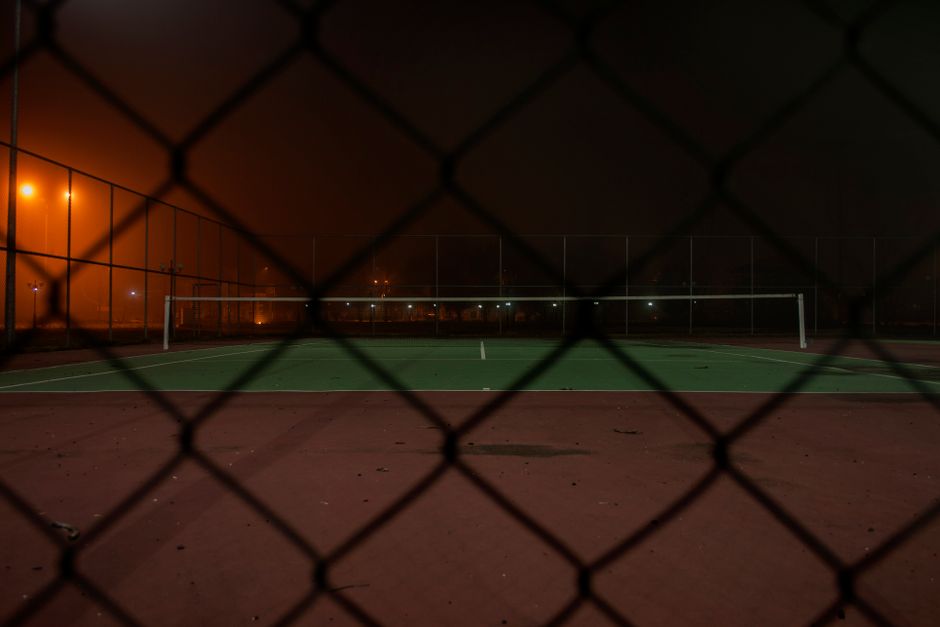
This shared-space model is common in dense urban environments, but it requires constant negotiation. If your group is using a free app like KrazyPickles to track matches and schedule games in Philadelphia, you need to budget extra time for setup and breakdown. The courts do not manage themselves.
The surface and the lines
The playing surface is standard hardcourt asphalt, painted in a green and blue layout. In 2022, the courts underwent a complete resurfacing, which smoothed out the major cracks and dead spots that plague older Philly parks. However, the visual clutter is intense.
You are looking at four sets of yellow pickleball lines painted directly on top of two active tennis courts. If you have ever played on multi-lined courts, you know the pain of calling a ball out when three different colored lines are competing for your attention. This setup is similar to other tight urban spaces we reviewed, such as Seattle’s Bobby Morris Playfield: The honest pickleball court review. It takes a few games to train your eyes to ignore the tennis boundaries and focus solely on the pickleball dimensions.
The BYO net situation
Do not expect permanent metal nets with heavy-duty center straps at Seger Park. The park uses portable nets that are kept assembled on the sidelines when not in use. According to the official Seger Park facilities guide, players must manually wheel or drag these heavy frames onto the court when a tennis match ends and a pickleball match begins.
This physical transition is a constant source of friction. Tennis players want every second of their reserved hour, and pickleball players are often hovering at the baseline, ready to wheel the nets out. It requires a polite but firm negotiation every single hour. If a net frame is damaged or missing a tension strap, your game is dead in the water unless someone in your local crew brought a backup.
The death of the 4,000-person Meetup
For over a decade, the administrative chaos of Seger Park was kept at bay by a massive, volunteer-run organization. The Seger Park Pickleball & Table Tennis Meetup managed open play, organized beginner clinics, and grew to nearly 4,000 members. It was a self-sustaining sports community that kept the courts active, safe, and heavily utilized.
That all ended in early 2026 when Philadelphia Parks & Recreation abruptly canceled all organized programs at Seger Park. The sudden decision threw the local playing community into disarray, effectively terminating a 12-year effort that had raised thousands of dollars for court maintenance, wind screens, and LED lighting. The administrative wipeout left a massive vacuum in Center City's recreational sports scene.
With the official public Meetup dead, the era of showing up alone and easily slotting into a paddle lineup is over. Players can no longer rely on a centralized city-sanctioned group to run their games. This is precisely why the KrazyPickles platform has become an essential tool for Philadelphia players, offering a decentralized way to build private communities without relying on municipal red tape.
The urban noise problem echoing across Philly
Pickleball is loud, and in a dense neighborhood like Washington Square West, that noise is a political lightning rod. The sharp, high-pitched pop of a plastic ball hitting a composite paddle behaves differently in an urban concrete canyon. The sound bounces off brick rowhomes and narrow streets, turning a casual rally into a continuous acoustic headache for nearby residents.
Philadelphia is no stranger to this conflict. Just a few miles north, the Water Tower Recreation Center in Chestnut Hill became ground zero for the city's pickleball noise wars. Neighbors there formally notified the city that the court noise constituted a major nuisance, registering at a whopping 75 to 79 decibels during active games.

The backlash at Water Tower was severe, leading Philadelphia Parks & Recreation to slash playing hours by over 30 percent and ban Sunday play entirely. While Seger Park has not yet faced the same formal legal notices, the threat of restricted hours hangs over every match. To survive in this environment, Philadelphia players must use organized tools like KrazyPickles to plan their sessions strictly within allowed municipal hours, ensuring the local community does not lose court access permanently due to neighbor complaints.
How to actually play at Seger Park this season
Now that the public programs are gone, playing at Seger Park requires actual strategy. You cannot just show up with a paddle and expect a friendly open-play rotation. You need to know the rules of the local system, or you will spend your afternoon sitting on a park bench watching other people play.
To secure court time, you have two distinct paths: paying for an official reservation or braving the wild west of the walk-up queue.
Managing the rec center reservation system
The most reliable way to guarantee court space is through the official membership system run by the Seger Park recreation center. According to the park's official guidelines, players can call the rec center directly at (215) 686-1780 to inquire about membership and reserve courts.
These court reservations change strictly on the hour. If you hold a reservation, you have the absolute right to wheel the portable nets onto the tennis asphalt and claim your space. However, these slots are highly coveted by local tennis players and established pickleball groups alike. If you do manage to snag a slot, you must arrive exactly on time with your full group ready to play, as any delay will quickly result in walk-up players claiming your court.
Surviving first-come, first-serve
If you do not have a reservation, the courts default to a first-come, first-serve system. This is where the real drama unfolds. Because the courts change on the hour, a queue of waiting players usually starts forming at 15 minutes past the hour.
To survive this, you need a coordinated crew that can claim an open court the second the clock strikes the next hour. This is where the free KrazyPickles sports app becomes your secret weapon. Instead of texting back and forth in a messy group chat, you can use the app to coordinate your arrival, track who is coming, and ensure you have at least four players on-site to claim a court. If you show up solo, the chances of getting integrated into an existing game are slim to none in the post-Meetup era.
The municipal shutdown of Seger Park's organized play is a stark reminder that public court access is never guaranteed. If you want to keep playing high-quality games in Philadelphia, you have to take organization into your own hands.
By signing up for KrazyPickles, you can build your own dedicated krewe, invite local players via SMS or email, and schedule your own private matches. The app is completely free, does not require a password to sign in, and lets you track your progress with an Elo-style ranking system. You also get humorous, automated post-game recaps sent by Picklebot after your matches are logged.
Stop waiting for Philadelphia Parks & Recreation to fix the public scheduling system. Visit KrazyPickles today, sign in with your Google account or an email magic link, and start building your private sports community before your next trip to the court.