Houston’s public pickleball scene in 2026 is a frustrating, first-come, first-served waiting game, but paying the municipal reservation fee to secure a dedicated court block is the only way to avoid wasting your evening. In our analysis of local parks, KrazyPickles found that Houston players routinely face 90-minute wait times and chaotic paddle-stacking politics at popular spots like Cleveland Park. Bypassing this bottleneck requires navigating the city's online portal to book facilities ahead of time or targeting specific indoor open-play hours at hubs like the Fonde Recreation Center. By moving from spontaneous walk-up play to scheduled group sessions, players can guarantee their court time and keep their games moving.
The Houston pickleball court crisis and the paddle stack problem
You show up to Cleveland Park at 6:00 p.m. on a Tuesday, paddle in hand, only to find twenty people already waiting for two shared courts. The humidity is thick, the mosquitoes are swarm-testing your bug spray, and half the players forgot to bring their own nets. You slide your paddle into a makeshift rack, realizing you will be lucky to play one game before the sun goes down.
This is the reality of walk-up play across the city. As the sport has exploded in popularity, Houston's public infrastructure has struggled to keep pace. Walk-up courts have become battlegrounds for court time, where informal rules and aggressive paddle-stacking politics dictate who gets to play.
In our review of municipal park setups across the country, we have observed this trend in almost every major metropolitan area. We highlighted similar municipal bottlenecks in our recent article, The Los Angeles public pickleball scorecard: Ranking 12 municipal courts. When court space is scarce, the spontaneous model breaks down, leaving players standing on the sidelines for hours.
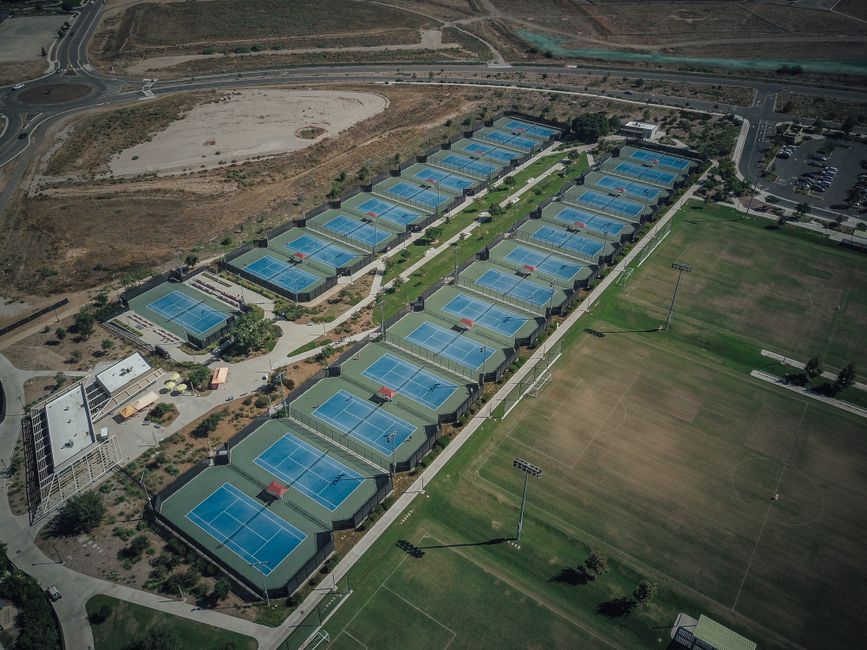
Why HPARD's outdoor pickleball system creates a natural bottleneck
The frustration of playing in Houston is not just about the number of players. It is directly tied to how the city has structured its public spaces.
The shared-court illusion
Most outdoor courts listed by the city are not dedicated facilities. They are multi-use spaces with pickleball lines painted over existing tennis courts. According to the official Houston Parks and Recreation Department Pickleball Court List, almost all of these locations operate on a strictly first-come, first-served basis.
The biggest logistical hurdle is the net situation. Except at Alief Park and Jaycee Park, players must bring their own portable nets to play. This requirement creates a massive bottleneck. If you show up to a park like Briarmeadow Park with a paddle but no net, you are entirely dependent on the generosity of strangers who brought their own gear.
This setup leads to highly unpredictable wait times. We explored how these equipment requirements and shared-space models stall court rotation in our post, Denver public pickleball courts ranked: the best, the worst, and the crowded. When players have to haul, set up, and tear down their own nets, games take longer to start, and players are highly reluctant to vacate a court they spent fifteen minutes assembling.
Furthermore, tennis players and pickleball players are increasingly at odds over court usage. The tension is real, as seen in nearby municipalities like Katy, where the city council recently rejected a proposal to convert public tennis courts to protect recreational tennis space. With tennis players fighting to keep their courts and pickleball players looking for painted lines, showing up without a reservation is a recipe for a turf war.
The awkward indoor schedule
If you try to beat the heat by playing indoors at a city community center, you run into a different problem: hyper-specific, mid-day schedules.
The indoor schedule is designed for convenience, but only if you do not work a standard job. The Fonde Recreation Center offers indoor play, but only on Tuesdays and Saturdays during highly restricted blocks. Other locations like the Judson Robinson, Jr. Community Center limit open play to specific weekday mornings or early afternoons.
If you are trying to organize a regular match play schedule for a working adult group, these hours are practically useless. You cannot build a consistent playing routine around a Tuesday at noon time slot.
How to bypass the crowds using KrazyPickles and city reservations
The good news is that you do not have to subject your group to the walk-up lottery. The city of Houston allows you to reserve specific park facilities in advance, giving you guaranteed court time.
Navigating the ActiveNet portal
To book a court, you have to use the city's official online registration portal. It is a dated system, but it is the gatekeeper to a stress-free game.
- Step 1: Go to the Houston Parks ActiveNet Reservation Options portal and create an account.
- Step 2: Navigate to facility reservations and filter by park location or amenity type.
- Step 3: Select your desired date and time slot, noting that reservation fees will apply.
- Step 4: Complete the checkout process to secure your permit.
Having a physical or digital copy of your permit is essential when you arrive at the court. Walk-up players may not be happy when you ask them to vacate, but a city-issued permit is your absolute right to play.
The Memorial Park tennis workaround
If you want to play at the premier public spot in the city, the reservation process is slightly different. The Memorial Park Tennis Center is managed by the city but requires a separate booking system.
You cannot use the standard ActiveNet portal for Memorial Park. Instead, you must book directly through the tennis center's dedicated system. While there is a small fee, the courts are lighted, well-maintained, and the atmosphere is highly competitive.
Cost splitting for krewes
While paying a fee for public park access might feel annoying at first, it is highly affordable when split among a group. Within KrazyPickles, social groups are called krewes. When you organize your players into a formal krewe, managing reservation costs becomes incredibly simple.
| Court Location | Access Model | Net Situation | Best For |
|---|---|---|---|
| Cleveland Park | Walk-up (Free) | Bring Your Own | Spontaneous singles, tight budgets |
| Briarmeadow Park | Walk-up (Free) | Bring Your Own | Local neighborhood players |
| Fonde Recreation Center | Scheduled Open Play | Provided | Escaping the summer heat |
| Memorial Park | Reserved (Paid) | Permanent | Competitive, high-energy matches |
By pooling your money, a two-hour reserved block costs just a few dollars per person. It is a tiny price to pay to avoid standing on the grass for ninety minutes waiting for a court to clear.

When your Houston pickleball krewe outgrows the public rotation
As your group of players grows from a casual foursome into a larger community, public walk-up play becomes completely unviable.
If you show up to a public park with eight or twelve players, you are effectively taking over the venue. This dominance leads to immediate friction with other local players who are waiting in the paddle line. You cannot run a smooth round-robin or ladder tournament when you have to rotate your players into a public queue with strangers.
Furthermore, trying to manage a larger group without dedicated court time leads to administrative headaches. Players show up only to find there are not enough open courts, or worse, half the group doesn't get to play because the paddle stack is too deep.
To run competitive games, track progress, and actually enjoy the social aspect of the sport, you need a controlled environment. Reserving a court block and using a dedicated platform to coordinate is the natural progression for any serious group of players.
Keeping your KrazyPickles group organized and off the waitlist
Once you have secured a court reservation, the next challenge is keeping your playing group organized. Nothing ruins a reserved court block faster than players backing out at the last minute or showing up with an odd number of people.
- Set up a weekly reservation rotation within your group so the administrative burden doesn't fall on one person.
- Require RSVPs at least 24 hours in advance of your reserved block to ensure you have multiples of four.
- Keep a backup list of players who can fill in on short notice if someone cancels.
- Log your match results immediately after playing to keep the group's competitive spirit alive.
Using KrazyPickles, you can easily manage these logistics without resorting to chaotic group chats or spreadsheets. You can create your own krewe, invite players via SMS or email, and let players RSVP directly for your scheduled court blocks.
Once the games are done, players can enter their scores to update their Elo-style rankings. Best of all, our automated assistant, Picklebot, sends out funny post-game recaps to keep the group engaged and laughing until the next reserved block.
Ready to stop standing around at Cleveland Park? Sign in with Google or get an email magic link at KrazyPickles today to set up your Houston krewe, schedule your next game, and start tracking your match statistics completely free.