
The logistics of filming at a private Las Vegas estate

Tiger Mansion LV

How do commercial production teams and creative directors execute high-impact video shoots in Las Vegas without navigating the heavy regulatory hurdles and public disruptions of the Strip? At Tiger Mansion LV, a historic private residence estate located near Sunset Park, filming crews can bypass standard resort restrictions by utilizing a completely controlled 2-acre private environment. Originally commissioned in 1982 by the Doumani Family and later known as a former residence of boxing legend Mike Tyson, the property provides nearly 18 distinct modular shooting areas that allow production companies to capture multiple distinct aesthetics under a single private booking.
Managing closed-set arrivals and privacy at Tiger Mansion LV
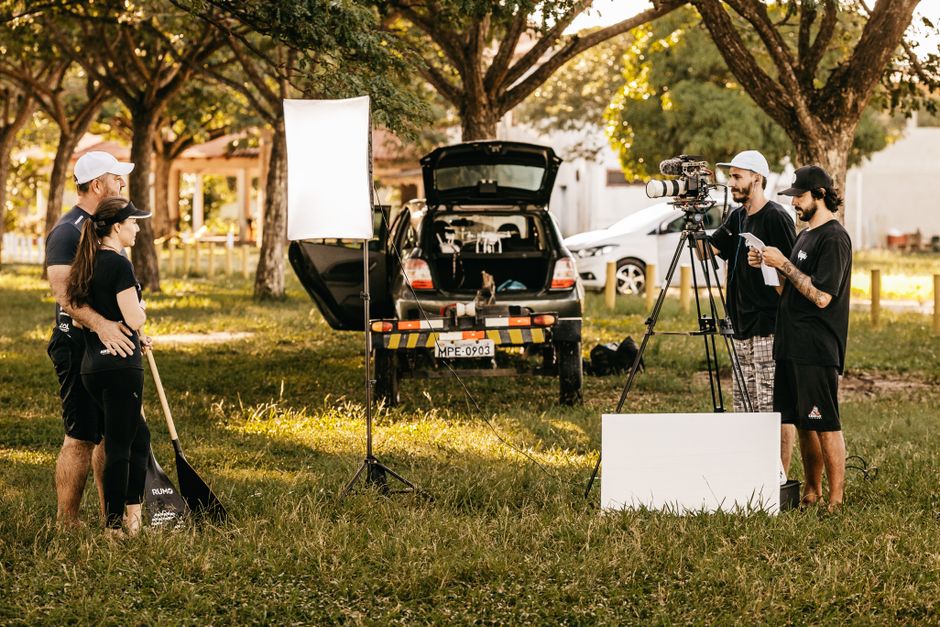
Filming on the Las Vegas Strip presents severe operational challenges. According to the Mr. Camera Las Vegas production guide, the entire Strip corridor is private property owned by various casino resorts. The sidewalks, pedestrian bridges, and plaza spaces are not public land, meaning crews cannot simply set up a camera setup without weeks of corporate negotiations, high location fees, and strict oversight from casino marketing departments.
Even when resort approvals are secured, managing public crowds, enforcing non-disclosure agreements, and controlling background audio remains incredibly difficult. If a commercial campaign features high-profile talent, a celebrity influencer, or an unreleased consumer product, public interference can easily compromise the security of the project.
Tiger Mansion LV addresses these challenges by operating on a strict inquiry and approval model. The entire 2-acre property is fully gated, preventing unauthorized access and keeping the set completely closed to the public from call time to wrap. The arrival sequence features a grand circular dual-entry approach and a covered porte-cochère, allowing production vans and talent transport to pull directly up to the main entry point under complete physical cover.
- Total perimeter control via a private gated entrance sequence.
- Zero public foot traffic or accidental background visual intrusions.
- No resort marketing personnel overseeing or restricting your camera angles.
- Enforced privacy for high-profile talent and corporate executive teams.
Mapping the estate for distinct visual setups
In commercial video production, every company move—relocating the crew, equipment trucks, and basecamp to an entirely new geographic location—costs hours of daylight and thousands of dollars in union labor. The primary advantage of booking a private estate like Tiger Mansion LV is the high density of diverse backdrops available within a single property.
Productions can capture a luxury hospitality scene, a high-end athletic spot, a modern corporate dialogue sequence, and a tropical outdoor scene without ever leaving the gates. According to documented production layouts, crews frequently use the property to simulate different international destinations or historical eras. The spatial flow of the estate allows a production manager to run primary and secondary units simultaneously in different zones without audio or visual interference. Teams interested in analyzing how these setups operate can review our notes on inside a closed-set commercial shoot at Tiger Mansion.
Interior backdrops: The Tyson era and old Vegas
The grand rotunda establishes an immediate visual weight for high-end fashion, music video, or commercial campaigns. It features glossy black granite floors, tall columns, an ornate three-tiered indoor fountain, and hand-carved stone details. Guarding this entrance sequence are original lion statues designed by the late Gianni Versace, which provide an authentic touch of classic luxury.
Further inside, the main gallery features the defining artistic footprint of the property's history: a massive, four-walled, floor-to-ceiling mural depicting the most famous boxers of the 20th century. This hand-painted boxing-themed artwork dates back to the property's ownership by Mike Tyson. Illuminated by an extraordinary grand crystal chandelier, this room functions as a highly dramatic, character-rich space. It is particularly popular for sports brand campaigns, gritty documentary interviews, and narrative film scenes requiring an authentic, nostalgic Vegas aesthetic that cannot be built on a soundstage within a standard budget.
Exterior backdrops: The Koi Lair and 80,000-gallon pool
Moving the camera outside reveals a resort-style environment set across a palm-lined green belt. The arrival sequence begins at the Koi Lair—historically the actual tiger enclosure during the Tyson era. Today, it has been converted into a flourishing freshwater ecosystem filled with koi and goldfish, surrounded by palms and tropical flora. This area functions as an ideal cinematic backdrop for slow-reveal vehicle arrivals or atmospheric outdoor dialogue.
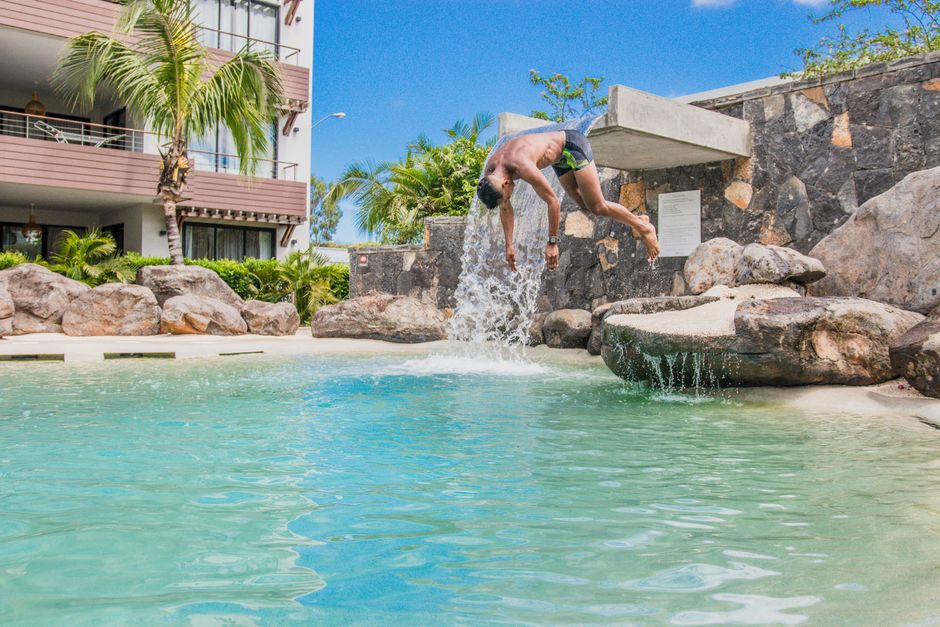
Just beyond the entryway sits the Outdoor Tiger Terrace, which overlooks the massive centerpiece of the outdoor grounds: an 80,000-gallon resort-style pool. The pool area features extensive rock work, a built-in cave, a cascading waterfall, a grotto, and an integrated slide. This expansive water feature allows directors to shoot scenes that feel like a tropical private resort, completely isolated from the Mojave desert surroundings. The outdoor space is supported by a dedicated pool bar and exterior media room, giving crews a base of operations for lighting setups, monitor feeds, and equipment storage directly adjacent to the water.
Supporting cast and crew with on-site staging infrastructure
A location can be visually perfect, but if it cannot support forty crew members working a fourteen-hour day, it is a liability. Commercial shoots require a clear distinction between the hot set and the staging areas. Because the Tiger Mansion LV estate features nearly 16,000 square feet of interior space, production managers have ample room to establish separate, dedicated zones for video village, client monitoring, hair and makeup, wardrobe, and talent holding without cluttering the frame.
The modular flow of the estate allows these support rooms to remain physically close to the shooting areas while remaining completely out of the camera's line of sight. For instance, the billiards room and adjoining living spaces can be closed off to serve as a quiet retreat for talent or a comfortable monitoring suite for agency clients and executives. This layout protects the director's focus and ensures that off-camera personnel are kept comfortable, which is especially important during multi-day commercial shoots.
The commercial kitchen specs
One of the most valuable operational assets of the property is its centrally located commercial kitchen, a feature detailed on the estate's About page. Unlike typical residential kitchens that struggle to accommodate professional use, this workspace is engineered to handle heavy catering and craft service operations. It is fully equipped with:
- A professional-grade commercial gas range and a heavy flattop grill.
- An integrated commercial deep fryer for fast food prep.
- A large center island designed for high-volume food plating and staging.
- Double commercial refrigerators and double commercial freezers to store extensive food and beverage supplies.
- Dual deep sinks and a commercial disposal system for fast cleanup.
This setup allows production companies to bring in professional culinary teams or high-end private chefs to feed the cast and crew on-site, eliminating the logistical headache of ordering individual boxed meals or setting up temporary outdoor catering tents in the desert heat. Crews can learn more about booking these tailored culinary operations by visiting the estate's Services page.
Navigating permits, power, and logistical specs
To help production coordinators evaluate this private residence estate against traditional commercial options, the following comparison highlights key operational factors:
| Logistical Dimension | Traditional Strip / Resort Shooting | Tiger Mansion LV Private Estate |
|---|---|---|
| Permit Timelines | 2 to 4 weeks minimum through corporate and municipal offices | 5 working days for standard municipal filing |
| Location Fees | High hourly/daily corporate rates + union shadow requirements | Flat per-day production booking rates |
| Environmental Control | Public crowds, casino noise, and security interruptions | 100% closed, gated perimeter with controlled access |
| Catering Logistics | Restricted to in-house resort banquet menus | Fully open to external caterers using on-site commercial kitchen |
| Setup Variety | Single venue aesthetic per booking | 18 modular indoor/outdoor shoot environments |
Electrical distribution
Power management is a major consideration for any lighting director or gaffer. Residential properties are typically metered for standard domestic use, meaning a professional lighting package can easily overload the existing breakers. When organizing lighting and grip packages for a shoot at Tiger Mansion LV, line producers should note that while the interior electrical panel supports standard production monitors, hair tools, and small LED lights, high-draw lighting units (such as 18K HMIs or large sky-panels) require an external generator.
The estate's spacious, palm-lined driveway and gated entry provide a highly practical staging area for a towed, silent generator unit. This ensures that the main grip truck and power plant can be positioned close enough to run cable runs through side entries without cluttering the driveway or disrupting the audio recording on set. Exact dedicated power drops and available amperage should be verified directly with the estate manager during your initial site scout.
Permitting and load-in
Filming commercial media in the Las Vegas valley requires adherence to local laws. For private properties in unincorporated Clark County (where the estate is situated), production teams must secure a permit from the Clark County Public Works department. As outlined in the Clark County film permit guide, a permit is mandatory for all commercial photography, motion pictures, and digital content creation. The standard application process is managed online and carries a modest $45 processing fee, but requires proof of general liability insurance.
According to the City of Las Vegas film permit FAQ, productions are required to maintain a minimum of $1 million per occurrence and $2 million aggregate in Commercial General Liability insurance, listing the local municipal entities as additional insureds. Working on a private residence estate simplifies these requirements significantly compared to shooting in public rights-of-way, which often demand expensive police escorts, traffic control plans, and barricade setups.
Load-in logistics are highly efficient due to the estate's layout. Equipment trucks can back directly up to the main covered entry via the circular driveway. The wide doorways and flat transitions allow heavy camera carts and grip packages to roll directly from the driveway into the grand rotunda without navigating stairs or tight residential hallways. To ensure a smooth load-in, the estate reviews all production inquiries for timing, scope, crew size, and access needs prior to booking.
For line producers, agency leads, and creative directors planning their next West Coast shoot, securing a location with built-in visual character and professional infrastructure is a massive head start. Rather than fighting the crowds and corporate restrictions of the Strip, you can secure complete creative control, absolute privacy, and a real piece of Las Vegas history.
To discuss your production schedule, crew size, or to coordinate a private site scout, visit the Tiger Mansion LV contact page and submit an inquiry. For more details on our flexible facilities and heritage, explore our About page or learn more at tigermansionlv.com.


