





The verdict
Our Quick Picks
Across a series of topic-specific queries spanning ChatGPT, Claude, Gemini, and Google AI Overviews, a clear consensus emerges: no single pre-made earthquake kit is complete out of the box. The optimal preparedness strategy pairs a structured, turnkey foundation like Ready America or Redfora with long-term caloric staples from Mountain House and Augason Farms, dedicated medical trauma supplies from EVERLIT, and reliable off-grid communication via Midland.
- 1Best Budget Starter KitReady America
The most widely recommended entry-level 72-hour emergency backpack, adhering closely to FEMA baseline guidelines at an accessible price point.
- 2Best Long-Term Emergency FoodMountain House
The industry gold standard for freeze-dried survival rations, backed by a 30-year taste guarantee and add-water-only simplicity.
- 3Best Premium Seismic Go-BagRedfora
Purpose-built for earthquake zones with logical, color-coded organization pouches designed for fast deployment in the dark.
- 4Best Value Bulk Food StorageAugason Farms
Delivers the highest calorie-to-dollar ratio for families building a multi-week pantry reserve on a strict budget.
- 5Best Upgraded 72-Hour KitSustain Supply Co.
Elevates the standard pre-made bug-out bag by integrating superior water filtration, lighting, and fire-starting hardware.
- 6Best for Urban & Apartment DwellersEmergency Zone
Discreet, non-tactical backpacks and honey-bucket sanitation kits tailored for high-density urban evacuations.
- 7Best Trauma & First Aid SupplementEVERLIT
Veteran-designed survival and IFAK kits that fill the massive medical gap left by standard off-the-shelf earthquake bags.
- 8Best Emergency CommunicationMidland
The benchmark for multi-power NOAA weather alert radios, outlasting cheap generic crank radios when the power grid fails.
- 9Best Emergency Water FiltrationSawyer Squeeze
An essential 0.1-micron hollow-fiber membrane filter that compensates for the inadequate water pouches inside pre-packaged kits.
Side by side
At a Glance
| Specialty | AI Visibility |  ChatGPT |  Claude |  Gemini |  Google AI Overviews |
|---|---|---|---|---|---|
| Best Budget Starter Kit | 45 | ● | ● | ● | ○ |
| Best Long-Term Emergency Food | 34 | ● | ● | ● | ● |
| Best Premium Seismic Go-Bag | 33 | ● | ● | ○ | ○ |
| Best Value Bulk Food Storage | 31 | ● | ● | ● | ● |
| Best Upgraded 72-Hour Kit | 30 | ● | ● | ● | ○ |
| Best for Urban & Apartment Dwellers | 27 | ○ | ● | ○ | ○ |
| Best Trauma & First Aid Supplement | 28 | ○ | ● | ○ | ○ |
| Best Emergency Communication | 15 | ● | ● | ● | ○ |
| Best Emergency Water Filtration | 28 | ○ | ● | ● | ● |
Ready America
readyamerica.comBest forBudget-conscious families, commuters, and first-time preppers who want an immediate FEMA-compliant foundation they can customize over time.
AI Visibility · how often AI recommends it for this topic
45/ 100
Covered by 3 of 4 AI assistants
- ChatGPT
- Gemini
- Claude
- Google AI


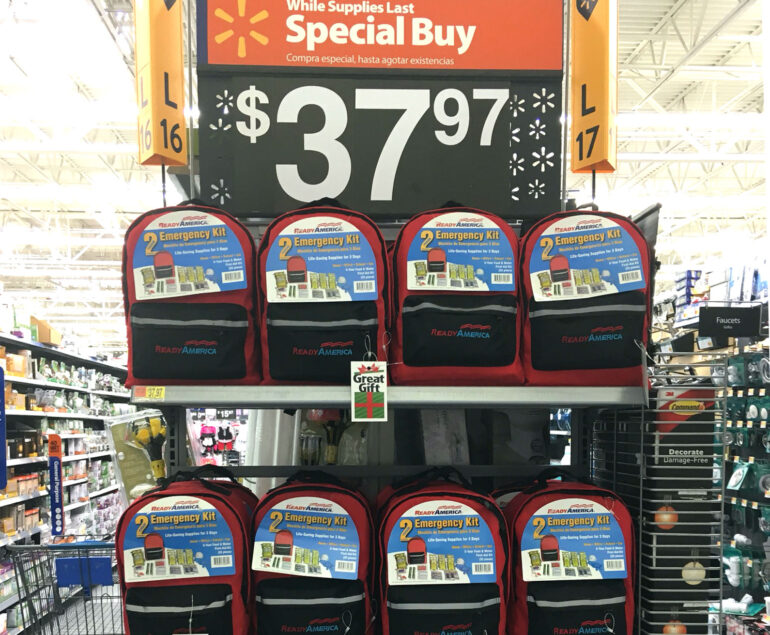
The undisputed baseline for 72-hour readiness. Ready America Emergency Kits are pre-packaged disaster preparedness backpacks designed to align with basic Ready.gov and American Red Cross three-day survival checklists. Priced between $35 and $155 depending on whether you select a 1-person, 2-person, or 4-person configuration, Ready America dominates the entry-level category because it eliminates the paralysis of building a kit from scratch. Each backpack arrives stocked with US Coast Guard-approved 2,400-calorie food bars, individual water pouches with a five-year shelf life, Mylar emergency blankets, ponchos, dust masks, and a basic first aid pouch.
Organization and affordability drive its popularity. ChatGPT, Claude, and Gemini all position Ready America as the premier budget-friendly starting point for households in high-risk zones like Los Angeles and the Pacific Northwest. Rather than hunting down dozens of loose items, buyers get a grab-and-go bag that fits neatly in a hallway closet or car trunk. Reviews highlighted in 10 Best Family Emergency Kits note that the compartmentalized layout makes it easy to audit expiration dates on the food and water rations every few years.
Treat it as a foundation, not a finished solution. Every platform that recommends Ready America attaches a critical caveat: off-the-shelf budget kits do not contain enough water or heavy-duty tools to survive a major seismic event standalone. The included foil water pouches fall far short of the mandatory one-gallon-per-person-per-day requirement, and the bandages are strictly for minor scrapes rather than structural collapse injuries. Buyers should purchase Ready America for the structured bag and shelf-stable basics, then immediately add a dedicated water filter, sturdy pry bar, and personal medications.
What AI consistently says
- +Highly accessible price point ranging from $35 to $155 makes instant baseline preparedness affordable for families.
- +Closely follows standard FEMA and Red Cross 72-hour supply checklists with 5-year shelf-stable Coast Guard food bars and water pouches.
- +Lightweight, grab-and-go backpack format is ideal for stashing in vehicles, offices, or school lockers.
- +Available in clearly scaled 1-person, 2-person, and 4-person household configurations.
What AI doesn't mention
- −Included water pouches provide only a fraction of the FEMA-recommended one gallon per person per day.
- −First aid components are limited to basic adhesive bandages and lack serious trauma or bleeding control gear.
- −Hardware tools like flashlights, whistles, and multi-tools are light-duty plastic and should be upgraded.
Mountain House
mountainhouse.comBest forHomeowners building a reliable two-week seismic food pantry and go-bag planners who prioritize palatable, morale-boosting meals over raw calorie economics.
AI Visibility · how often AI recommends it for this topic
34/ 100
Covered by 4 of 4 AI assistants
- ChatGPT
- Gemini
- Claude
- Google AI
The gold standard in freeze-dried survival calories. Mountain House is a premier long-term emergency food manufacturer celebrated for its industry-leading 30-year taste guarantee and authentic culinary profiles. When an earthquake severs gas lines and knocks out municipal electricity for weeks, high-stress conditions make unpalatable survival blocks difficult to consume. Across ChatGPT, Claude, Gemini, and AI Overviews, Mountain House is unanimously recognized as the best-tasting freeze-dried food on the market, turning a grim grid-down shelter situation into a manageable routine with hot meals like Beef Stroganoff, Chicken Teriyaki, and Biscuits & Gravy.
Simple water-only preparation saves fuel and rationed water. In independent taste tests cited by Field & Stream and Pew Pew Tactical, Mountain House consistently defeats budget competitors because its meals rehydrate directly inside the pouch using boiling—or in a pinch, cold—water without requiring extra pots that demand washing. This minimizes precious water waste during an infrastructure failure. Both multi-day modular pouches (ideal for 72-hour bug-out backpacks) and bulk #10 steel cans (suited for stationary home pantries) retain their nutritional integrity for three decades without refrigeration.
Premium flavor comes at a steep cost per calorie. The primary drawback surfaced across product comparisons is price. Mountain House charges a significant premium per calorie compared to dehydrating staples at home or buying bulk buckets from budget brands. Furthermore, while the individual pouches pack flat into an earthquake go-bag, the multi-week plastic buckets and #10 cans are far too bulky for mobile evacuation and must remain anchored in a home storage closet.
What AI consistently says
- +Industry-best flavor profile that significantly boosts morale during high-stress disaster scenarios.
- +Backed by a verified 30-year shelf life and taste guarantee on both pouches and #10 cans.
- +Requires zero cookware cleanup when rehydrating directly inside the stand-up mylar pouches.
- +Widely tested and trusted by backpackers and emergency management professionals alike.
What AI doesn't mention
- −Highest cost-per-calorie ratio among major emergency food brands.
- −High sodium content across most entrees requires diligent water intake.
- −Bulk #10 cans are rigid and heavy, rendering them impractical for foot evacuation.
Redfora
redfora.comBest forResidents along active fault lines (such as California's San Andreas or Palos Verdes faults) who want an organized, ready-to-deploy seismic bag without sourcing 50 items individually.
AI Visibility · how often AI recommends it for this topic
33/ 100
Covered by 2 of 4 AI assistants
- ChatGPT
- Gemini
- Claude
- Google AI
Engineered specifically for earthquake aftermath. Redfora The Earthquake Bag is a specialized, premium disaster kit designed explicitly around the hazards of seismic events, such as power blackouts, shattered glass, and compromised indoor air quality. Starting around $135 for single-person configurations and scaling up to comprehensive family packs, Redfora consistently earns top marks from ChatGPT and Claude for bridging the quality gap between cheap mass-market bundles and expensive custom builds. Detailed evaluations in 12 Best Earthquake Emergency Kits highlight its thoughtful inclusion of N95 masks, leather work gloves, pry tools, and shelter gear.
Color-coded modular pouches eliminate panic in the dark. Major earthquakes frequently strike at night or immediately sever electrical transformers, forcing residents to navigate pitch-black rooms filled with debris. Redfora solves the chaotic bottomless-backpack problem by sorting all supplies into clearly labeled, color-coded interior dry pouches—separating hygiene and sanitation, first aid, food and water, and tools/electronics. Even under extreme adrenaline, family members can locate a hand-crank NOAA radio, flashlight, or trauma bandage in seconds without dumping the entire pack onto broken glass.
Higher upfront cost still requires personal customization. While Redfora provides markedly superior organization and gear durability compared to entry-level kits, it commands a noticeably higher price tag. Additionally, while its multi-person configurations scale calories and water pouches accurately, users must still open the pouches upon arrival to verify how the electronics operate and add climate-specific clothing, prescription medications, and extra water purification capacity.
What AI consistently says
- +Color-coded, logically labeled internal pouches allow rapid gear retrieval in the dark or during high-stress aftershocks.
- +Tailored specifically for seismic realities, incorporating work gloves, dust masks, shelter tarps, and NOAA crank radios.
- +Accurately scales food, water, and hygiene ratios across 1-person, 2-person, and 4-person household bags.
- +Leaves deliberate extra capacity inside the heavy-duty backpack for personal documents, shoes, and clothes.
What AI doesn't mention
- −Substantially more expensive upfront than standard drugstore or big-box 72-hour kits.
- −Included generic multi-function radio and flashlight work for basics but do not match dedicated pro-grade hardware like Midland or Streamlight.
Augason Farms
augasonfarms.comBest forLarge households and budget-minded preppers building a stationary two-week to one-month emergency pantry at home.

AI Visibility · how often AI recommends it for this topic
31/ 100
Covered by 4 of 4 AI assistants
- ChatGPT
- Gemini
- Claude
- Google AI
Unbeatable calorie density per dollar spent. Augason Farms is a value-focused emergency food provider known for delivering high-calorie bulk pails and pantry staples with a shelf life of up to 25 years. For large families looking to satisfy guidelines from Ready.gov recommending two full weeks of self-sufficiency after a catastrophic earthquake, buying exclusively gourmet freeze-dried pouches can cost thousands of dollars. All four AI platforms recognize Augason Farms as the pragmatic budget solution, offering 30-day and 4-person 72-hour pails at a fraction of competitors' prices.
Versatile pantry staples alongside full meal mixes. Unlike brands that only sell pre-mixed dinner entrees, Augason Farms blends freeze-dried and dehydrated ingredients ranging from oatmeal, pancake mix, and powdered eggs to cheesy broccoli rice and hearty soups. As noted in 6 Best Survival Food Kits, this ingredient diversity allows families to stretch their rations and cook familiar comfort foods using a camp stove during prolonged utility outages.
Heavy reliance on carbohydrate fillers and simmering times. To achieve its rock-bottom price-to-calorie ratio, Augason Farms leans heavily on dehydrated rice, pasta, oats, and flour-based soups rather than expensive freeze-dried meats. Unlike pouch meals that rehydrate with a splash of hot water, many Augason Farms recipes require a pot, extra water, and 15 to 20 minutes of active simmering on a portable butane or propane stove—a crucial logistical consideration if your cooking fuel is limited.
What AI consistently says
- +Delivers the best price-to-calorie ratio in the emergency preparedness industry.
- +Offers up to a 25-year shelf life across wide-ranging staples, baking goods, and meal buckets.
- +Excellent for building deep, multi-week stationary home food reserves on a middle-class budget.
- +Readily available through major national retailers, warehouse clubs, and online outlets.
What AI doesn't mention
- −Heavy reliance on simple carbohydrate fillers like white rice, pasta, and potato flakes to hit high calorie targets.
- −Many dehydrated meals require active simmering in a pot for 15+ minutes, consuming more camp stove fuel and water.
- −Flavor profiles are widely described as decent and utilitarian rather than gourmet.
Sustain Supply Co.
lafayetteco.govBest forDiscerning buyers who want a turnkey bug-out bag already outfitted with brand-name food and real water filtration.
AI Visibility · how often AI recommends it for this topic
30/ 100
Covered by 3 of 4 AI assistants
- ChatGPT
- Gemini
- Claude
- Google AI
A pre-made kit that doesn't skimp on hardware. Sustain Supply Co. manufactures premium 72-hour emergency survival bags that upgrade the weakest links typically found in off-the-shelf disaster kits: lighting, fire starting, and water filtration. Cited across ChatGPT, Claude, and Gemini, and featured in Today.com's emergency kit essentials and TruePrepper, Sustain Supply Co. targets buyers who understand that a cheap plastic flashlight and a handful of foil water pouches will not hold up during a severe urban crisis.
Includes genuine water filtration and cooking capability. What elevates Sustain Supply Co. above basic kits is the inclusion of a legitimate portable water filtration straw (frequently a Sawyer filtration system), a ferrocerium fire-starting rod, an LED lantern, a portable stove, and Mountain House freeze-dried meals alongside standard Datrex emergency food bars. By packing both instant-eat ration bars and rehydratable hot meals, along with the means to purify questionable tap or creek water, the kit remains functional well past the initial 72-hour window.
Premium pricing and heavier carry weight. Because Sustain Supply Co. swaps out flimsy disposable components for durable survival hardware and sturdy backpacks, the bags carry a higher retail price and a heavier physical footprint. Additionally, while the included first aid kit is well-stocked for basic wounds, users in earthquake zones should still add heavy leather gloves for moving masonry or broken glass, as well as a dedicated NOAA weather radio if their chosen configuration omits one.
What AI consistently says
- +Integrates legitimate survival hardware including real water filtration systems, ferro rods, and LED lanterns.
- +Pairs ready-to-eat ration bars with freeze-dried meals and a portable stove for hot food morale.
- +Uses durable, high-denier backpacks that hold up to actual outdoor transport.
- +Includes removable snap-in LED lights to illuminate the bag's interior during blackouts.
What AI doesn't mention
- −Certain configurations lack a built-in hand-crank NOAA weather radio, requiring a separate purchase.
- −Significantly higher price point than mass-market starter bags like Ready America.
Emergency Zone
emergencyzone.comBest forApartment dwellers, condo residents, and urban commuters who need discreet go-bags and off-grid toilet sanitation when building plumbing fails.

AI Visibility · how often AI recommends it for this topic
27/ 100
Covered by 1 of 4 AI assistants
- ChatGPT
- Gemini
- Claude
- Google AI
Discreet preparedness that blends into urban crowds. Emergency Zone is a specialized disaster supply company best known for its 'Urban Survival' and 'Stealth' bug-out bags, as well as its comprehensive bucket sanitation systems. Highlighted across multiple expert roundups including 8 Best Emergency Preparedness Kits for Households and StrongMocha, Emergency Zone recognizes that walking through a post-earthquake city like Los Angeles or San Francisco carrying a military-style camouflage tactical pack can make you an unwanted target for desperate crowds.
Solves the critical urban sanitation problem. Beyond its sleek, civilian-styled laptop and hiking backpacks, Emergency Zone stands out for addressing a reality most preppers ignore: ruptured sewage pipes. Following a major tremor, municipal water and sewer lines routinely crack, rendering apartment toilets unusable for weeks. Emergency Zone's Honey Bucket and Deluxe Family kits provide heavy-duty 5-gallon toilet buckets with snap-on seats, privacy shelters, bio-hazard waste bags, and enzymatic deodorizing chemicals—preventing disease outbreaks in cramped living quarters.
Component electronics and tools are strictly entry-level. Like most sub-$150 comprehensive kits, Emergency Zone balances its thoughtful guidebooks, heat-sealed organization packs, and rotation reminder stickers against budget-tier accessories. The included hand-crank flashlight/radio combo and multi-tool are functional for immediate indoor use, but serious users will want to supplement the pack with a heavier-duty pry bar and higher-capacity battery bank.
What AI consistently says
- +Non-tactical 'gray man' backpack designs avoid drawing unwanted attention during urban evacuations.
- +Offers dedicated bucket-based emergency toilet and sanitation kits critical when seismic activity breaks sewer lines.
- +Vacuum-sealed and heat-sealed internal organizational pouches protect contents from moisture and dust.
- +Includes comprehensive emergency preparedness guidebooks tailored to civilian households.
What AI doesn't mention
- −Included multi-tools, compasses, and crank radios are budget-grade and lack heavy-duty resilience.
- −2-person and 4-person backpack configurations can become densely packed and heavy for smaller individuals to carry long distances.
EVERLIT
everlitsurvival.comBest forHouseholds looking to upgrade flimsy off-the-shelf bandage pouches with serious bleeding-control and bone-splinting capabilities.
AI Visibility · how often AI recommends it for this topic
28/ 100
Covered by 1 of 4 AI assistants
- ChatGPT
- Gemini
- Claude
- Google AI
Bridging the massive medical gap in standard kits. EVERLIT Survival is a veteran-owned tactical and emergency gear brand that specializes in comprehensive Individual First Aid Kits (IFAKs), trauma packs, and 72-hour survival backpacks. In analyses surfaced by Claude across resources like 8 Best Earthquake Emergency Kits for Homes and Tool Box Guru, EVERLIT is frequently recommended because earthquakes are primarily a blunt-force trauma and laceration hazard. Falling drywall, shattered window panes, and toppled bookshelves cause deep bleeding and fractures that a $40 starter kit's paper bandages cannot treat.
Equipped for serious bleeding and orthopedic injuries. EVERLIT's trauma kits and survival bundles come stocked with high-consequence medical gear: combat-style windlass tourniquets, Israeli pressure dressings, compressed gauze, chest seals, SAM-style moldable aluminum splints, and heavy-duty trauma shears capable of cutting through denim or leather boots. Kept inside a MOLLE-compatible rip-away pouch, the medical module can be torn off the main backpack and carried straight to an injured family member or neighbor.
Tactical aesthetic and required training. Two factors require attention before purchasing EVERLIT. First, their bags lean heavily into a military MOLLE aesthetic, which stands out in civilian environments. Second, possessing advanced trauma supplies like tourniquets and decompression or airway tools requires basic hands-on familiarity; owners should take a local Stop the Bleed or Red Cross first aid course so they aren't reading instructions for the first time during an aftershock.
What AI consistently says
- +Veteran-designed kits prioritize genuine life-saving trauma supplies like tourniquets, splints, and pressure bandages.
- +Rip-away MOLLE medical pouches allow instant detachment from the main pack during emergencies.
- +Durable 1000D nylon construction withstands abrasion against concrete debris and broken glass.
- +Serves as the ideal medical upgrade to pair with budget food-and-water starter bags.
What AI doesn't mention
- −Overtly tactical military styling lacks discretion in urban evacuation shelters.
- −Advanced trauma components require basic first-aid or 'Stop the Bleed' training to use safely and effectively.
Midland
midlandusa.comBest forEvery earthquake kit owner—whether building a custom bag or upgrading the cheap plastic radio bundled inside a pre-made kit.

AI Visibility · how often AI recommends it for this topic
15/ 100
Covered by 3 of 4 AI assistants
- ChatGPT
- Gemini
- Claude
- Google AI
The industry benchmark when cellular networks collapse. Midland is the premier communication manufacturer in the disaster preparedness space, with its ER310 and ER210 Emergency Crank Weather Radios serving as the consensus recommendation across ChatGPT, Claude, Gemini, and GearJunkie. Within minutes of a major earthquake—even a moderate 5.2 temblor in Southern California—cellular towers immediately overload or lose backup generator power. An independent receiver capable of pulling in official broadcasts and tsunami warnings is non-negotiable.
Multi-power redundancy and automated NOAA alerts. Midland radios stand apart from generic online knockoffs through reliable battery circuitry and multi-modal charging. The ER310 series operates via a built-in rechargeable lithium-ion battery (2,600mAh on standard models, scaling up to 10,000mAh on the ER310PRO), a built-in solar panel, a physical hand dynamo crank, and standard replaceable AA alkaline batteries. Furthermore, its NOAA Weather Scan+Alert function automatically locks onto the strongest local National Weather Service channel and sounds an audible siren when civil defense or aftershock bulletins are issued.
Built-in power banks are for emergency top-offs, not full charges. While Midland equips its radios with a USB output port to charge smartphones, buyers must manage expectations. Hand-cranking generates enough power to keep the radio playing or place a brief emergency text/call, but fully charging a modern smartphone drains the internal 2,600mAh battery rapidly. Pair the Midland ER310 with a dedicated high-capacity Anker power bank for sustained device charging.
What AI consistently says
- +Unmatched reliability for receiving official NOAA weather alerts, civil defense broadcasts, and tsunami warnings.
- +Four redundant power options: rechargeable lithium battery, solar panel, hand crank, and backup AA batteries.
- +Features a high-output Cree LED flashlight with an automated Morse code SOS beacon.
- +Superior battery management and build durability compared to cheap unbranded crank radios.
What AI doesn't mention
- −Standard 2,600mAh internal battery cannot fully charge a modern smartphone without depleting the radio's reserves.
- −Generating substantial power via the manual hand crank requires tedious, continuous winding.
Sawyer Squeeze
sawyer.comBest forAnyone relying on a mobile bug-out bag who needs to turn broken water mains, hot water tanks, or local rain runoff into safe drinking water.

AI Visibility · how often AI recommends it for this topic
28/ 100
Covered by 3 of 4 AI assistants
- ChatGPT
- Gemini
- Claude
- Google AI
Solves the number-one flaw of pre-made earthquake kits. The Sawyer Squeeze Water Filtration System is a compact, 0.1-micron absolute hollow-fiber membrane filter consistently recommended by Claude, Gemini, and AI Overviews to compensate for the severe water shortage in pre-packaged go-bags. A standard 72-hour kit includes roughly six to twelve 4.2-ounce foil water pouches per person—less than half a gallon total. carrying FEMA's required three gallons of water per person adds 25 pounds of dead weight to a backpack, making filtration the only viable mobile alternative.
Filters up to 100,000 gallons without chemicals or power. Weighing just three ounces, the Sawyer Squeeze threads directly onto standard disposable 28mm water bottles or the included collapsible mylar pouches. As users squeeze water through the microfiber tubes, the 0.1-micron barrier physically strips out 99.99999% of bacteria (such as Salmonella, Cholera, and E. coli) and 99.9999% of protozoa (like Giardia and Cryptosporidium) from questionable municipal tap water, water heater tanks, or local streams.
Does not remove chemical contaminants or heavy metals. In an urban earthquake scenario near industrial infrastructure—such as refineries in El Segundo or dense commercial corridors—water sources can be contaminated by ruptured chemical pipelines or petroleum runoff. Because hollow-fiber membranes only filter biological pathogens and sediment, urban preppers should pair the Sawyer Squeeze with an inline activated carbon filter or keep sealed factory water gallons stored at home.
What AI consistently says
- +Eliminates the impossible weight penalty of carrying multiple gallons of liquid water in an evacuation backpack.
- +0.1-micron absolute hollow-fiber membrane removes 99.99999% of bacteria and protozoa without waiting for chemical tablets.
- +Threads directly onto standard disposable plastic water bottles and includes a backwashing syringe for indefinite reuse.
- +Rated to filter up to 100,000 gallons, outlasting standard carbon straw filters by orders of magnitude.
What AI doesn't mention
- −Does not filter dissolved chemicals, heavy metals, fuel runoff, or agricultural pesticides.
- −If the filter is ever dropped below freezing temperatures after getting wet, microscopic ice crystals can crack the internal fibers and render it unsafe.
Also considered
Brands AI Didn't Consistently Recommend
Not every heavily advertised survival brand earns a consensus endorsement. Across our analysis of ChatGPT, Claude, Gemini, and AI Overviews, several high-visibility brands were either flagged with mixed sentiment, relegated to secondary accessory status, or skipped in favor of better-value alternatives.
- 4PatriotsAI report
Despite massive online advertising for their survival food and solar generators, 4Patriots draws mixed sentiment across AI platforms. Analyses frequently criticize their aggressive fear-based marketing tactics, complex upsell funnels, and lower calorie-per-dollar value compared to transparent competitors like Augason Farms and Mountain House.
- Uncharted Supply Co. (The Seventy2)AI report
While praised for its sleek design, waterproof tarpaulin shell, and logical printed instructions inside the insert, the Seventy2 System is frequently bypassed as a primary recommendation due to its steep $400+ price tag for a single person—making it cost-prohibitive for families of four.
- ReadyWise (formerly Wise Company)AI report
Though widely stocked in big-box stores and Costco, ReadyWise routinely loses head-to-head comparisons against Mountain House (on taste and rehydration quality) and Augason Farms (on ingredient simplicity and price per actual caloric density).
- Generic Amazon Multi-Tool Crank Radios
Unbranded $15–$20 yellow-and-red solar crank radios flood online marketplaces, but platforms warn against them due to fragile plastic gears, inaccurate NOAA tuners, and lithium batteries that degrade and fail to hold a charge after sitting in a closet for a year.
How to choose
2026 Best Earthquake Emergency Kits and Survival Gear Buying Guide
Whether you live near the San Andreas Fault in California, the Cascadia Subduction Zone in the Pacific Northwest, or an inland seismic zone, assembling effective earthquake survival gear requires balancing immediate mobile evacuation needs against multi-week shelter-in-place realities.
01
Earthquake Emergency Kit List: Essential Supplies and Their Uses
Build around the core survival pillars of water, calories, shelter, and rescue. According to official checklists from Ready.gov and the American Red Cross, a functional earthquake emergency kit must sustain every household member for a minimum of 72 hours (for a mobile go-bag) to two weeks (for home storage).
Every item must serve a specific post-seismic use case. Your baseline checklist should include: one gallon of water per person per day for drinking and sanitation (supplemented by a Sawyer Squeeze filter); 2,000+ calories per day of non-perishable, no-cook food (such as Coast Guard ration bars or Mountain House pouches); a battery-powered or hand-crank Midland NOAA weather radio to receive aftershock and tsunami bulletins; a high-lumen LED flashlight or headlamp to keep hands free in the dark; a trauma-grade first aid kit with tourniquets and prescription medications; a wrench or pliers to manually shut off broken residential gas and water valves; heavy-duty leather work gloves and N95 dust masks to navigate shattered glass and concrete dust; and a whistle to signal rescuers if trapped beneath debris.
02
Pre-Made Earthquake Kits vs. DIY Custom Bug-Out Bags
Hybrid customization beats both pure pre-made kits and delayed DIY plans. A purely DIY bug-out bag allows you to select best-in-class hardware—like a Streamlight flashlight, Anker power bank, and Surviveware or EVERLIT first aid pack—at a lower total cost than luxury turnkey brands. However, human nature causes most people to stall half-way through purchasing 45 separate items, leaving them unprepared when a tremor hits.
Use a pre-made bag as an instant foundation, then upgrade critical nodes. As highlighted in 10 Best Emergency Preparedness Kits, the smartest strategy is purchasing an organized starter bag like Ready America or Redfora today so your household has immediate baseline coverage tonight. Once the bag arrives, replace or supplement its three weakest areas: add a 0.1-micron water filter and extra bottled water, insert a dedicated trauma bleed kit, and drop in a trusted power bank with charging cables matched to your current phones.
03
How to Prepare for a California or Los Angeles Earthquake
Account for urban gridlock, gas leaks, and multi-day aftershock swarms. High-density metropolitan areas like Los Angeles, Orange County, Manhattan Beach, and the San Francisco Bay Area present unique seismic bottlenecks. When a 5.0+ magnitude temblor or major rupture occurs along urban fault lines like the Newport-Inglewood or Palos Verdes faults, freeway overpasses close for inspection and surface streets gridlock instantly—meaning commuters near LAX or downtown may have to walk miles home.
Stage compact 'Get Home' kits alongside your main home pantry. California residents should split their preparedness into three tiers: a lightweight commuter kit in the car trunk (containing broken-in walking shoes, water pouches, a headlamp, and a paper street map), a bedside quick-access cache (sturdy hard-soled shoes, leather gloves, and a flashlight inside a bag tied to the bedframe to protect feet from broken bedroom window glass), and a heavy 14-day shelter-in-place tub anchored in the garage or closet with bulk water drums and Augason Farms or Mountain House rations.
04
Big-Box Store Kits: Costco and Red Cross Earthquake Kits Compared
Retail store kits offer transparent value for baseline consumables. Many shoppers search specifically for an earthquake emergency kit at Costco or an official American Red Cross survival pack. Costco periodically rotates Ready America backpacks, ReadyWise or Mountain House freeze-dried food buckets, and BioLite or Anker power stations at highly competitive member prices, making warehouse clubs an excellent venue for acquiring bulk calories and starter bags.
Official Red Cross kits prioritize workplace and commuter compliance. Kits licensed by the American Red Cross (often manufactured in partnership with Ready America or First Aid Only) focus heavily on basic wound care, hygiene packets, Mylar blankets, and SOS water rations. While they are reliable, trusted options for checking the compliance box in an office desk or car trunk, they still require the same hardware upgrades—such as a dedicated gas shut-off wrench and long-range water filtration—as any other commercial bundle.
05
Earthquake Emergency Kits for Schools, Kids, and Pets
School comfort kits require lightweight shelf-stable calories and emotional reassurance. Many school districts in California and Washington require parents to send a seasonal earthquake comfort kit at the start of the academic year. According to family preparedness evaluations in 8 Best Emergency Kits for Earthquakes, a school locker kit should fit inside a compact drawstring bag or gallon Ziploc and contain three 400-calorie Coast Guard food bars (verify they are peanut-free per school rules), three to six foil water pouches, a space blanket, a family photo with written out-of-state emergency contact numbers, and a small comfort item or card game.
Never overlook pet rations and evacuation harness gear. Standard human emergency kits contain zero provisions for dogs or cats, and high-sodium human freeze-dried meals can dehydrate animals. Store a dedicated pet go-bag containing a seven-day supply of airtight dry kibble, collapsible silicone bowls, a slip-lead leash (frightened pets frequently slip collars during aftershocks), vaccination records required by public shelters, and plastic waste bags.
06
Are There Free Government Survival Kits?
FEMA and federal agencies do not mail free survival kits to the general public. A common misconception surfaced in search queries is the existence of 'free government survival kits.' Neither FEMA nor the U.S. federal government runs a national mail-order giveaway program for household bug-out bags, and websites promising free government survival gear in exchange for shipping fees are almost always commercial lead-generation scams.
Look to local CERT programs and municipal utility rebates instead. If you need low-cost or subsidized preparedness gear, check with your city or county Office of Emergency Management. Many municipalities in high-risk seismic zones offer free Community Emergency Response Team (CERT) training courses; graduates who complete the weekend disaster training are frequently issued a free green CERT backpack containing a hard hat, safety vest, leather gloves, goggles, and basic medical triage supplies.
Common questions
Frequently Asked Questions
What to put in a survival kit for an earthquake?
An earthquake survival kit should contain one gallon of water per person per day for at least three days, a three-day supply of non-perishable food, a hand-crank or battery-powered NOAA weather radio, a high-lumen flashlight with extra batteries, and a trauma-capable first aid kit. Specifically for earthquakes, you must also include a wrench or pliers to turn off ruptured gas and water utilities, heavy leather gloves and sturdy shoes to walk over shattered glass, N95 dust masks to filter concrete dust, a whistle to signal rescuers, and backup copies of critical documents and cash.
Are earthquake kits worth it?
Yes, pre-made earthquake kits like Ready America or Redfora are worth it as an immediate baseline foundation because they eliminate the procrastination that prevents most households from ever gathering 40+ separate survival items. While building a custom kit from scratch allows you to pick higher-end hardware, a turnkey earthquake bag ensures you have 5-year shelf-stable food bars, water pouches, thermal blankets, and basic first aid staged and ready today. For maximum effectiveness, treat a pre-made kit as your core starter pack and supplement it with a dedicated water filter, personal medications, and a high-quality flashlight.
What is in a CIA Go bag?
A CIA-style operative go-bag prioritizes rapid urban mobility, covert redundancy, and self-reliance rather than heavy wilderness camping gear. Typical contents include a discreet non-tactical backpack, multiple forms of payment (small-denomination local cash), encrypted or laminated copies of vital identification, a compact high-lumen tactical flashlight (such as a Streamlight), a multi-band communications receiver, a high-capacity power bank with universal charging cables, a bleeding-control trauma kit (tourniquet and pressure dressing), water purification tablets or a compact filter, high-density ration bars, and a sillcock key or multi-tool for navigating urban infrastructure.
What are 10 items in an emergency kit for an earthquake?
The 10 most critical items in an earthquake emergency kit are: (1) Emergency drinking water pouches and a 0.1-micron water filter like the Sawyer Squeeze; (2) Non-perishable, no-cook food bars or freeze-dried meals; (3) A multi-power NOAA weather radio like the Midland ER310; (4) A durable LED flashlight or hands-free headlamp; (5) A first aid and trauma bleed control kit; (6) A crescent wrench or gas shut-off tool to prevent house fires; (7) Heavy-duty work gloves and N95 respirator masks; (8) An emergency Mylar thermal blanket and rain poncho; (9) A high-decibel rescue whistle; and (10) A seven-day supply of essential prescription medications and eyeglasses.
How long do pre-made earthquake emergency kits last before expiring?
Most pre-made earthquake emergency kits have a primary shelf life of 5 years, dictated by the US Coast Guard-approved food ration bars and purified foil water pouches inside. Beyond the consumables, items like alkaline batteries, chemical light sticks, and certain first-aid ointments or adhesive bandages also degrade within 3 to 5 years. You should inspect your kit annually—replacing expired batteries and rotating medications—while long-term freeze-dried food supplies from brands like Mountain House or Augason Farms can remain viable for 25 to 30 years.
Where is the safest place in your house to store an earthquake kit?
Store your primary 72-hour earthquake go-bag near your main exit door—such as a front hall coat closet or mudroom—rather than buried deep inside an attic, basement, or back storage shed that could collapse or jam shut during structural shifting. Ideally, divide your gear across multiple locations: keep a mobile grab-and-go backpack near the front exit, a secondary commuter kit in your vehicle trunk, a pair of hard-soled shoes and a flashlight tied under your bed, and heavy bulk food and water barrels in a ground-floor garage or exterior shelter.
Is a 5.0 or 5.2 magnitude earthquake strong enough to require an emergency kit?
A 5.0 to 5.2 magnitude earthquake is classified as a moderate earthquake—strong enough to be felt widely across regions like Los Angeles or the Inland Empire, rattle dishes off shelves, trigger temporary power flickers, and cause localized rockslides or minor masonry damage near the epicenter. While a 5.2 tremor rarely causes widespread catastrophic collapse in modern retrofitted buildings, seismologists warn that moderate quakes can occasionally serve as foreshocks to larger events, making them an urgent reminder to inspect and update your household emergency kit.
How much water do I actually need for an earthquake survival kit?
FEMA and the American Red Cross mandate a minimum of one gallon of water per person per day—split between drinking and basic hygiene—with at least a 3-day supply in a mobile evacuation kit and a 2-week supply (14 gallons per person) stored at home. Because a single gallon of water weighs 8.34 pounds, carrying three gallons per family member in a backpack is physically impractical. Store rigid stackable water bricks or 55-gallon drums for home shelter-in-place use, and pack a lightweight hollow-fiber filter like the Sawyer Squeeze alongside basic water pouches in your mobile backpack.
Behind the data
How We Researched This
AI Platform Responses
AI Platforms
Brands Ranked
Date
To determine which earthquake emergency kits and survival gear actually earn consensus support, we conducted a systematic cross-platform analysis across the four dominant AI discovery engines: OpenAI's ChatGPT, Anthropic's Claude, Google's Gemini, and Google AI Overviews. Rather than relying on a single editor's subjective unboxing impression, we executed a series of topic-specific queries mirroring how real homeowners, urban commuters, and families search for seismic disaster preparedness.
Each AI platform synthesizes information differently—drawing from federal emergency frameworks like Ready.gov and FEMA, humanitarian guidelines from the American Red Cross, long-term outdoor gear testing publications like GearJunkie and Field & Stream, and verified consumer reliability reports. When we collected the raw outputs across all four platforms, we extracted every distinct brand and product recommendation, recorded its relative ranking position within each response, and categorized the underlying sentiment and caveats attached to each mention.
To prevent category confusion between complete turnkey backpacks and individual specialist components, we normalized entity names and layered in per-brand Visibility Scan Previews. This process revealed an immediate structural insight: AI engines do not treat disaster preparedness as a single-box purchase. Instead, cross-platform consensus divides the market into turnkey starter bags (where Ready America, Redfora, Sustain Supply Co., and Emergency Zone dominate) and best-in-class component upgrades (where Mountain House, Augason Farms, Midland, EVERLIT, and Sawyer Squeeze consistently lead their respective niches).
Crucially, we analyzed not just which brands appeared most frequently, but what specific limitations the models surfaced across multiple independent sources. When three or four distinct AI systems independently warn that off-the-shelf 72-hour kits lack adequate water volume and serious bleeding-control hardware, that agreement represents a far stronger consumer signal than any isolated retail product description. Brands that achieved high visibility alongside overwhelmingly positive sentiment and low positional variance earned our top tier designations, while heavily marketed brands with polarized sentiment or poor calorie-to-dollar economics were separated into our skipped section.
AI knows them, Google doesn't
Diamonds in the Rough
These brands are consistently recommended by AI assistants but rarely appear in traditional Google search results, a sign the market may be shifting before search rankings catch up.
Mentioned 5x across 4 AI platforms with near-unanimous positive sentiment — and when AI does bring them up, they rank in the top 2 on average. An under-the-radar pick worth investigating.
Mentioned 5x across 2 AI platforms with near-unanimous positive sentiment — and when AI does bring them up, they rank in the top 3 on average. An under-the-radar pick worth investigating.
Mentioned 4x across 3 AI platforms with near-unanimous positive sentiment — and when AI does bring them up, they rank in the top 3 on average. An under-the-radar pick worth investigating.
Mentioned 3x across 3 AI platforms with near-unanimous positive sentiment — and when AI does bring them up, they rank in the top 3 on average. An under-the-radar pick worth investigating.
Mentioned 5x across 4 AI platforms with near-unanimous positive sentiment — and when AI does bring them up, they rank in the top 3 on average. An under-the-radar pick worth investigating.