





The verdict
Our Quick Picks
Across a series of topic-specific queries on ChatGPT, Claude, Gemini, and Google AI Overviews, a clear division emerges between convenient all-in-one foundation packs and rugged, specialized survival components. While Ready America and Redfora dominate the pre-assembled earthquake go-bag market for families, our cross-platform analysis strongly advocates pairing these baseline kits with superior standalone water filters, freeze-dried rations from Mountain House, and ANSI-certified trauma kits.
- 1Best Overall Value for FamiliesReady America
The most reliable, budget-friendly 72-hour foundation kit for families of four looking to quickly check off FEMA basics.
- 2Best Organized Complete KitRedfora
A premium, color-coded earthquake bag with wheeled transport options and upgraded personal water filtration.
- 3Best Tactical & Trauma-Ready BagEVERLIT
Built from rugged 1000D nylon, this go-bag upgrades standard first-aid with serious trauma gear like a CAT tourniquet.
- 4Best Long-Term Emergency FoodMountain House
The gold standard in freeze-dried emergency meals, offering a 30-year shelf life and vastly better flavor than dry ration bars.
- 5Best Medical & First-Aid UpgradeAdventure Medical Kits
Professional-grade, modular medical kits equipped with hospital-quality instruments and expert wilderness medicine guides.
- 6Best for Apartments & Tight SpacesEmergency Zone
Compact, discreetly styled backpacks packed with USCG-approved rations tailored for urban dwellers with limited closet space.
- 7Best Emergency CommunicationMidland
The industry benchmark for multi-power NOAA weather radios featuring hand-crank, solar, and rechargeable battery backups.
- 8Best Water Filtration UpgradeLifeStraw
Essential hollow-fiber membrane water filters that turn questionable local water sources into safe drinking water when pouches run dry.
Side by side
At a Glance
| Specialty | AI Visibility |  ChatGPT |  Claude |  Gemini |  Google AI Overviews |
|---|---|---|---|---|---|
| Best Overall Value for Families | 46 | ● | ● | ● | ● |
| Best Organized Complete Kit | 39 | ● | ● | ● | ● |
| Best Tactical & Trauma-Ready Bag | 32 | ○ | ● | ● | ○ |
| Best Long-Term Emergency Food | 12 | ● | ● | ● | ● |
| Best Medical & First-Aid Upgrade | 10 | ● | ○ | ● | ● |
| Best for Apartments & Tight Spaces | 26 | ○ | ● | ○ | ● |
| Best Emergency Communication | 8 | ● | ● | ● | ○ |
| Best Water Filtration Upgrade | 25 | ● | ● | ○ | ● |
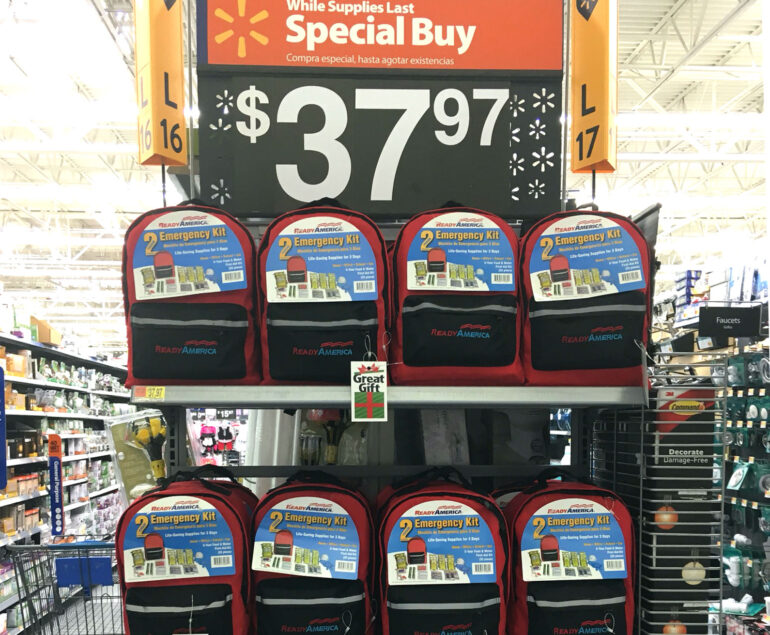
Ready America
readyamerica.comBest forFamilies of two to four and budget-conscious homeowners who want an affordable, pre-packed FEMA-compliant foundation they can easily customize.
AI Visibility · how often AI recommends it for this topic
46/ 100
Covered by 4 of 4 AI assistants
- ChatGPT
- Gemini
- Claude
- Google AI


The most practical baseline for families. Ready America 72 Hour Deluxe Emergency Kits are pre-assembled survival packs designed to meet basic FEMA emergency supply guidelines for households of one to four people at an accessible under-$150 price point. When you need to go from zero preparedness to having a functional disaster plan in a single afternoon, Ready America is the undisputed starting line. It removes the paralysis of building a kit from scratch by bundling US Coast Guard-approved food and water rations (carrying a 5-year shelf life), emergency ponchos, light sticks, a whistle, and basic first-aid supplies into a single grab-and-go backpack.
Designed as a foundation, not a finish line. While ChatGPT, Claude, Gemini, and AI Overviews all position Ready America as the top entry-level recommendation, the consensus across our analysis highlights a crucial caveat: treat this kit as a chassis to build upon. As noted in comparisons by the Los Angeles Times, pre-made kits at this price tier prioritize ticking checklist boxes over component luxury. The included water pouches provide the bare minimum hydration for 72 hours of mild activity, and the 2,400-calorie food bars—while shelf-stable and non-thirst-provoking—are notoriously dry and bland.
Easy to store and expand for pets. Beyond standard two-person and four-person backpacks, Ready America stands out for its specialized variations, including the Ready America Large Dog Evacuation & Emergency Kit. To make the human kits truly earthquake-ready, buyers should use the extra room in the backpack to pack personal prescription medications, sturdy leather work gloves for clearing debris, an upgraded water filter, and at least one extra gallon of water per person.
What AI consistently says
- +Exceptionally budget-friendly entry point, routinely priced well under $150 even for four-person configurations
- +Strictly aligns with core FEMA and Red Cross 72-hour survival checklists for food, water, and basic signaling
- +5-year shelf life on USCG-approved water pouches and calorie bars makes for low-maintenance closet storage
- +Offers dedicated pet evacuation kits so households can prepare for animals alongside family members
What AI doesn't mention
- −Water pouch volume represents the absolute bare survival minimum and won't suffice in hot climates or heavy physical exertion
- −The included first-aid kit is strictly for minor scrapes and lacks trauma supplies for severe earthquake injuries
- −Compressed ration bars are dry, chalky, and offer zero morale boost during a stressful grid-down event
Redfora
redfora.comBest forHomeowners and families willing to pay a premium for an expertly organized, turnkey earthquake bag that requires minimal post-purchase upgrading.
AI Visibility · how often AI recommends it for this topic
39/ 100
Covered by 4 of 4 AI assistants
- ChatGPT
- Gemini
- Claude
- Google AI
Superior organization for high-stress moments. The Redfora Complete Earthquake Bag is a premium, modularly organized disaster survival kit tailored specifically for seismic events and sudden urban evacuations. Priced around the $200 mark depending on headcount configuration, Redfora directly addresses the biggest complaint about budget go-bags: chaotic internal layouts. When the power is out and aftershocks are rolling, digging through a loose pile of plastic-wrapped gear is dangerous. Redfora solves this by sorting supplies into clearly labeled, color-coded internal pouches—separating hygiene and sanitation, tools and first aid, nutrition, and lighting.
Built for mobility and practical field use. Evaluated heavily by platforms citing resources like EarthquakeNearMe and QuakeKits, Redfora wins high marks for ergonomics and upgraded hardware. Larger family configurations are available in heavy-duty wheeled duffel bags rather than spine-straining backpacks, ensuring that older adults or parents carrying small children can actually move their supplies during an evacuation. Furthermore, Redfora steps above entry-level kits by including a personal water-filter straw alongside its 5-year shelf-life water pouches and 3,600-calorie food bars.
Worth the premium over basic kits. You pay noticeably more for a Redfora bag than a big-box hardware store bucket, and the core nutrition still relies on dense ration blocks rather than hot freeze-dried meals. However, the inclusion of practical earthquake gear—such as heavy-duty work gloves, a multi-function hand-crank flashlight/radio/charger, waste bags for when plumbing fails, and a spacious bag with room for personal clothes—makes it the top turnkey solution for buyers who refuse to build a DIY pack.
What AI consistently says
- +Color-coded, logically separated internal bags allow instant access to first-aid or lighting during panic-inducing blackouts
- +Wheeled bag options on larger multi-person kits make transporting heavy water and gear realistic for all fitness levels
- +Includes a personal water filtration straw to supplement the pre-packaged water pouches
- +Leaves dedicated extra capacity inside the main compartment for personal documents, cash, and seasonal clothing
What AI doesn't mention
- −Noticeably more expensive than entry-level competitors while still relying on basic 3,600-calorie ration bars for nutrition
- −The included personal water straw varies by kit tier and isn't as high-flow or versatile as a dedicated Sawyer or Katadyn filter
EVERLIT
everlitsurvival.comBest forPreparedness-minded individuals and outdoor enthusiasts who prioritize rugged 1000D pack durability and life-saving trauma medical gear over soft-sided family bags.
AI Visibility · how often AI recommends it for this topic
32/ 100
Covered by 2 of 4 AI assistants
- ChatGPT
- Gemini
- Claude
- Google AI
Rugged durability meets serious trauma care. The EVERLIT Complete 72-Hour Earthquake Bug Out Bag is a heavy-duty, tactical-grade survival pack engineered by veteran-owned product designers who prioritize structural toughness and severe wound management. While standard family emergency kits pack flimsy nylon bags that can tear on shattered glass or exposed rebar after a major tremor, EVERLIT constructs its packs from high-denier 1000D water-resistant nylon with MOLLE webbing. As highlighted in expert roundups like StrongMocha and Talk of the House, this physical resilience is paired with a massive upgrade in medical capability.
Equipped for real earthquake injuries, not just paper cuts. The standout differentiator in the EVERLIT system is its 200-piece first-aid kit, which steps beyond adhesive bandages to include legitimate trauma gear—most notably a Combat Application Tourniquet (CAT), emergency thermal blankets, and splint materials. In a severe magnitude 7.0+ earthquake, falling masonry and shattered windows cause arterial bleeding and fractures long before starvation becomes a factor. EVERLIT recognizes this reality and pairs its medical suite with a hand-crank NOAA weather radio, flashlight, and phone charger combo.
Tactical styling isn't for everyone. Despite its superior hardware and 5-year shelf-life food and water rations, EVERLIT has a distinct military aesthetic that some urban emergency planners avoid in order to keep a low profile at public evacuation shelters. Additionally, buyers must carefully verify the person-capacity of the specific SKU they select, as the compact tactical pack frame packs tightly and leaves less room for bulky extra jackets than wheeled duffels.
What AI consistently says
- +Constructed from ultra-tough 1000D tactical nylon that withstands abrasion from rubble, debris, and rough outdoor handling
- +Upgrades the standard first-aid pouch to a comprehensive 200-piece medical kit featuring a life-saving CAT tourniquet
- +Bundles high-utility electronics and tools, including a multi-powered hand-crank radio, flashlight, and USB power bank
- +Strong price-to-performance ratio considering the cost of buying a 1000D pack and trauma kit separately
What AI doesn't mention
- −Overt military/tactical appearance with exterior MOLLE webbing may draw unwanted attention during civil emergencies
- −Food and water rations are the same basic bars and pouches found in standard budget packs
- −Internal volume is densely packed, offering limited spare capacity for bulky personal items
Mountain House
mountainhouse.comBest forHomeowners building a shelter-in-place pantry or upgrading their go-bags who want comforting, great-tasting meals that won't expire for 30 years.
AI Visibility · how often AI recommends it for this topic
12/ 100
Covered by 4 of 4 AI assistants
- ChatGPT
- Gemini
- Claude
- Google AI
The gold standard in emergency nutrition. Mountain House Freeze-Dried Emergency Meals are shelf-stable, just-add-water culinary rations backed by an industry-leading 30-year taste guarantee. Across ChatGPT, Claude, Gemini, and Google AI Overviews, one critique of pre-made earthquake kits appears universally: compressed 2,400-calorie survival bars taste like sawdust and do nothing to calm panicked children or exhausted adults during a multi-day crisis. As noted in food storage evaluations by Forbes, Mountain House solves this by freeze-drying real, cooked comfort meals—such as Beef Stroganoff, Chili Mac, and Chicken Fajita Bowls—that lock in both nutritional density and genuine flavor.
Unmatched shelf life versus budget competitors. While alternative food storage brands like ReadyWise and Augason Farms frequently surface in our data as strong value options for bulk calorie buckets, Mountain House consistently commands the top qualitative consensus. You can stash a Mountain House 3-Day or 14-Day Emergency Food Supply box in a basement or closet and genuinely forget about it for three decades, whereas standard kit ration bars require replacement every five years.
Requires extra water and a heat source. The critical trade-off with freeze-dried meals in an earthquake scenario is preparation logistics. Unlike ready-to-eat ration bars, Mountain House pouches require clean water to rehydrate—and ideally a portable butane or propane camp stove to boil that water. While you can rehydrate Mountain House meals with cold water in a pinch (doubling the soak time), stocking these pouches means you must substantially increase your stored water reserves beyond basic drinking calculations.
What AI consistently says
- +Backed by a proven 30-year shelf life, eliminating the need to rotate food supplies every five years
- +Vastly superior taste, texture, and psychological comfort compared to dense, dry coast guard ration blocks
- +Lighter to carry per calorie than canned goods, packaged in durable pouches that double as the eating vessel
- +Widely preferred over budget bulk brands like ReadyWise and Augason Farms for actual meal palatability
What AI doesn't mention
- −Requires additional potable water for rehydration, which can rapidly deplete emergency drinking supplies if not planned for
- −Needs a portable camping stove or heat source for optimal preparation when gas and electric utilities are shut off
- −Pouches are bulkier inside a go-bag than vacuum-compressed survival bricks
Adventure Medical Kits
adventuremedicalkits.comBest forAnyone upgrading a pre-packaged go-bag or assembling a custom home earthquake kit who wants reliable, physician-organized medical supplies for serious injuries.

AI Visibility · how often AI recommends it for this topic
10/ 100
Covered by 3 of 4 AI assistants
- ChatGPT
- Gemini
- Claude
- Google AI
Hospital-grade organization for high-stress injuries. Adventure Medical Kits is a premier manufacturer of modular, trauma-capable first-aid systems designed by wilderness physicians and emergency responders. A recurring theme in our cross-platform analysis—echoed by emergency preparedness reporting at NBC News Select—is that the first-aid pouches tucked inside $100 pre-made earthquake bags are dangerously inadequate. They rarely contain more than a handful of cheap bandages, alcohol wipes, and aspirin. Adventure Medical Kits (alongside tactical trauma specialist North American Rescue) is the primary upgrade recommended to bridge that safety gap.
Engineered for untrained users in a crisis. What sets Adventure Medical Kits apart from throwing loose gauze and tape into a Ziploc bag is their Easy Care organization system and expert field manuals. Inside their Mountain Series and Trauma packs, supplies are segregated into injury-specific pockets (Bleeding, Fractures/Sprains, Wound Care, Medications) with clear visual labels. Furthermore, kits include A Comprehensive Guide to Wilderness & Travel Medicine by Dr. Eric A. Weiss, giving everyday citizens step-by-step instructions on how to manage severe lacerations, shock, or broken bones when 911 dispatchers are overwhelmed after a major quake.
Built to ANSI and professional standards. Many of their home and workplace models comply with strict ANSI/ISEA Z308.1 standards and incorporate hospital-quality instruments like precision forceps, trauma shears, irrigation syringes, and QuikClot hemostatic gauze. While higher-tier kits represent a significant additional investment and contain specialized tools that require familiarization before a disaster strikes, they transform a basic survival backpack into a true life-saving station.
What AI consistently says
- +Injury-specific internal compartments allow panicked users to locate bleeding or fracture supplies in seconds
- +Includes expert-authored wilderness medical manuals essential for treating injuries when hospitals are unreachable
- +Features legitimate medical instruments—trauma shears, wound irrigation syringes, and hemostatic gauze—rather than just adhesive strips
- +Complies with high professional safety benchmarks, including ANSI/ISEA standards on designated models
What AI doesn't mention
- −Advanced medical modules can overwhelm users who haven't opened the kit and read the guide prior to an emergency
- −Adding a comprehensive medical kit adds noticeable cost and weight to an existing pre-made earthquake bag
Emergency Zone
emergencyzone.comBest forApartment dwellers, city commuters, and small households looking for a low-profile, space-efficient go-bag that hides easily in a standard closet.

AI Visibility · how often AI recommends it for this topic
26/ 100
Covered by 2 of 4 AI assistants
- ChatGPT
- Gemini
- Claude
- Google AI
Discreet preparedness for urban dwellers. The Emergency Zone Family Emergency Kit is a compact, thoughtfully curated 72-hour survival pack specifically engineered for apartment residents, condo owners, and commuters with minimal storage space. Not everyone has a suburban garage or basement to stack five-gallon survival buckets. As noted in residential preparedness guides like Jason Wordie's Home Reviews, Emergency Zone solves the urban storage dilemma by packing a comprehensive two-person or four-person disaster loadout into a sleek, compact backpack that fits effortlessly into a coat closet or under a bed frame.
Avoids tactical panic with civilian styling. A thoughtful detail frequently praised across our analysis is Emergency Zone's discreet exterior design. Unlike bright red bags stamped with massive cross logos or camouflage tactical packs that scream "I have food and supplies," Emergency Zone uses muted, everyday backpack styling. In a dense urban evacuation following a major earthquake—where thousands of residents may be funneling into public parks or high school gymnasiums—carrying a bag that doesn't make you a target for theft is a major practical advantage.
Comprehensive basics in a small footprint. Inside, the kit punches well above its compact dimensions, bundling a 121-piece first-aid kit, USCG-approved 5-year food bars and water pouches, a hand-crank flashlight/radio, duct tape, a multi-tool, and frontier water filtration straws. While the compact profile means it lacks the expansive long-term shelter and heavy-duty prying tools found in giant trunk kits, it is the smartest ready-made option for city apartments.
What AI consistently says
- +Compact, space-saving footprint is ideal for small city apartments, dorms, and cramped coat closets
- +Discreet, non-tactical backpack exterior avoids drawing unwanted attention during public evacuations
- +Packs a comprehensive 121-piece first-aid kit alongside USCG-approved food, water, and basic water filtration straws
- +Avoids bulky, wasteful plastic packaging inside the bag to maximize usable space
What AI doesn't mention
- −Compact dimensions leave very little spare room for packing extra shoes, heavy clothes, or supplemental water bottles
- −Not designed for extended off-grid sustainability compared to larger bucket-style or modular DIY systems
Midland
midlandusa.comBest forEvery household emergency kit—either as the centerpiece of a DIY bag or as a high-reliability replacement for the cheap radios bundled in pre-made kits.

AI Visibility · how often AI recommends it for this topic
8/ 100
Covered by 3 of 4 AI assistants
- ChatGPT
- Gemini
- Claude
- Google AI
The gold standard when cellular networks collapse. The Midland Emergency Radio Line—anchored by the widely acclaimed ER310 and ER210 E+Ready models—is the definitive communication and backup lighting tool for earthquake preparedness. Within minutes of a major seismic event, local cell towers either lose grid power or become completely jammed by millions of simultaneous calls. As emphasized by federal guidelines at Ready.gov and the American Red Cross, a battery-powered or hand-crank NOAA Weather Radio is your primary lifeline for receiving official evacuation orders, boil-water advisories, and aftershock warnings.
Triple-redundant power architecture. While many pre-made earthquake kits toss in a generic $10 plastic crank radio, our cross-platform data overwhelmingly singles out Midland as a vital standalone purchase or upgrade. Midland radios integrate three distinct power sources: a high-capacity rechargeable lithium-ion internal battery, a top-mounted solar panel for passive daytime charging, and a smooth mechanical hand-crank dynamo for nighttime emergencies. Models like the ER310 also accommodate standard AA alkaline batteries as a fourth fallback.
Doubles as a signaling beacon and phone charger. Beyond crystal-clear AM/FM and automatic NOAA Alert reception, Midland units pack high-output Cree LED flashlights (often with built-in SOS Morse code strobe beacons), an ultrasonic dog whistle to help search-and-rescue teams locate trapped survivors under rubble, and a USB output port to trickle-charge your smartphone enough to send an emergency text message.
What AI consistently says
- +Automatic NOAA Weather Alert functionality sounds an alarm whenever local authorities broadcast severe emergency bulletins
- +Triple-power redundancy (solar panel, hand crank, and rechargeable lithium battery) guarantees operation during weeks-long blackouts
- +Integrated USB output port provides vital emergency trickle-charging for dead smartphones
- +Includes earthquake-specific rescue features like an SOS flashlight beacon and an ultrasonic search-and-rescue dog whistle
What AI doesn't mention
- −Hand-cranking a smartphone battery takes sustained physical effort and only provides enough charge for brief emergency calls or texts
- −Internal lithium batteries still require periodic testing and topping off every few months while in storage
LifeStraw
lifestraw.comBest forEvery go-bag owner who needs to bridge the gap between the minuscule foil water pouches included in pre-made kits and real-world 72-hour hydration needs.

AI Visibility · how often AI recommends it for this topic
25/ 100
Covered by 3 of 4 AI assistants
- ChatGPT
- Gemini
- Claude
- Google AI
Solves the weight limit of pre-packaged water. LifeStraw Personal and Peak Series Water Filters are ultra-lightweight hollow-fiber membrane filtration tools that remove 99.999999% of bacteria (including E. coli and Salmonella), 99.999% of parasites (Giardia and Cryptosporidium), and microplastics from questionable water sources. Across all four AI platforms, water scarcity is flagged as the single greatest point of failure in pre-made 72-hour kits. Because water weighs 8.34 pounds per gallon, pre-packaged backpacks typically include only six to twelve 4.2-ounce foil water pouches per person—barely enough to keep an adult alive for three days, and nowhere near the Ready.gov standard of one gallon per person per day.
Turns compromised water sources into safe hydration. Rather than strapping 25 pounds of liquid water onto your back during an evacuation, tossing a two-ounce LifeStraw (or close competitors Sawyer Squeeze and Katadyn BeFree, which also earned strong validation in Emergency Gear Lab tests) into your go-bag provides up to 1,000 gallons of clean drinking water. If municipal water mains fracture during an earthquake, a LifeStraw allows you to safely drink from backyard rainwater barrels, freshwater creeks, water heater tanks, or unchlorinated local reservoirs.
Know the limits of hollow-fiber filtration. While the classic LifeStraw is unbeatable for cost, weight, and simplicity, users must understand that standard hollow-fiber straws allow you to drink directly from a source rather than filtering water into a cooking pot for Mountain House meals (unless you opt for the LifeStraw Peak Gravity or Sawyer Squeeze pouch systems). Additionally, basic microfilters do not remove dissolved heavy metals, chemical spills, or viruses—making water purification tablets like Katadyn Micropur a smart secondary backup.
What AI consistently says
- +Weighs just two ounces while capable of filtering up to 1,000 gallons of contaminated water without chemicals or batteries
- +Eliminates 99.999999% of waterborne bacteria and 99.999% of protozoan parasites instantly upon drawing water
- +Virtually unlimited shelf life when stored dry in an emergency kit, unlike liquid water pouches that expire after five years
- +Inexpensive upgrade that immediately resolves the severe water deficit found in every pre-made earthquake backpack
What AI doesn't mention
- −Standard straw models only filter water directly into your mouth and cannot fill water bottles or rehydrate freeze-dried food pouches
- −Standard hollow-fiber membranes do not filter out chemical contamination, heavy metals, or fuel runoff common in urban floods
Also considered
Brands AI Didn't Consistently Recommend
While dozens of tactical, outdoor, and big-box brands sell disaster gear, several heavily marketed names were either bypassed or relegated to niche mentions across our cross-platform analysis due to cost, weight, or narrow utility.
- Uncharted Supply Co. (The Seventy2)AI report
While praised by gear enthusiasts for sleek design and waterproof tarpaulin construction, its $400+ price tag for a single-person 72-hour pack makes it prohibitively expensive for families of four compared to Ready America or Redfora.
- JUDY (The Safe / The Mover)
Heavily advertised on social media with bright orange branding, JUDY kits are frequently criticized by preparedness forums for prioritizing trendy aesthetics and cardboard organization boxes over rugged durability and per-dollar gear value.
- 4Patriots
Despite massive direct-to-consumer marketing for long-term survival food and solar generators, AI platforms overwhelmingly favor Mountain House, ReadyWise, and Augason Farms for verified shelf-life data, transparent nutritional calorie counts, and retail availability.
- Coleman (Pre-Made First Aid & Survival Tins)
While Coleman dominates recreational family car camping, their pocket survival tins and basic hardware-store first-aid pouches lack the trauma capability, calorie density, and ANSI compliance required for serious seismic disasters.
How to choose
2026 Best Emergency Preparedness and Earthquake Survival Kits Buying Guide
Whether you live along California's San Andreas Fault, the Pacific Northwest's Cascadia Subduction Zone, or simply want a dependable home emergency plan, buying a pre-made kit requires looking past inflated "piece counts." A 300-piece kit where 250 pieces are cotton swabs and mini bandages won't help you when utilities fail. Here is how to evaluate, buy, and upgrade an earthquake survival kit based on cross-platform consensus and federal emergency standards.
01
Earthquake Emergency Kit List: The Core FEMA 72-Hour Essentials
Start with the federal 72-hour baseline. A complete earthquake emergency kit list must provide three full days of self-sufficiency for every person and pet in your household, covering water, non-perishable food, medical care, communication, illumination, and shelter. According to official checklists from Ready.gov and the American Red Cross, municipal rescue services and utility grids are routinely overwhelmed during the first 72 hours following a major quake.
Prioritize high-impact survival categories over piece counts. At minimum, your checklist must include one gallon of water per person per day (plus a backup filter like a LifeStraw or Sawyer Squeeze), at least 2,000 calories of no-cook food per day (such as Datrex or SOS ration bars, supplemented by Mountain House pouches for home storage), a multi-powered NOAA weather radio like the Midland ER310, an ANSI-compliant first-aid kit with a tourniquet, a high-lumen LED headlamp or flashlight, a 20,000mAh Anker power bank with charging cables, a wrench or pliers to turn off leaking natural gas valves, N95 dust masks for breathing amidst pulverized drywall dust, and sturdy leather work gloves.
02
Building vs. Buying: Are Pre-Made Earthquake Kits Worth It?
Pre-made kits buy you immediate compliance; DIY kits buy you superior gear. Pre-made earthquake kits are well worth the money for busy households who would otherwise procrastinate on disaster preparedness, provided you view the purchased bag as an 80% solution that requires personal customization. As debated extensively in preparedness communities like Reddit's r/Survival and analyzed by EU-CIRCLE, building a custom go-bag from scratch allows you to select top-tier components—like an Osprey backpack, North American Rescue trauma supplies, and a Katadyn water filter—without paying for cheap filler items.
The hybrid approach is the smartest path. However, sourcing 40 separate items across five different retailers takes hours of research and typically costs 50% to 100% more than a bundled kit. The consensus winner for most families is a hybrid approach: purchase an organized foundation pack like the Redfora Complete Earthquake Bag or Ready America 72-Hour Deluxe Kit today, then spend 30 minutes adding a dedicated water filter, an upgraded Adventure Medical Kit, personal medications, and broken-in walking shoes.
03
Where to Buy: Earthquake Kit Costco vs. Amazon vs. Specialty Retailers
Match your retailer to your customization goals. You can purchase reliable emergency preparedness kits through warehouse clubs like Costco, large marketplaces like Amazon, or dedicated seismic specialists like QuakeKits and Redfora, each offering distinct advantages in bulk pricing versus specialty curation. Shoppers searching for an earthquake kit at Costco will frequently find exceptional seasonal bulk deals on ReadyWise or Mountain House freeze-dried food buckets, Ready America 4-person backpacks, and multi-packs of Duracell flashlights at prices 20% below standard retail.
Verify shelf-life dates when ordering online. Purchasing an earthquake kit on Amazon gives you instant access to tactical brands like EVERLIT, trauma upgrades from North American Rescue, and portable power from Anker. However, when buying pre-assembled survival kits on third-party marketplaces, always inspect the USCG water pouch and food bar stamping immediately upon delivery. Reputable specialty retailers rotate their warehouse inventory continuously so you receive the full 5-year shelf life, whereas stagnant third-party marketplace stock can occasionally arrive with 12 to 18 months already elapsed.
04
Urban & Apartment Preparedness: Planning for Southern California and City Quakes
Urban earthquakes create unique hazards beyond the tremor itself. Whenever a magnitude 4.2 or larger temblor strikes near Los Angeles, Pasadena, Whittier, or downtown LA, millions of residents immediately search for live USGS updates while confronting the reality of dense urban vulnerability. In multi-story apartment buildings and dense residential corridors, an earthquake emergency kit for home use must account for failed elevator systems, broken municipal water mains, ruptured gas lines, and unreinforced masonry blocking street exits.
Store kits near structural exits and keep shoes by the bed. According to the Red Cross Earthquake Preparedness Guide, urban residents should store compact packs—such as the Emergency Zone Family Kit—in a hallway closet near the front door rather than buried behind heavy storage racks in a garage that could buckle. Most importantly, because earthquakes frequently strike at night and shatter windows across bedroom floors, every family member should keep a pair of hard-soled shoes and a flashlight tucked in a bag tied directly to their bedframe.
05
How to Pack an Earthquake Emergency Kit for School, Work, and Commuters
Don't assume you will be at home when the fault slips. Because adults and children spend up to half their waking hours away from home, every household should maintain a lightweight commuter go-bag in their car trunk and a dedicated earthquake emergency kit for school or office desks. If a major quake drops highway overpasses or halts commuter rail lines, you may have to walk 10 to 15 miles back home across damaged pavement.
Keep vehicle and school kits compact and climate-resilient. For a workplace desk or car trunk, avoid storing standard plastic water bottles that leach chemicals or burst in freezing temperatures; instead, use heat-resistant USCG foil water pouches (rated from -22°F to 149°F) and Datrex ration bars, which withstand baking summer car interiors. School emergency kits—often required by California and Washington elementary districts at the start of the academic year—should fit inside a gallon Ziploc bag or mini drawstring pack containing three 400-calorie food bars, three water pouches, a Mylar thermal blanket, a comforting family photo, and an emergency contact card.
06
Emergency Power and Lighting: Why Solar, Crank, and Anker Banks Matter
Modern emergencies require keeping smartphones alive. After water and trauma care, portable electrical power is the most critical modern addition to an earthquake survival kit. Your smartphone isn't just for calling family; it holds offline GPS maps, digital copies of homeowner insurance policies, medical records, and FEMA app alerts. Relying solely on the tiny dynamo hand-crank inside a budget radio to charge a modern smartphone battery is practically impossible—15 minutes of vigorous cranking yields barely 2% to 3% of battery life.
Layer a dedicated power bank with a multi-power radio. As detailed in technical reviews at Cree LED Revolution and Progressive Radio Network, the optimal setup pairs a Midland solar/crank NOAA radio (strictly for broadcasts and ambient area lighting) with a dedicated 20,000mAh Anker power bank. Charge the Anker brick every six months when you test your smoke detectors, store it alongside physical charging cables for every phone model in your house, and keep it inside a waterproof zip pouch inside your go-bag.
Common questions
Frequently Asked Questions
Are earthquake kits worth it?
Yes, pre-made earthquake kits are well worth the investment because they immediately establish a FEMA-compliant 72-hour baseline of shelf-stable food, water, lighting, and basic first aid at a lower cost than buying every item individually. While hardcore survivalists prefer building custom DIY bags, a pre-assembled pack from Ready America, Redfora, or EVERLIT eliminates procrastination and gives families an organized foundation they can easily upgrade with personal medications and better water filters.
What should be in your earthquake emergency kit?
Your earthquake emergency kit should contain a minimum 72-hour supply of water (one gallon per person per day plus a LifeStraw or Sawyer filter), non-perishable food (2,400-calorie ration bars or Mountain House pouches), a comprehensive first-aid kit with trauma supplies, a hand-crank NOAA weather radio, an LED flashlight, and a smartphone power bank. You should also pack N95 dust masks, sturdy work gloves, a wrench to shut off gas valves, sanitation waste bags, cash in small bills, and a 7-day supply of prescription medications.
What are 10 items in an emergency kit for an earthquake?
The 10 most essential items in an earthquake emergency kit are: (1) potable water pouches and a personal water filter, (2) high-calorie non-perishable emergency food bars, (3) a trauma-capable first-aid kit, (4) a hand-crank and solar NOAA weather radio, (5) a high-lumen LED flashlight or headlamp with extra batteries, (6) a fully charged USB power bank with cables, (7) a crescent wrench for shutting off utility gas valves, (8) N95 respirators to block concrete and drywall dust, (9) Mylar thermal emergency blankets, and (10) copies of vital identification, insurance policies, and emergency cash.
What is in a CIA Go Bag?
A CIA or operative-style go-bag focuses on rapid urban evasion, self-defense, communication redundancy, and zero-profile mobility rather than bulky family camping supplies. In addition to compact survival essentials like a Sawyer water filter, a trauma kit with a CAT tourniquet and QuikClot gauze, and high-calorie energy bars, an operative go-bag typically includes a discreet civilian backpack, multi-band radio equipment, a high-output tactical flashlight, a multi-tool, cash in multiple denominations, backup identification documents, a sillcock key for accessing commercial water spigots, and an encrypted USB drive.
Are there free government survival kits available for homeowners?
No, the federal government and FEMA do not distribute free pre-made survival kits directly to general households across the United States. However, local city Office of Emergency Management (OEM) programs, Community Emergency Response Teams (CERT), and regional non-profits occasionally provide free starter backpacks or disaster preparedness grants to low-income seniors, disabled residents, or citizens who complete free municipal CERT disaster training courses.
How long do pre-made earthquake survival kits last before expiring?
Most pre-made earthquake survival kits carry a 5-year shelf life dictated by the US Coast Guard-approved foil water pouches and compressed 2,400-calorie or 3,600-calorie food bars inside. While hardware components like flashlights, tarps, and tools last indefinitely, you should inspect your kit annually to recharge lithium power banks, replace alkaline batteries, rotate personal prescription medications, and refresh the food and water rations every five years (or upgrade to 30-year Mountain House freeze-dried pouches).
How do I prepare an earthquake kit for dogs and cats?
To prepare a pet earthquake kit, pack a separate grab-and-go backpack—or buy a pre-made pack like the Ready America Pet Evacuation Kit—containing at least three days of your pet's regular dry or canned food (rotated every six months), collapsible silicone water bowls, and extra water pouches. Always include a backup slip leash and harness, waste cleanup bags, a pet first-aid guide, current vaccination records (required by many emergency shelters), a recent photo of you with your pet in case of separation, and a collapsible travel carrier for cats or small dogs.
What is the difference between compressed ration bars and freeze-dried emergency food?
Compressed emergency ration bars (such as Datrex, SOS, or Grizzly bars) are ready-to-eat, non-thirst-provoking shortbread blocks with a 5-year shelf life that require zero water or heat to consume, making them ideal for lightweight mobile go-bags. Freeze-dried emergency meals (such as Mountain House or ReadyWise) offer a 25-to-30-year shelf life and taste like real home-cooked food, but they are bulkier and require clean water and a portable camp stove to rehydrate properly.
Behind the data
How We Researched This
AI Platform Responses
AI Platforms
Brands Ranked
Date
To determine which emergency preparedness and earthquake survival kits actually earn the trust of modern AI systems, Pendium Research conducted a systematic cross-platform analysis across the four leading generative search engines: OpenAI's ChatGPT, Anthropic's Claude, Google's Gemini, and Google AI Overviews.
Rather than relying on a single editor's afternoon unpacking one box, our methodology evaluates the collective consensus synthesized by these platforms across a series of topic-specific queries covering family earthquake kits, individual 72-hour bug-out bags, apartment survival packs, and essential component upgrades. Every time an AI engine generates a recommendation, it cross-references thousands of underlying data points—including FEMA and American Red Cross safety checklists, long-term shelf-life testing from major newspapers like the Los Angeles Times and NBC News, wilderness medicine standards, and candid field criticisms from survivalist communities on Reddit.
We extracted every brand mention, ranking position, cited publisher URL, and positive-versus-negative sentiment indicator from the raw responses. Because disaster preparedness spans both complete pre-assembled backpacks and specialized individual subsystems, our pipeline normalized product-level mentions (such as the Midland ER310 radio or Ready America 72-Hour Deluxe Pack) back to their parent brands, then layered in per-brand Visibility Scan Previews to examine how each manufacturer is evaluated for specific attributes like pack durability, water filtration safety, trauma readiness, and calorie palatability.
Crucially, cross-platform agreement acts as our primary filter against marketing hype. Brands that spend heavily on social media advertising but deliver flimsy components or poor price-to-gear ratios are routinely filtered out or flagged with caveats by multiple AI models. Conversely, when ChatGPT, Claude, Gemini, and AI Overviews independently converge on the same core assertion—such as recommending Ready America for budget family readiness, Redfora for superior organization, EVERLIT for rugged trauma gear, and Mountain House plus LifeStraw as indispensable food and water upgrades—that convergence represents the strongest, most rigorously vetted buying signal available to consumers in 2026.
AI knows them, Google doesn't
Diamonds in the Rough
These brands are consistently recommended by AI assistants but rarely appear in traditional Google search results, a sign the market may be shifting before search rankings catch up.
Mentioned 2x on one AI platform with near-unanimous positive sentiment — and when AI does bring them up, they rank in the top 3 on average. An under-the-radar pick worth investigating.
Mentioned 3x across 2 AI platforms with near-unanimous positive sentiment — and when AI does bring them up, they rank in the top 3 on average. An under-the-radar pick worth investigating.
Mentioned 3x across 3 AI platforms with near-unanimous positive sentiment — and when AI does bring them up, they rank in the top 4 on average. An under-the-radar pick worth investigating.
Mentioned 3x across 2 AI platforms with near-unanimous positive sentiment — and when AI does bring them up, they rank in the top 4 on average. An under-the-radar pick worth investigating.
Mentioned 4x across 3 AI platforms with near-unanimous positive sentiment — and when AI does bring them up, they rank in the top 5 on average. An under-the-radar pick worth investigating.