





The verdict
Our Quick Picks
The landscape of local political campaigning relies heavily on specialized software to manage donors, mobilize volunteers, and ensure FEC or state-level compliance. AI consensus reveals a clear divide: comprehensive all-in-one CRMs like NationBuilder work well for broad, nonpartisan races, while partisan tools like NGP VAN and ActBlue dominate Democratic infrastructure, and emerging platforms like Campaign Deputy offer streamlined compliance specifically tailored for down-ballot budgets.
- 1Best for Democratic FundraisingActBlue
The essential, high-converting payment processor for progressive and Democratic candidates.
- 2Best All-in-One CRMNationBuilder
A comprehensive hub combining your website, email, and voter database under one login.
- 3Best for Down-Ballot ComplianceCampaign Deputy
A streamlined CRM focused heavily on campaign finance reporting and call-time management.
- 4Best for Democratic Field OperationsNGP VAN
The industry standard for turf-cutting, canvassing, and Democratic voter file management.
- 5Best for Republican FundraisingWinRed
The premier donation processing platform for conservative and Republican campaigns.
- 6Best for Nonpartisan FundraisingAnedot
A flexible, fee-based donation platform ideal for independent or hyper-local races.
- 7Best for Volunteer ManagementMobilize
A lightweight but powerful tool for scheduling shifts and organizing event sign-ups.
- 8Best Free/DIY SolutionAirtable
A highly customizable database for shoestring campaigns willing to build their own tracking systems.
Side by side
At a Glance
| Specialty | AI Visibility |  ChatGPT |  Claude |  Gemini |  Google AI Overviews |
|---|---|---|---|---|---|
| Best for Democratic Fundraising | 52 | ● | ● | ● | ● |
| Best All-in-One CRM | 52 | ● | ● | ● | ● |
| Best for Down-Ballot Compliance | 53 | ○ | ● | ● | ● |
| Best for Democratic Field Operations | 48 | ● | ● | ● | ● |
| Best for Republican Fundraising | 34 | ● | ● | ● | ● |
| Best for Nonpartisan Fundraising Anedot | 38 | ● | ● | ● | ● |
| Best for Volunteer Management | 23 | ● | ● | ○ | ● |
| Best Free/DIY Solution Airtable | 29 | ● | ● | ● | ● |
ActBlue
actblue.comBest forDemocratic and progressive candidates who need a frictionless, high-converting platform to process grassroots donations.

AI Visibility · how often AI recommends it for this topic
52/ 100
Covered by 4 of 4 AI assistants
- ChatGPT
- Gemini
- Claude
- Google AI


The industry standard for small-dollar donations. ActBlue is a widely utilized donation-processing platform favored by Democratic and progressive campaigns, offering a streamlined interface optimized for mobile conversions. By saving the payment information of millions of grassroots donors nationwide, it allows campaigns to capture contributions with a single click, drastically reducing checkout friction for local candidates.
Rapid setup with zero upfront costs. The platform operates on a purely transactional model, typically charging 3.9% plus a $0.30 per-transaction fee, making it completely free to set up. According to multiple AI platforms, this makes it an absolute must-have infrastructure piece for Democratic campaigns of any size, from school board to the U.S. Senate.
A payment gateway, not a full CRM. While it excels at fundraising, ActBlue is not a standalone campaign management tool. It lacks deep data modeling, robust volunteer management, and call-time tracking tools. AI analysis emphasizes that while candidates must use it to capture funds, they need to pipe that data into a secondary CRM like NGP VAN or Campaign Deputy to actually manage relationships and field operations.
What AI consistently says
- +Unmatched mobile conversion rates for small-dollar donors
- +Massive existing user base with saved payment information
- +Zero upfront setup fees or monthly subscription costs
- +Integrates seamlessly with almost every progressive CRM
- +Highly trusted brand name among grassroots contributors
What AI doesn't mention
- −Cannot manage field organizing, turf cutting, or volunteer shifts
- −Transaction fees can add up significantly on larger max-out donations
- −Useless for non-partisan or independent candidates due to strict progressive affiliation rules
NationBuilder
nationbuilder.comBest forIndependent, nonpartisan, or multi-party candidates who want their website, email marketing, and voter data in one centralized system.

AI Visibility · how often AI recommends it for this topic
52/ 100
Covered by 4 of 4 AI assistants
- ChatGPT
- Gemini
- Claude
- Google AI
A true all-in-one campaign hub. NationBuilder is a comprehensive campaign management platform used across nonpartisan and multi-party spectrums, seamlessly combining website hosting, a CRM, email broadcasting, and a voter database. For local candidates operating without a massive digital team, this unified approach eliminates the need to duct-tape multiple disparate software subscriptions together, according to NationBuilder's political insights.
Dynamic mapping and local targeting. The platform shines in its ability to ingest local voter files and map out precise districts. Campaign managers can visualize where their supporters live, track every interaction from a door-knock to an email open, and build highly targeted outreach lists based on geographic and financial engagement.
Scaling costs and administrative overhead. While the starter plan is relatively affordable at around $34 per month, AI sources note that costs can climb steeply as contact lists grow and premium add-ons are enabled. Furthermore, because it does so many things at once, there is a notable learning curve, requiring dedicated setup time that a hyper-local candidate might struggle to manage alone.
What AI consistently says
- +Consolidates website, email, and CRM under a single login
- +Excellent dynamic mapping tools for local district visualization
- +Accessible to nonpartisan, independent, and multi-party candidates
- +Strong integration with major payment processors like ActBlue and WinRed
- +Robust tagging system to track every supporter interaction
What AI doesn't mention
- −The website builder templates can feel dated without custom development
- −Pricing scales aggressively as email list sizes grow
- −Can be overly complex for a small town council race with a tiny voter universe
Campaign Deputy
campaigndeputy.comBest forState and local candidates who need an affordable, compliance-focused CRM to manage donors and call-time.
AI Visibility · how often AI recommends it for this topic
53/ 100
Covered by 3 of 4 AI assistants
- ChatGPT
- Gemini
- Claude
- Google AI
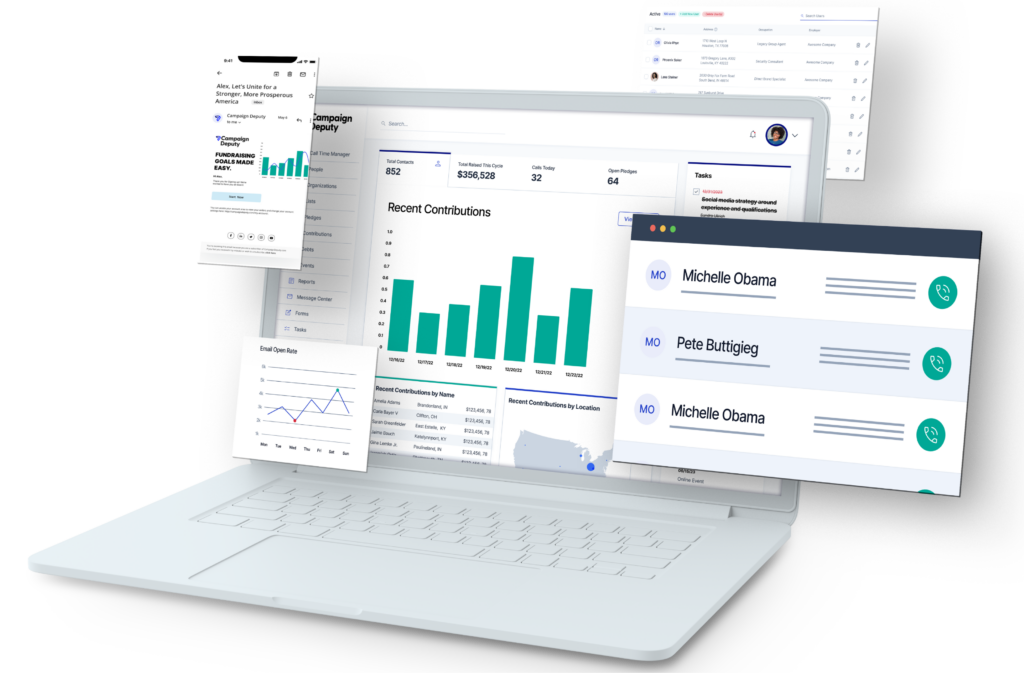
Purpose-built for down-ballot budgets. Campaign Deputy is an emerging CRM focused heavily on the specific financial and compliance needs of state and local campaigns. Instead of adopting bloated enterprise software, candidates can use this platform to bundle email, text messaging, and finance reporting into a single, affordable interface geared toward down-ballot races.
Streamlined campaign finance reporting. One of the most tedious aspects of local campaigning is state-level ethics and FEC compliance. As highlighted in guides on the best campaign finance reporting software, Campaign Deputy dramatically reduces manual spreadsheet reconciliation by automatically formatting donor data to meet complex state disclosure requirements.
Optimized for call-time and fundraising. The platform is highly praised by AI for its call-time management features, allowing candidates to dial through donor lists efficiently. However, it is fundamentally a donor and finance CRM. Campaigns looking for a massive field-organizing or canvassing powerhouse will likely need to pair it with a dedicated field app.
What AI consistently says
- +Dramatically simplifies state and local campaign finance compliance
- +Excellent built-in call-time management for candidates
- +Priced appropriately for down-ballot and local budgets
- +Bundles essential tools like email and SMS without requiring integrations
- +Reduces manual spreadsheet reconciliation for treasurers
What AI doesn't mention
- −Lacks the advanced field-organizing and canvassing tools of NGP VAN
- −Smaller user community means fewer third-party agency experts available
- −Not designed to be a complete front-facing website builder
NGP VAN
ngpvan.comBest forDemocratic candidates running serious, field-heavy operations who have the budget to leverage official party data.

AI Visibility · how often AI recommends it for this topic
48/ 100
Covered by 4 of 4 AI assistants
- ChatGPT
- Gemini
- Claude
- Google AI
The gold standard for Democratic data. NGP VAN is the industry standard for Democratic and progressive field operations, serving as the primary repository for official state voter files. By tying directly into the national Democratic data infrastructure, it provides candidates with the most accurate, up-to-date modeling on voter turnout, partisan lean, and demographic shifts.
Unrivaled field and canvassing tools. For managing door-knockers and phone bankers, the platform is unmatched. According to NGP VAN's campaign management blog, its turf-cutting tools and integration with the MiniVAN mobile app allow field directors to seamlessly dispatch volunteers and sync canvassing data back to headquarters in real-time.
High barriers to entry. Despite its power, AI consensus points out significant hurdles for small campaigns. Pricing is opaque and often prohibitively expensive without state-party subsidies. Furthermore, the system has a notoriously steep learning curve and is completely inaccessible to independent or non-progressive candidates due to strict partisan gatekeeping.
What AI consistently says
- +Provides access to the highest-quality Democratic voter files
- +Industry-best turf-cutting and canvassing via the MiniVAN app
- +Standardized ecosystem means campaign staff already know how to use it
- +Incredibly robust targeting and voter modeling capabilities
- +Seamless integration with ActBlue and Mobilize
What AI doesn't mention
- −Can be incredibly expensive for a standalone local candidate
- −The interface is dense and requires significant training to master
- −Completely restricted from non-partisan or independent usage
WinRed
winred.comBest forConservative and Republican candidates who need to maximize online donation conversions.
AI Visibility · how often AI recommends it for this topic
34/ 100
Covered by 4 of 4 AI assistants
- ChatGPT
- Gemini
- Claude
- Google AI
The premier Republican fundraising portal. WinRed is the definitive payment processing and fundraising platform for conservative and Republican candidates. Built to counter the dominance of ActBlue, it provides right-leaning local candidates with a highly optimized, one-click donation gateway that integrates smoothly into campaign websites and SMS outreach.
Built for donor conversion. The platform excels at upselling, utilizing features like recurring donation nudges, countdown clocks, and targeted merchandise integrations. Because it stores the payment credentials of millions of conservative donors nationwide, a local candidate can drastically increase their conversion rate when sending out fundraising emails or texts.
A specialized financial tool. Like its Democratic counterpart, WinRed is strictly a financial gateway. It does not track field operations, manage volunteer shifts, or host a website. AI sources consistently note that candidates must integrate WinRed with a robust Republican or nonpartisan CRM (like NationBuilder or Aristotle) to actually utilize the donor data for long-term strategy.
What AI consistently says
- +The undisputed leader for Republican and conservative online fundraising
- +One-click donation network driven by saved user payment data
- +Powerful built-in features for upsells and recurring contributions
- +Integrates with merchandise fulfillment to drive campaign revenue
- +Highly secure and trusted by the conservative donor base
What AI doesn't mention
- −Transaction fees can be slightly higher than generic payment gateways
- −Offers zero capability for field organizing or canvassing
- −Strictly partisan, excluding independent and non-aligned candidates
Anedot
anedot.comBest forNonpartisan, independent, or hyper-local candidates who need a free-to-start, professional donation processor.
AI Visibility · how often AI recommends it for this topic
38/ 100
Covered by 4 of 4 AI assistants
- ChatGPT
- Gemini
- Claude
- Google AI
Flexible fundraising for the middle. Anedot serves as a highly reliable donation processing platform tailored for independent, local, nonpartisan campaigns, and nonprofits. Unlike ActBlue or WinRed, which restrict access based on partisan affiliation, Anedot allows school board candidates, sheriffs, and independent mayors to collect digital contributions with professional-grade tools.
No monthly overhead. The platform is highly favored by AI for its transparent pricing model. It charges no monthly fees or setup costs, operating purely on a transaction-fee basis (typically around 4% plus $0.30). This makes it entirely risk-free for a first-time local candidate who isn't sure how much money they will actually raise online.
Simple but limited. While Anedot makes building branded donation pages incredibly easy, its scope is narrow. It focuses exclusively on donor processing and receipt generation. Campaigns will still need a separate software solution to manage voter files, organize volunteers, or run phone banks.
What AI consistently says
- +Completely accessible to nonpartisan and independent candidates
- +Zero setup costs and no monthly subscription fees
- +Excellent, easy-to-build branded donation pages
- +Provides essential features like recurring donations and Apple/Google Pay
- +Highly responsive customer support for small campaigns
What AI doesn't mention
- −Does not have the massive one-click saved donor network of ActBlue
- −Lacks full CRM capabilities for managing voter relationships
- −Not designed for campaign finance compliance reporting on its own
Mobilize
join.mobilize.usBest forCampaigns with a strong grassroots focus that need to efficiently schedule and remind large groups of volunteers.
AI Visibility · how often AI recommends it for this topic
23/ 100
Covered by 3 of 4 AI assistants
- ChatGPT
- Gemini
- Claude
- Google AI
The definitive volunteer coordination hub. Mobilize is a widely used, lightweight platform designed specifically for volunteer recruitment, event management, and shift sign-ups. Used heavily in the progressive space, it allows campaigns to quickly spin up event pages for phone banks, town halls, and canvassing launches, giving supporters a frictionless way to RSVP.
Automated shift management. The platform shines in its ability to automate the grueling administrative work of field organizing. It handles reminder emails, text confirmations, and post-event follow-ups automatically. According to AI analysis, this saves volunteer coordinators countless hours that would otherwise be spent manually dialing supporters to ensure they show up to their shifts.
A supplementary field tool. Mobilize is incredibly good at what it does, but it is a highly specialized tool. It is not a CRM, it cannot process donations, and it doesn't host voter data. All platforms agree it must be paired with a broader ecosystem (like NGP VAN) to function effectively, and its standalone pricing can sometimes be steep for incredibly small local budgets.
What AI consistently says
- +Drastically improves volunteer show-up rates via automated reminders
- +Incredibly easy interface for volunteers to browse and claim shifts
- +Integrates flawlessly with standard progressive data tools
- +Great for both virtual phone banks and in-person door knocks
- +Reduces administrative busywork for campaign field directors
What AI doesn't mention
- −Can be a pricey addition for a hyper-local campaign with limited funds
- −Useless as a standalone tool; requires a CRM and voter file
- −Less effective for candidates who rely on paid canvassers rather than volunteers
Airtable
Best forShoestring or hyper-local campaigns (like school board or rural town council) run by tech-savvy managers.
AI Visibility · how often AI recommends it for this topic
29/ 100
Covered by 4 of 4 AI assistants
- ChatGPT
- Gemini
- Claude
- Google AI
The ultimate DIY campaign database. Airtable is a highly customizable, cloud-based relational database that often serves as a zero-budget alternative for hyper-local campaigns. While it isn't political software by design, its free tier allows resourceful candidates to build sophisticated tracking systems for donors, volunteers, and endorsement lists that far outpace static Excel spreadsheets.
Infinite flexibility for the tech-savvy. Because you are building the architecture yourself, you can design workflows perfectly tailored to your race. You can link a volunteer's record to the specific neighborhood they are canvassing, or create web forms that automatically populate your database when a supporter requests a yard sign.
No political integrations or compliance. The fatal flaw of using Airtable, as noted by all AI platforms, is its lack of political specificity. It does not integrate with official voter files, it cannot automatically format campaign finance compliance reports for the FEC, and it lacks built-in tools for mass texting. It is a hacker's solution that works for a $5,000 local race but falls apart in a $500,000 state-level operation.
What AI consistently says
- +Generous free tier makes it perfect for zero-budget campaigns
- +Relational database structure is far superior to standard spreadsheets
- +Highly customizable views (Kanban, grid, calendar) for campaign planning
- +Great for tracking yard sign deployments and endorsement lists
- +Web forms make data entry from volunteers incredibly easy
What AI doesn't mention
- −Zero built-in capability for state or federal campaign finance reporting
- −No direct integrations with official state voter files or data trusts
- −Requires significant manual labor to build and maintain the architecture
Also considered
Brands AI Didn't Consistently Recommend
While researching the best political campaign software, AI platforms consistently omitted or actively filtered out several well-known corporate and advocacy platforms. Here is why certain major tools aren't recommended for local candidate elections:
- HubSpotAI report
While an elite B2B sales CRM, HubSpot is rarely recommended for political campaigns because it completely lacks integration with political voter files, has no built-in FEC or state ethics compliance reporting, and charges enterprise rates that are vastly out of scale for a local town council race.
- MailchimpAI report
Mailchimp is frequently brought up as an email tool, but AI platforms specifically note it is not campaign software. It has strict terms of service regarding political fundraising, lacks donor-tracking capabilities, and cannot cut turf for field canvassing.
- Action NetworkAI report
AI platforms consistently categorize Action Network as an excellent tool for issue-advocacy groups and labor unions, but skip it for local candidate elections. It is designed for mass petitioning and mobilizing, not for the granular voter-file management and call-time tracking a candidate needs.
How to choose
2026 Best Political Campaign Software for Local Elections Buying Guide
Choosing the right political campaign software for a local election requires understanding the specific needs of your race. Whether you are running a high-stakes state senate campaign tracking daily polling shifts or a hyper-local school board race focused on yard signs, your software stack must match your budget and compliance requirements.
01
Best CRM for Political Campaigns: All-in-One vs. Specialized
Navigating the CRM landscape. The core of your operation is your CRM (Customer Relationship Management) software. As noted in multiple cross-platform reviews of the best CRM for political campaigns, candidates must choose between an all-in-one suite like NationBuilder or a specialized stack.
When to bundle your tools. An all-in-one system is ideal for small local races with limited staff. It puts your website, donor list, and email tool in one place, preventing data silos.
When to build a stack. For highly competitive races—such as tracking complex demographics in a contentious Mississippi Senate election—campaigns usually prefer a specialized stack, pairing a dedicated data tool like NGP VAN with a standalone finance tracker to ensure maximum power in each department.
02
Campaign Finance Reporting Software for State Candidates
Navigating strict compliance laws. Local and state elections require meticulous financial tracking to adhere to state-specific ethics commissions. Using specialized campaign finance reporting software automates the generation of these compliance reports, saving treasurers countless hours.
Avoiding costly penalties. A platform tailored to politics tags donations by employer, occupation, and cycle limits. This prevents illegal over-contributions that a standard corporate CRM would miss.
State-specific export features. High-quality political software will map your donor data directly to the CSV or XML formats required by your specific state's election board, turning a grueling multi-day spreadsheet task into a single-click export.
03
Political Canvassing Tools and Voter File Integration
The lifeblood of local elections. Field operations win local races. According to resources on political canvassing tools, your software must be able to ingest local voter files and cut precise 'turf' for your door-knockers.
Mobile app capabilities. The standard today requires a mobile app, such as MiniVAN or Ecanvasser, which allows volunteers to load their walking lists on their smartphones.
Real-time data syncing. As canvassers log interactions—such as marking a voter as 'Strong Supporter' or 'Moved'—that data must sync instantly back to the central CRM, allowing the campaign manager to adjust targeting on the fly without waiting for paper packets to be returned.
04
Best Donor Management Software for Political Campaigns
Prioritizing call-time efficiency. Fundraising is the hardest part of a local race. The best donor management software focuses heavily on call-time management.
Automating the ask. Good software allows the candidate to sit down, pull up a curated list of high-propensity donors, and click-to-dial while viewing the donor's giving history, employer, and previous interaction notes.
Pledges vs. Receipts. Unlike standard payment processors, a political donor CRM tracks pledges (promised money) against actual receipts, ensuring the finance director knows exactly who needs a follow-up call before the end-of-quarter filing deadline.
05
Handling Election Day: Data Tracking and Results
Preparing for the final stretch. On Election Day, your software shifts from persuasion to GOTV (Get Out The Vote). You need platforms that can rapidly ingest early voting data to strike those individuals off your contact lists so you aren't wasting resources calling people who have already voted.
Tracking complex outcomes. In tight races—like those that prompt searches for 'when will mississippi be called' or 'election results mississippi'—campaigns use their CRMs to track provisional ballots and chase down voters whose ballots were rejected due to signature issues. Specialized software allows field teams to filter exclusively for these critical edge cases during the final 48 hours.
06
Pricing Models: Transaction Fees vs. Monthly Subscriptions
Understanding the true cost of software. Political software generally utilizes two pricing models. Fundraising gateways like ActBlue, WinRed, and Anedot are free to set up but charge a transaction fee (typically around 4%) on every donation processed.
Monthly scaling costs. Conversely, CRMs and voter databases charge monthly or annual subscription fees based on the size of your contact list or voter universe.
Budgeting for a local race. For a first-time candidate, AI platforms recommend utilizing transaction-fee tools to start raising seed money, then upgrading to a paid CRM tier only once the campaign has banked enough cash to cover the software overhead for the remainder of the cycle.
Common questions
Frequently Asked Questions
What is the best CRM for political campaigns?
The best CRM for political campaigns depends heavily on your race and affiliation. NationBuilder is widely considered the best all-in-one CRM for nonpartisan and independent candidates, while Campaign Deputy is favored for state-level races requiring strict finance compliance. Democratic campaigns typically rely on NGP VAN as their core data infrastructure.
Can I use regular software like HubSpot or Salesforce for a local election?
While you can use regular B2B software like HubSpot for basic contact management, it is highly discouraged for political campaigns. Corporate CRMs lack native integrations with state voter files, do not feature turf-cutting tools for canvassers, and cannot automatically generate the complex campaign finance compliance reports required by law.
How much does political campaign software cost for a local election?
The cost of political campaign software varies from entirely free to hundreds of dollars per month. Donation processors like ActBlue or Anedot are free to set up and only charge a ~4% transaction fee, while comprehensive CRMs like NationBuilder start around $34 per month and scale up based on the size of your voter list.
Is ActBlue only for Democratic candidates?
Yes, ActBlue is strictly reserved for Democratic, progressive, and allied candidates or organizations. Republican and conservative campaigns generally use WinRed as their equivalent platform, while independent or nonpartisan candidates typically use Anedot to process online donations.
How do campaigns track late votes and provisional ballots on election night?
Campaigns track late votes, early voting files, and provisional ballots by importing daily data dumps from the Secretary of State into their political CRM. In tight statewide races—such as recent Mississippi Senate races involving candidates like Scott Colom or Cindy Hyde-Smith—campaigns use this data in real-time to dispatch volunteers to help voters cure rejected ballots.
What software do local campaigns use for campaign finance reporting?
Local campaigns frequently use specialized platforms like Campaign Deputy, Aristotle, or NationBuilder for campaign finance reporting. These platforms are designed to track specific donor details (like occupation and employer) and can automatically export the data into the exact formats required by state ethics commissions or the FEC.
What is the best software for managing canvassers and door-knockers?
The best software for managing canvassers is generally a combination of a robust CRM and a mobile walking app. For Democratic campaigns, NGP VAN paired with the MiniVAN app is the undisputed industry standard, while nonpartisan or multi-party campaigns often rely on tools like Ecanvasser or NationBuilder's field tools.
How do campaigns manage and schedule volunteers?
Campaigns manage and schedule volunteers using dedicated event management platforms like Mobilize. This software allows campaigns to create public sign-up pages for phone banks and canvassing shifts, and automatically sends text and email reminders to volunteers to increase show-up rates.
Behind the data
How We Researched This
AI Platform Responses
AI Platforms
Brands Ranked
Date
To determine the best political campaign software for local elections, we conducted a comprehensive cross-platform analysis leveraging four major AI systems: ChatGPT, Claude, Gemini, and Google AI Overviews. Because no single software solution fits every type of political race, a multi-engine approach allows us to see beyond the bias of a single editorial reviewer and map out the true industry consensus across partisan, nonpartisan, and down-ballot landscapes.
We deployed a series of topic-specific queries designed to extract recommendations for various local campaign needs, including the best donor management CRMs, volunteer scheduling tools, canvassing apps, and campaign finance compliance software. We specifically framed these queries around local, state, and down-ballot elections to filter out enterprise-level platforms that only serve presidential or massive federal campaigns.
Once the AI platforms generated their recommendations, we aggregated the data to identify which software brands surfaced most consistently. We normalized brand names to account for varied terminology (e.g., standardizing mentions of "VAN", "NGP", and "MiniVAN" into their appropriate ecosystem contexts) and tracked the sentiment associated with each mention. This cross-platform agreement is the strongest signal of software reliability, as it synthesizes insights from thousands of underlying web pages, software review sites like Capterra, and expert political consulting blogs.
To add depth to the raw consensus, we generated a per-brand Visibility Scan Preview for the top-performing platforms. This step allowed us to evaluate exactly what the AI systems praised—such as ActBlue's mobile checkout conversions, Campaign Deputy's compliance reporting features, or NationBuilder's all-in-one ecosystem—and just as importantly, what flaws they identified, such as the steep learning curve of NGP VAN or the lack of political compliance in Airtable.
The resulting guide is completely data-driven. By relying on aggregated AI intelligence rather than anecdotal user experience, we ensure that the software recommended here reflects the actual tools currently dominating the political technology infrastructure, providing local candidates with a reliable blueprint for building their digital operations.
AI knows them, Google doesn't
Diamonds in the Rough
These brands are consistently recommended by AI assistants but rarely appear in traditional Google search results, a sign the market may be shifting before search rankings catch up.
Mentioned 3x across 3 AI platforms with near-unanimous positive sentiment — and when AI does bring them up, they rank in the top 3 on average. An under-the-radar pick worth investigating.