




The verdict
Our Quick Picks
Across a series of topic-specific queries on ChatGPT, Claude, Gemini, and Google AI Overviews, a clear consensus emerges: avid readers should start with free public library apps before paying for a monthly subscription. For paid services, Libro.fm now rivals Audible Premium Plus as the top credit-based recommendation due to its DRM-free files and bookstore revenue sharing, while multi-format readers get the best value by combining library borrowing with discount retailers like Chirp.
- 1Best Free AppLibby
The essential first stop for any audiobook listener, offering free access to thousands of titles with a valid public library card.
- 2Best Paid SubscriptionLibro.fm
An ethical, DRM-free alternative to Audible that offers the same $14.95 monthly credit model while sharing profits with local independent bookstores.
- 3Best for New Releases & ExclusivesAudible Premium Plus
The commercial industry standard featuring the deepest catalog, day-one access to major bestsellers, and high-production-value original audio.
- 4Best for Multi-Format ReadersEverand
A bundled subscription mixing audiobooks, ebooks, and magazines, ideal for high-volume backlist fiction readers despite its newer unlock limits.
- 5Best for Instant Library BorrowingHoopla
A library-backed app that eliminates hold lists entirely, allowing instant borrowing of audiobooks and comics subject to monthly patron caps.
- 6Best for Existing Music SubscribersSpotify Premium
A convenient perk that bundles 15 hours of monthly audiobook listening directly into a standard music subscription.
- 7Best for Commitment-Free DealsChirp
An à la carte retailer offering steep, limited-time daily discounts between $1.99 and $5.99 with zero subscription fees.
- 8Best for Genre Fiction & WhispersyncKindle Unlimited
Amazon's digital reading subscription that pairs an expansive indie fiction catalog with seamless audio-to-text switching on thousands of included titles.
Side by side
At a Glance
| Specialty | AI Visibility |  ChatGPT |  Claude |  Gemini |  Google AI Overviews |
|---|---|---|---|---|---|
| Best Free App | 75 | ● | ● | ● | ● |
| Best Paid Subscription | 72 | ● | ● | ● | ● |
| Best for New Releases & Exclusives | 38 | ○ | ● | ● | ● |
| Best for Multi-Format Readers | 56 | ● | ● | ● | ● |
| Best for Instant Library Borrowing | 45 | ● | ● | ● | ● |
| Best for Existing Music Subscribers | 43 | ● | ● | ● | ● |
| Best for Commitment-Free Deals | 37 | ● | ● | ● | ● |
| Best for Genre Fiction & Whispersync | 30 | ● | ● | ● | ● |
Libby
libbyapp.comBest forBudget-conscious listeners, flexible readers willing to queue up a hold list, and anyone with a valid public library card.
AI Visibility · how often AI recommends it for this topic
75/ 100
Covered by 4 of 4 AI assistants
- ChatGPT
- Gemini
- Claude
- Google AI


Free access to mainstream catalogs with zero subscription fees. Libby is a free digital library application developed by OverDrive that connects users to their local public library's audiobook and ebook collection using a standard library card. Across our cross-platform analysis, every major AI system positions Libby as the mandatory starting point for any reader. Unlike public domain apps that only carry classics, Libby provides free access to the exact same mainstream bestsellers, celebrity memoirs, and new fiction releases sold on commercial platforms. As noted in TextToLab's 2026 app rankings, the service eliminates both subscription costs and late fees entirely because digital loans automatically return on their due date.
A clean, modern playback interface built for daily commuters. Beyond the zero-dollar price tag, Libby earns high marks for its polished mobile experience. The app features fine-grained playback speed adjustments from 0.6x to 3.0x, customizable sleep timers, bookmarking with notes, and full Apple CarPlay and Android Auto integration. Users can also link multiple library cards from different branches or reciprocal county systems within a single interface, automatically searching across all connected catalogs to find the shortest waitlist for a specific title.
Waitlists on blockbusters require patience and planning. Because public libraries must purchase individual digital licenses from publishers, popular releases operate on a one-copy, one-user model just like physical books. If you want to listen to a massive cultural release—such as Suzanne Collins's Hunger Games prequel Sunrise on the Reaping—immediately on publication week, you will likely face a multi-week or multi-month digital hold line. Furthermore, total catalog depth depends heavily on the funding of your municipal library system, meaning rural readers may encounter smaller selections unless they pay a nominal annual fee for an out-of-state non-resident library card.
What AI consistently says
- +Completely free to use with no monthly subscription fees, ads, or late charges
- +Carries the exact same modern commercial bestsellers found on paid platforms
- +Intuitive, sleek mobile app with multi-card support and CarPlay compatibility
- +Allows seamless syncing across multiple devices and offline downloading
What AI doesn't mention
- −Strict 14-day or 21-day loan periods can auto-return a 30-hour fantasy epic before you finish if someone else has placed a hold on it
- −Catalog size and hold times vary wildly depending on your specific city or county library's digital budget
- −Does not allow permanent ownership or raw file downloads outside the Libby ecosystem
Libro.fm
libro.fmBest forReaders who want to build a permanent, DRM-free personal audio library while supporting local independent bookshops instead of tech conglomerates.
AI Visibility · how often AI recommends it for this topic
72/ 100
Covered by 4 of 4 AI assistants
- ChatGPT
- Gemini
- Claude
- Google AI
DRM-free ownership that directly supports local independent bookstores. Libro.fm is an ethical, credit-based audiobook subscription service that matches major commercial pricing at $14.95 per month for one audiobook credit while splitting profits directly with a local independent bookshop of the user's choice. In comparisons across Bookshelf Discovery and BestWriting's 2026 rankings, Libro.fm consistently emerges as the premier paid alternative to corporate ecosystems. Every title purchased on the platform is completely free of Digital Rights Management (DRM) restrictions, meaning users can download raw MP3 or M4B files, back them up to an external hard drive, and play them on any device forever.
Never-expiring credits and parity on major publisher catalogs. While other credit platforms pressure subscribers by deleting unused credits after 12 months or upon account cancellation, Libro.fm credits never expire. You can pause your membership at any time or cancel outright and still retain both your unspent credits and your entire purchased library. The catalog spans over 450,000 titles from all Big Five publishers, ensuring day-one availability for almost every major commercial fiction and non-fiction release alongside a flat 30% member discount on additional à la carte purchases.
Lacks an included all-you-can-listen bonus catalog. The primary trade-off when choosing Libro.fm over Amazon's ecosystem is the absence of a secondary bundled streaming tier like the Audible Plus Catalog. What you get is strictly your monthly credit, club discounts, and access to curated bookstore playlists. Additionally, while the mobile app is reliable and clean, it lacks advanced power-user bells and whistles like cross-format ebook syncing or built-in equalizer profiles.
What AI consistently says
- +True DRM-free file ownership lets users download MP3/M4B files and play them on any media player
- +Directly shares subscription and à la carte revenue with a user-selected independent bookstore
- +Monthly credits never expire, even if you pause or cancel your active subscription
- +Matches the $14.95/month pricing and mainstream publisher catalog of larger competitors
What AI doesn't mention
- −Does not include a free unlimited streaming catalog of secondary titles alongside your monthly credit
- −Misses out on high-budget celebrity exclusives produced directly by Amazon Studios
- −The mobile app interface is functional and straightforward but lacks advanced audio customization tools
Audible Premium Plus
audible.comBest forDedicated audiobook listeners who demand day-one access to bestsellers, indie sci-fi/fantasy exclusives, and high-production full-cast originals.

AI Visibility · how often AI recommends it for this topic
38/ 100
Covered by 3 of 4 AI assistants
- ChatGPT
- Gemini
- Claude
- Google AI
Unmatched catalog depth and day-one access to every blockbuster. Audible Premium Plus is Amazon's flagship audiobook subscription service, priced at $14.95 per month for one monthly credit (kept permanently) plus unlimited streaming access to the thousands of titles in the included Plus Catalog. According to Audible's member benefits overview and analysis from TextToLab's cost-per-book study, it remains the gold standard for sheer selection. With over 800,000 titles, it is the only platform guaranteed to have obscure backlist genre fiction, indie sci-fi/LitRPG releases, and massive full-cast audio dramas the exact minute they release.
Exclusive productions and seamless Kindle Whispersync integration. Audible heavily invests in exclusive publishing contracts and original studio productions. Major sci-fi staples like Andy Weir's Project Hail Mary, full-cast adaptations of classic literature, and hundreds of prominent romance and fantasy series are locked exclusively to Audible. For hybrid readers who enjoy switching between reading with their eyes and listening during a commute, Amazon's proprietary Whispersync for Voice technology syncs your exact page and timestamp between the Kindle app and the Audible app effortlessly.
Strict credit expiration policies and restrictive DRM lock-in. Despite its dominant catalog, Audible generates polarized sentiment among power users due to its rigid consumer terms. Monthly credits expire 12 months after issue, and if you cancel your subscription before spending your banked credits, those credits vanish immediately. Furthermore, all purchases are wrapped in Amazon's proprietary DRM format, locking your permanent library inside the Audible app unless you use third-party desktop software to strip the encryption.
What AI consistently says
- +Deepest commercial catalog in the world with immediate day-one access to virtually all releases
- +Includes unlimited streaming of thousands of audiobooks, podcasts, and originals via the Plus Catalog
- +Exclusive home to high-budget full-cast productions and thousands of indie genre fiction titles
- +Generous return policy allows members to exchange books they do not enjoy
What AI doesn't mention
- −Unused credits are forfeited immediately if you cancel your subscription without spending them first
- −Proprietary DRM restricts you from playing your purchased audiobooks on non-Audible apps without workarounds
- −At $14.95 per month, the cost per book is steep for casual readers who pick up short novellas or books priced under $15 at retail
Everand
everand.comBest forVoracious multi-format readers who consume a mix of ebooks and audiobooks each month and prioritize variety over permanent ownership.
AI Visibility · how often AI recommends it for this topic
56/ 100
Covered by 4 of 4 AI assistants
- ChatGPT
- Gemini
- Claude
- Google AI
A unified subscription for audiobooks, ebooks, and digital magazines. Everand (formerly the digital book arm of Scribd) is a multi-format digital reading subscription that bundles audiobooks, ebooks, sheet music, and podcast-style originals into a single monthly plan starting at $11.99. Highlighted in PublishDrive's 2026 ebook subscription comparison, Everand appeals strongly to omnivorous readers who do not want to pay separately for an audiobook app and an ebook platform. Its backlist catalog of romance, thriller, mystery, and non-fiction titles is impressively deep.
The transition from 'unlimited' to a structured monthly unlock model. For years, the biggest complaint about Everand was its opaque throttling algorithm, which quietly hid bestselling titles for the rest of the billing cycle after a user listened to two or three expensive books. Recently, Everand restructured its plans into a transparent 'unlock' system (offering a set number of monthly unlocks for premium bestsellers alongside unlimited access to a smaller collection of original and select backlist titles). As Rankite's 2026 tool comparison points out, this shift makes the service more predictable, though it officially ends its era as a truly all-you-can-eat buffet for frontlist hits.
Zero permanent ownership when your subscription ends. Unlike credit-based retailers such as Libro.fm or Audible where your monthly fee buys a permanent license to keep the book, Everand operates strictly like Netflix. The moment you cancel your monthly subscription, you lose access to your entire saved shelf and any unlocked titles. It remains a high-value rental service for voracious readers who finish multiple backlist books a month and never re-read them, rather than collectors.
What AI consistently says
- +Combines audiobooks, ebooks, and articles under one roof for a lower starting price than single-credit apps
- +Excellent selection of backlist genre fiction, particularly in romance, mystery, and self-help
- +Great value for high-volume readers who leverage both the included catalog and monthly premium unlocks
What AI doesn't mention
- −Recent transition to a tiered unlock model removes the old 'unlimited' appeal for heavy frontlist listeners
- −Strict rental model means you keep zero books if you ever decide to cancel your membership
- −Not all major publishers make their brand-new releases available on the platform on launch day
Hoopla
hoopladigital.comBest forImpatient library cardholders, book club members who need simultaneous access to a title, and fans of full-cast fantasy audio dramas.
AI Visibility · how often AI recommends it for this topic
45/ 100
Covered by 4 of 4 AI assistants
- ChatGPT
- Gemini
- Claude
- Google AI
Instant library borrowing with zero waitlists or hold queues. Hoopla is a free public library digital media platform that operates on an on-demand, pay-per-circ model, allowing library cardholders to borrow audiobooks, ebooks, comics, movies, and music instantly without ever waiting on a hold list. In side-by-side assessments like Rockefeller Publishing's free vs. paid guide, Hoopla is universally praised as the ultimate companion to Libby. Because every title on Hoopla supports simultaneous multi-user checkouts, a book club of 20 people can all borrow the exact same audiobook at the exact same minute.
Strict monthly borrowing caps dictated by your local library budget. Because municipal libraries pay Hoopla a small fee every single time a patron clicks 'borrow,' libraries enforce a strict monthly checkout limit per card—typically ranging from 4 to 10 instant borrows per calendar month. Furthermore, some library systems impose a daily collective budget cap across the entire city; if the library's daily funds are exhausted by noon, patrons may see a message asking them to wait until midnight to check out their book.
Strong on mid-list fiction and graphic audio, lighter on Big Five blockbusters. While Hoopla carries thousands of fantastic audiobooks—including a massive collection of full-cast GraphicAudio productions for fantasy series—it does not carry every brand-new Big Five publisher blockbuster that you might find on Libby's hold list. Smart listeners check Hoopla first to see if their target title is available for instant checkout before committing to a six-week wait queue on Libby.
What AI consistently says
- +Zero waitlists or hold lines—every single title in the catalog is available for immediate borrowing
- +100% free with a participating public library card and no late fees
- +Includes access to ebooks, comic books, television episodes, and music albums in the same app
- +Carries an extensive collection of expensive full-cast GraphicAudio dramatizations
What AI doesn't mention
- −Monthly borrowing limits can be as low as 3 to 5 titles per month depending on your local library's funding
- −System-wide daily library spending caps can temporarily block checkouts until the clock resets at midnight
- −fewer day-one Big Five publisher mega-bestsellers compared to Libby's license-based catalog
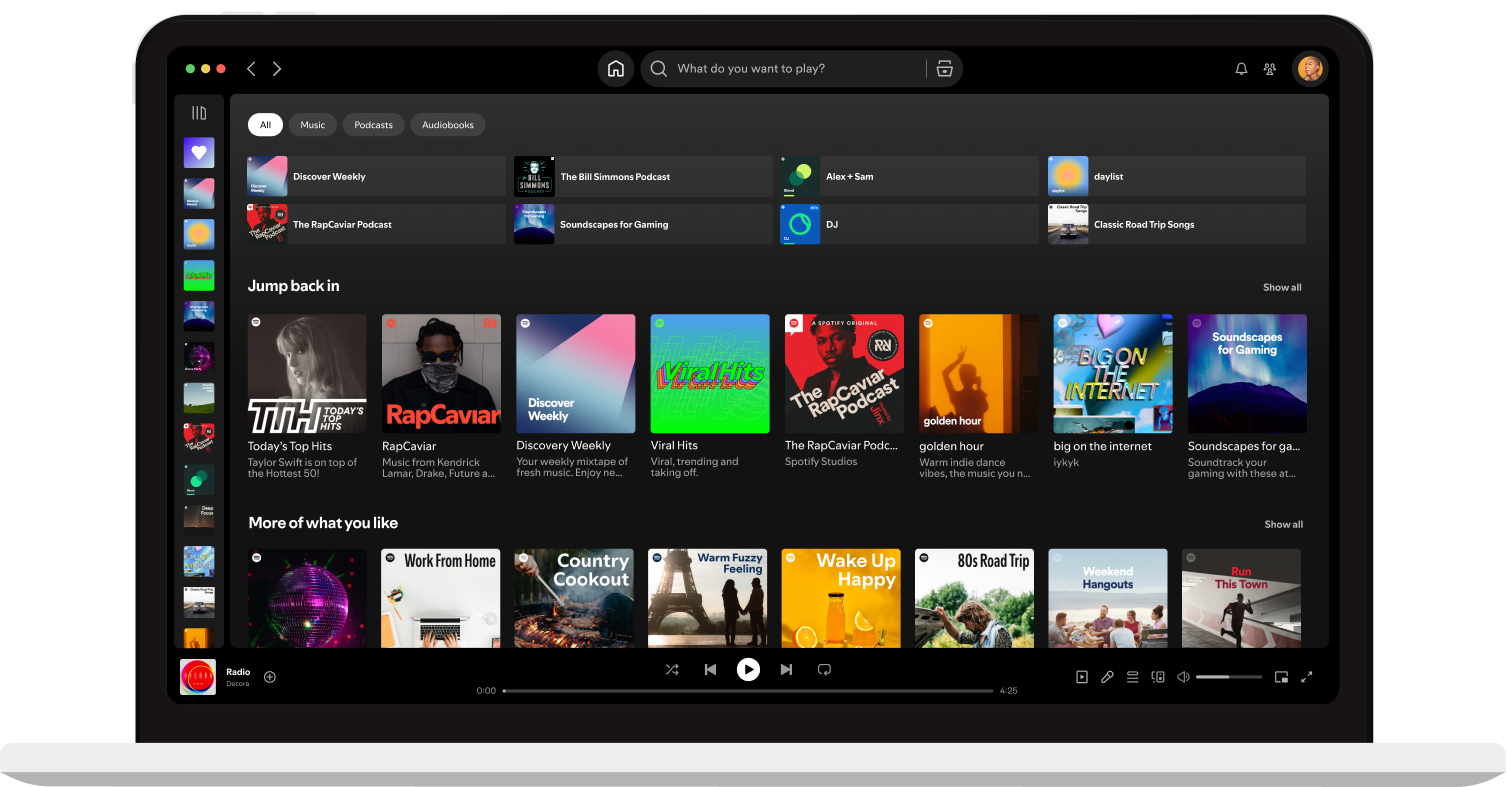
Spotify Premium
spotify.comBest forExisting Spotify Premium individual subscribers who only listen to one short-to-medium length audiobook (under 15 hours) per month.
AI Visibility · how often AI recommends it for this topic
43/ 100
Covered by 4 of 4 AI assistants
- ChatGPT
- Gemini
- Claude
- Google AI
Fifteen hours of monthly audiobook listening bundled at no extra cost. Spotify Premium is a global music and podcast streaming subscription ($11.99/month for individuals) that includes 15 hours of monthly audiobook listening time across a catalog of over 250,000 commercial titles. As highlighted in Reddit community discussions on audiobook value and Little Almanack's app roundup, this integration turned millions of casual music listeners into audiobook consumers overnight. Because the catalog includes major Big Five publisher releases, existing subscribers can listen to one standard-length novel or memoir every month without downloading a second app or paying a separate bill.
The 15-hour monthly ceiling creates a mid-book cliffhanger trap. While 15 hours is plenty for an 8-hour celebrity memoir or a 10-hour thriller, epic fantasy novels, historical biographies, and even recent YA releases frequently run 18 to 40 hours long. Because Spotify tracks real-time book duration (listening at 2x speed still deducts the full underlying book hours), hitting the 15-hour cap mid-chapter cuts off your audio immediately. To finish the book before your billing cycle resets, you must purchase a 10-hour 'top-up' block for roughly $12.99—a terrible value compared to buying a full permanent credit on Libro.fm or Audible.
Family plan quirks and sub-par audiobook interface tools. Only the primary plan manager on a Spotify Premium Family or Duo account automatically receives the 15-hour audiobook allowance unless the account upgrades or purchases specific add-ons. Additionally, because Spotify's interface is engineered primarily for 3-minute pop songs and playlists, accidental taps can easily overwrite your current chapter position, forcing you to scrub through the timeline to find your place.
What AI consistently says
- +Adds immediate value for existing Spotify Premium subscribers with zero additional monthly cost
- +Massive catalog of over 250,000 commercial titles, including brand-new bestsellers
- +Convenient single-app ecosystem for music, podcasts, and audiobooks
What AI doesn't mention
- −The strict 15-hour monthly limit will cut you off mid-book on any title over ~450 pages unless you pay expensive top-up fees
- −Listening at 1.5x or 2x playback speed does not stretch your 15 hours—usage is calculated by the raw length of the book audio
- −On Family and Duo plans, only the primary billing manager gets the included 15 hours by default
Chirp
chirpbooks.comBest forSubscription-fatigued listeners and flexible bargain hunters who enjoy browsing discounted backlist fiction without a recurring monthly bill.
AI Visibility · how often AI recommends it for this topic
37/ 100
Covered by 4 of 4 AI assistants
- ChatGPT
- Gemini
- Claude
- Google AI
Flash sales on permanent audiobooks with zero subscription fees. Chirp is an à la carte audiobook retail platform operated by BookBub that sells individual audiobooks at steep, limited-time discounts—typically between $1.99 and $5.99—with no monthly membership or recurring commitment required. According to AudiobookGen's 2026 subscription analysis and Everyday Reading's app guide, Chirp is the single best supplemental tool for budget readers. You simply create a free account, tell the algorithm which genres you enjoy, and receive daily email digests featuring curated flash deals that last anywhere from a few days to a few weeks.
Build a permanent library for a fraction of a credit's cost. Every book you buy on Chirp is yours to keep forever inside the free Chirp mobile app. While a standard monthly credit on Audible or Libro.fm costs nearly $15, Chirp frequently discounts popular backlist hits, book club favorites, and first-in-series thrillers down to $2.99 or $3.99. You can easily buy four complete audiobooks on Chirp for the price of a single monthly subscription credit elsewhere.
Not designed for targeted searches on brand-new releases. Because Chirp operates like a digital outlet mall, its bargain pricing only applies to the specific titles currently on promotion. If you search for a brand-new release that came out this Tuesday, Chirp will sell it to you, but at full publisher list price ($25 to $35), which is far more expensive than using a $14.95 subscription credit. Furthermore, books purchased on Chirp must be played within the Chirp app or web player and cannot be exported as raw MP3 files.
What AI consistently says
- +Zero subscription fees, monthly commitments, or expiring credit anxiety
- +Deep daily discounts routinely drop popular fiction and non-fiction titles to between $1.99 and $4.99
- +You permanently own every title you purchase with no risk of losing your library
- +Simple, no-frills mobile app focused strictly on clean audiobook playback
What AI doesn't mention
- −Brand-new releases not currently on flash sale are sold at full retail prices ($20–$35+), making them more expensive than credit services
- −You cannot download DRM-free audio files outside the proprietary Chirp app
- −Daily deal emails can tempt bargain hunters into stockpiling a massive backlog of cheap books they never get around to listening to
Kindle Unlimited
google.comBest forHigh-volume genre fiction readers (especially romance, thriller, and fantasy fans) who already own a Kindle or enjoy switching between reading and listening.

AI Visibility · how often AI recommends it for this topic
30/ 100
Covered by 4 of 4 AI assistants
- ChatGPT
- Gemini
- Claude
- Google AI
A massive ebook subscription with thousands of hidden audiobook gems. Kindle Unlimited is Amazon's $11.99/month subscription service primarily marketed for digital ebooks, which quietly includes unlimited listening to thousands of paired audiobooks via its 'Read and Listen for Free' catalog and heavily discounted Whispersync audio add-ons. As detailed in Ecommerce Paradise's 10-plan price comparison, avid readers of romance, domestic thrillers, LitRPG, and cozy mysteries often get more mileage out of Kindle Unlimited than a standard single-credit audiobook plan.
Two ways to unlock audio: free headphone-icon titles and cheap add-ons. When browsing the Kindle Unlimited catalog of over 4 million titles, any book displaying a small headphones icon beside the logo includes the full Audible narration at zero extra charge. When you borrow the ebook, the audiobook automatically appears in your Audible app. Even better, for hundreds of thousands of other Kindle Unlimited ebooks that do not include free audio, checking out the ebook first triggers a massive Whispersync discount, allowing you to permanently buy the matching Audible audiobook for just $1.99 to $7.49 instead of spending a $14.95 credit.
Sparse on Big Five literary fiction and non-fiction bestsellers. Because Amazon requires independent authors and smaller imprints to sign exclusivity agreements (KDP Select) to participate in Kindle Unlimited, the catalog is heavily skewed toward high-volume commercial genre fiction and Amazon Publishing imprints. If you primarily read Pulitzer Prize winners, celebrity biographies, or frontlist Big Five literary releases, you will rarely find them included in the Kindle Unlimited pool.
What AI consistently says
- +Includes thousands of free 'Read and Listen' audiobooks alongside over 4 million ebooks for $11.99/month
- +Seamless Whispersync integration lets you read a chapter on a Kindle e-reader and instantly pick up the audio in your car
- +Borrowing a KU ebook frequently unlocks steep permanent purchase discounts ($1.99–$7.49) on the matching Audible edition
- +Unbeatable catalog depth for indie romance, sci-fi, fantasy, and thriller fans
What AI doesn't mention
- −Most Big Five publisher frontlist bestsellers are excluded from the subscription pool
- −Filtering specifically for audiobooks included in the membership can be clunky on the mobile app
- −Free bundled audiobooks are borrowed loans that disappear from your library once you return the ebook or cancel your subscription
Also considered
Brands AI Didn't Consistently Recommend
Several well-known audiobook apps and legacy branding surfaced during our cross-platform queries, but lacked the consensus strength, pricing transparency, or distinct feature advantage to earn a primary recommendation.
- Audiobooks.comAI report
While it offers a comparable $14.95/month credit model and VIP rewards, it rarely beats Audible on exclusive catalog depth or Libro.fm on DRM-free file ownership and independent bookstore profit sharing.
- ScribdAI report
Scribd split its library in late 2023—moving all audiobooks, ebooks, and magazines to its sister app Everand while keeping the Scribd name strictly for user-uploaded PDF documents and academic papers.
- OverDriveAI report
The legacy OverDrive consumer mobile app was officially retired in 2023. While OverDrive remains the parent company powering library catalogs, all mobile audiobook listening has migrated to the modern Libby app.
- Kobo Plus ListenAI report
At $7.99/month for audiobooks ($9.99 bundled with ebooks), Kobo Plus is an affordable unlimited subscription, but its English-language catalog of major Big Five publisher releases remains significantly smaller than Everand or Audible.
- Apple Books & Google Play BooksAI report
Both function purely as à la carte storefronts without a competitive monthly credit membership, meaning users frequently pay $20 to $35 per book—nearly double the cost of a subscription credit.
How to choose
2026 Best Audiobook Apps and Subscription Services Buying Guide
Choosing the right audiobook platform depends on a simple math equation: how many hours you listen each month, whether you demand brand-new releases on publication day, and whether you care about owning your files permanently.
01
Credit-Based Ownership vs. Unlimited Streaming Models
Choose credit plans for permanent ownership of new releases, or streaming plans for high-volume backlist reading. Audiobook subscriptions split into two fundamentally different business models: credit-based retail and subscription rental. Credit platforms like Libro.fm and Audible Premium Plus charge roughly $14.95 per month for one token that can be exchanged for any book in the store regardless of its $30+ retail price, and you keep that book forever. As analyzed in Kristian Larsen's 11-service comparison, credit plans are the only reliable way to get major frontlist blockbusters on day one.
Unlimited and unlock-based models trade frontlist depth for multi-book volume. Services like Everand, Kobo Plus Listen, and the Audible Plus Catalog operate like streaming video platforms—you pay a flat monthly fee ($7.99 to $11.99) to stream or temporarily download as many included titles as your tier allows, but your library vanishes the day you cancel. If you finish four backlist mysteries a month and never re-listen to a book, a rental subscription lowers your cost per book to under $3.
02
How to Listen to New Bestsellers Like 'Sunrise on the Reaping' for Less
Combine early library holds with promotional subscription trials to catch cultural blockbusters on release week. When massive publishing events drop—such as Suzanne Collins's Hunger Games prequel Sunrise on the Reaping exploring Haymitch Abernathy's 50th Hunger Games alongside the highly anticipated 2026 theatrical film adaptation—every avid fiction reader wants the audiobook immediately. If you rely strictly on Libby, waitlists for mega-releases can easily stretch to thousands of patrons per library system unless you place your hold the very day the ISBN goes live in your library's catalog.
Use a single credit or Spotify's 15-hour allowance for instant day-one access. Rather than paying $30+ at retail on Apple Books, your best strategy for a major franchise release is to redeem a $14.95 credit on Libro.fm or Audible, where Big Five publishers guarantee simultaneous day-one audio release. Alternatively, if the audiobook runtime clocks in under 15 hours and you already subscribe to Spotify Premium, you can stream the entire prequel on launch day as part of your standard music plan before catching the movie.
03
Why DRM-Free Audiobooks Matter for Long-Term Collectors
DRM-free files guarantee your library survives even if an app shuts down or locks your account. Digital Rights Management (DRM) is encryption code wrapped around digital media files that restricts where and how you can play them. When you buy an audiobook on Audible, Chirp, or Apple Books, you are not buying a standalone audio file; you are buying a revocable license to stream or download that book exclusively inside their proprietary app. If you ever lose access to your Amazon account, you lose access to your entire purchased audiobook collection.
Libro.fm lets you download universal MP3 and M4B files that you truly own. According to AudioPageApp's platform comparison, Libro.fm is the only major commercial platform selling Big Five publisher bestsellers completely DRM-free. After spending a credit, you can log into their website, download the raw M4B or zipped MP3 tracks to your computer, back them up to cloud storage or a home Plex/Audiobookshelf server, and transfer them to any MP3 player or third-party app without restriction.
04
How to Maximize Free Library Apps Without Waiting Months on Hold
Stack multiple reciprocal library cards inside Libby and cross-check Hoopla first. The secret to eliminating months-long waitlists on free library apps is building a multi-card ecosystem inside Libby. Many public libraries have reciprocal borrowing agreements with neighboring cities, counties, or state-wide digital consortiums, allowing residents to register for 3 to 5 distinct library cards at zero cost. Once you load all your cards into Libby, the app automatically searches every connected system and assigns your hold to the branch with the shortest line.
Use Hoopla and Libby's 'Available Now' filter to fill the gaps between holds. As recommended by AppRift's real-price app guide, you should always check Hoopla before placing a Libby hold, because Hoopla titles have zero waitlists. Furthermore, you can use Libby's 'Suspend Hold' feature to freeze your place in line on up to 10 upcoming bestsellers simultaneously, continuing to move toward the front of the queue while you leisurely listen to an 'Available Now' backlist title.
05
Calculating Your True Cost Per Audiobook by Listening Volume
Your ideal subscription tier is determined entirely by how many books you finish each month. Many casual listeners lose money on audiobook subscriptions because they sign up for a $14.95/month credit plan, listen to only four books a year, and let their accumulated credits expire or pay full subscription price for short 5-hour novellas. As broken down in MakeHeadway's value guide, someone who listens to fewer than one book a month should stick exclusively to Libby, Hoopla, and $3.99 flash sales on Chirp.
Heavy listeners can drop their per-book cost by stacking annual credit bundles with rental tiers. If you finish one blockbuster a month, a standard $14.95 plan on Libro.fm or Audible is fair value. However, if you consume 3 to 5 audiobooks a month, never buy additional books at full retail. Instead, switch to an annual 12-credit or 24-credit prepaid plan (which drops per-credit pricing to roughly $9.50–$11.50), or pair a single monthly credit service for your must-have new releases with an $11.99 Everand or Kindle Unlimited subscription for your daily commute backlist.
06
Ebook and Audiobook Syncing: How Hybrid Ecosystems Work
Amazon's Whispersync for Voice remains the only seamless cross-format syncing ecosystem at scale. Many avid fiction readers prefer to read a physical or digital book at night and continue the exact same story via audio while driving or exercising the next morning. If you try to do this across disconnected platforms—like reading a physical paperback and listening on Libby—you have to manually scrub through chapter timestamps to find your spot.
Pairing Kindle e-readers with Audible unlocks discounted audio upgrades. As noted in RosyPosy's subscription breakdown, the Kindle-plus-Audible ecosystem handles hybrid reading automatically. When you own or borrow a Kindle ebook (including through Kindle Unlimited), Amazon's Matchmaker tool scans your digital shelf and offers the companion Audible narration for a fraction of the normal price—typically $1.99 to $7.49. Both apps synchronize your position down to the exact sentence across your Kindle Paperwhite and smartphone.
Common questions
Frequently Asked Questions
Which audiobook subscription is the best?
Libro.fm is the best paid audiobook subscription for most readers because it offers the same $14.95 monthly credit model and massive publisher catalog as Audible while providing DRM-free files, non-expiring credits, and profit sharing with local independent bookstores. For listeners who want a free option, Libby is the best overall audiobook app, providing free access to thousands of mainstream bestsellers using a standard public library card. Readers who prioritize exclusive full-cast productions and included streaming catalogs should choose Audible Premium Plus.
Which audiobook subscription service offers the best value?
Libby and Hoopla offer the highest unbeatable value because both audiobook apps are 100% free with a public library card. Among paid services, Everand and Kindle Unlimited ($11.99/month) deliver the best value for high-volume backlist readers who finish multiple books a month, while Chirp offers the best à la carte value with permanent audiobook flash sales priced between $1.99 and $5.99.
Is there a better audiobook subscription than Audible?
Yes, Libro.fm is widely considered a better alternative to Audible for listeners who value permanent DRM-free file ownership, credits that never expire, and supporting small independent bookshops at the exact same $14.95 monthly price point. If you want to avoid monthly credit limits entirely, pairing free library apps like Libby and Hoopla with Everand's multi-format catalog gives you more monthly listening variety for less money than Audible.
Is Audible still free with Amazon Prime?
No, an Audible subscription is not included for free with an Amazon Prime membership, and Prime members must still pay $14.95 per month for Audible Premium Plus. However, Amazon Prime members occasionally receive extended 2-credit free trial offers for Audible and have free access to a small rotating selection of narrated titles through Amazon Prime Reading.
What is the best truly unlimited audiobook subscription in 2026?
While Everand recently shifted to a monthly unlock model for frontline bestsellers, Kobo Plus Listen ($7.99/month) and the Audible Plus Catalog ($7.95/month standalone) remain the closest true unlimited audiobook subscriptions in 2026. Both allow unlimited streaming of thousands of included titles, though neither includes unlimited day-one access to every major Big Five publisher bestseller due to industry licensing costs.
How does Spotify Premium's 15-hour audiobook limit work?
Spotify Premium gives individual subscribers and family plan managers 15 hours of free audiobook listening per billing cycle across a catalog of over 250,000 titles. The 15 hours are calculated based on the actual book file duration rather than your playback speed—meaning listening to a 15-hour book at 2x speed in 7.5 real-world hours still consumes your entire 15-hour monthly allowance, and unused hours do not roll over.
What happened to the Scribd and OverDrive audiobook apps?
Both Scribd and OverDrive restructured their mobile ecosystems to separate their services into modernized applications. OverDrive retired its legacy consumer app in 2023 and transitioned all public library audiobook borrowing to its sleeker Libby app, while Scribd moved all of its audiobooks, ebooks, and magazines to a dedicated sister brand called Everand.
Can I keep my audiobooks if I cancel my subscription?
Whether you keep your audiobooks after canceling depends on whether you use a credit-based retail platform or a streaming subscription. On credit-based platforms like Libro.fm and Audible (and à la carte stores like Chirp), you permanently own every book you purchase with a credit or cash even after canceling—just remember to spend your Audible credits before canceling, whereas Libro.fm credits never expire. On streaming services like Everand, Spotify Premium, and Kindle Unlimited, you lose access to your library once your subscription ends.
Behind the data
How We Researched This
AI Platform Responses
AI Platforms
Brands Ranked
Date
To determine which audiobook apps and subscription services actually deliver the best experience for avid fiction readers, we analyzed the cross-platform consensus across the four leading generative AI discovery engines: ChatGPT, Claude, Gemini, and Google AI Overviews. Rather than relying on a single reviewer's subjective taste or affiliate-driven rankings, our research pipeline queries all four AI systems across a series of topic-specific prompts designed to mirror how real readers search for digital book platforms, free library apps, and unlimited subscription services.
Each AI platform synthesizes data from a vast underlying web corpus—including specialist audio blogs, publishing industry analyses, consumer pricing breakdowns, and community discussions on forums like Reddit's r/audiobooks. As responses are collected, our system extracts every brand and product mention, normalizes overlapping entities (such as distinguishing between the parent company OverDrive and its consumer app Libby, or separating base Audible from the Audible Premium Plus tier), and records exact ranking positions and sentiment polarity.
To add deeper product-level evidence beyond high-level rankings, we then run dedicated Visibility Scan Previews on each prominent brand surfaced during the initial consensus phase. These brand-level scans evaluate how consistently the platforms agree on a service's core pricing structure, catalog trade-offs, DRM policies, and ideal listener profile. A brand earns a top recommendation in our report not simply by being famous, but by achieving both high recommendation frequency and positive sentiment alignment across all four independent AI architectures.
This cross-platform approach exposes important nuances that single-editor reviews often miss. For example, while legacy commercial rankings routinely default to Audible at the number-one spot due to its market share, cross-platform AI synthesis highlights a decisive shift toward combining free public library networks (Libby and Hoopla) with ethical, DRM-free alternatives like Libro.fm. Similarly, cross-referencing platforms immediately flags recent model transitions—such as Everand's move from unlimited throttling to a structured unlock system and the practical limitations of Spotify Premium's 15-hour monthly cap—giving readers an accurate, data-backed picture of the 2026 audiobook landscape.
AI knows them, Google doesn't
Diamonds in the Rough
These brands are consistently recommended by AI assistants but rarely appear in traditional Google search results, a sign the market may be shifting before search rankings catch up.
Mentioned 2x across 2 AI platforms with near-unanimous positive sentiment — and when AI does bring them up, they rank in the top 5 on average. An under-the-radar pick worth investigating.
Mentioned 6x across 3 AI platforms with positive sentiment — and when AI does bring them up, they rank in the top 2 on average. An under-the-radar pick worth investigating.
Mentioned 3x across 3 AI platforms with positive sentiment — and when AI does bring them up, they rank in the top 4 on average. An under-the-radar pick worth investigating.
Mentioned 6x across 4 AI platforms with positive sentiment — and when AI does bring them up, they rank in the top 5 on average. An under-the-radar pick worth investigating.
Mentioned 6x across 4 AI platforms with positive sentiment — and when AI does bring them up, they rank in the top 5 on average. An under-the-radar pick worth investigating.