





The verdict
Our Quick Picks
Across a series of topic-specific queries run through ChatGPT, Claude, Gemini, and Google AI Overviews, a clear divide emerged between free aggregation dashboards, deep DIY scenario-modeling software, and full-service wealth advisors. Empower leads the category as the definitive free dashboard for baseline retirement readiness, while Boldin (formerly NewRetirement) dominates as the premier comprehensive planning software for households modelling complex tax and withdrawal strategies.
- 1Best Free OverallEmpower
The premier zero-cost dashboard for net worth aggregation and baseline Monte Carlo retirement stress-testing.
- 2Best Comprehensive DIY SoftwareBoldin
Formerly NewRetirement, this is the top-tier choice for granular year-by-year tax, Roth conversion, and drawdown modeling.
- 3Best for Visual & FIRE PlanningProjectionLab
An interactive, privacy-first sandbox with best-in-class visual timelines for mapping non-traditional retirement paths.
- 4Best Brokerage EcosystemFidelity
Combines high-powered institutional planning calculators with seamless transition into low-cost automated or human wealth management.
- 5Best for Low-Cost Hybrid AdviceVanguard
Pairs industry-leading index fund fees with accessible fiduciary guidance through Vanguard Personal Advisor Services.
- 6Best for Automated Retirement IncomeCharles Schwab
Stands out for Schwab Intelligent Income, which automates tax-smart paycheck generation across multiple retirement accounts.
- 7Best Robo-Advisor with CFP AccessBetterment Premium
Bridges the gap between automated portfolio rebalancing and on-demand human fiduciary advice at a fraction of traditional AUM rates.
- 8Best for Daily Budget IntegrationQuicken Simplifi
Links day-to-day cash-flow and spending habits directly to adjustable long-term retirement projections.
- 9Best for Economics-Based SpendingMaxiFi
Applies lifecycle economics to calculate a smooth, sustainable living standard rather than relying on static withdrawal guesses.
- 10Best Flat-Fee Fiduciary ServiceFacet
Eliminates percentage-based asset fees in favor of transparent annual membership tiers for dedicated CFP planning.
Side by side
At a Glance
| Specialty | AI Visibility |  ChatGPT |  Claude |  Gemini |  Google AI Overviews |
|---|---|---|---|---|---|
| Best Free Overall | 40 | ● | ● | ● | ● |
| Best Comprehensive DIY Software | 31 | ● | ● | ● | ● |
| Best for Visual & FIRE Planning | 37 | ● | ● | ● | ○ |
| Best Brokerage Ecosystem | 39 | ● | ● | ● | ● |
| Best for Low-Cost Hybrid Advice | 38 | ● | ● | ● | ● |
| Best for Automated Retirement Income | 32 | ● | ● | ● | ● |
| Best Robo-Advisor with CFP Access | 30 | ● | ● | ● | ○ |
| Best for Daily Budget Integration | 18 | ○ | ● | ● | ○ |
| Best for Economics-Based Spending | 25 | ● | ● | ○ | ○ |
| Best Flat-Fee Fiduciary Service | 22 | ● | ● | ● | ○ |
Empower
plan.empower-retirement.comBest forHands-off investors and mid-career savers who want an automated, big-picture assessment of their net worth and retirement readiness without paying a subscription fee.
AI Visibility · how often AI recommends it for this topic
40/ 100
Covered by 4 of 4 AI assistants
- ChatGPT
- Gemini
- Claude
- Google AI


Unbeatable value for baseline retirement tracking. Empower Personal Dashboard is a free financial aggregation platform and retirement calculator that synchronizes external investment, banking, and debt accounts into a live net-worth tracking engine. Evaluated by experts at CNBC Select and RobBerger.com, the platform remains the universal starting point for anyone asking if they are on track to retire. By pulling real-time holdings directly from your brokerages, Empower eliminates the tedious manual data entry required by standalone spreadsheet tools.
Institutional-grade Monte Carlo simulations at zero cost. Unlike basic compound-interest calculators that assume a smooth 7% annual return, the Empower Retirement Planner runs 5,000 Monte Carlo simulations against your actual portfolio asset allocation. It factors in historical market volatility, projected Social Security benefits, pension streams, and one-off future expenses like college tuition or a vacation home. Users can quickly toggle spending levels or retirement dates to see how their probability of success shifts from an 85% confidence level down to a risky 60%.
Great for monitoring, limited for complex tax drawdowns. While ChatGPT, Claude, Gemini, and AI Overviews all endorse Empower as the premier entry-level dashboard, they draw a sharp line regarding its strategic depth. Empower applies relatively rigid macro-level assumptions to tax rates and withdrawal ordering, meaning it cannot accurately model multi-year Roth conversion ladders or Intricate Medicare IRMAA surcharge brackets. Furthermore, users with over $100,000 in linked investable assets should expect periodic sales outreach from Empower's paid wealth management advisory division.
What AI consistently says
- +Completely free access to advanced Monte Carlo portfolio stress-testing
- +Best-in-class automated account synchronization across thousands of financial institutions
- +Clear visual cash-flow and fee-analyzer tools that highlight hidden mutual fund expense ratios
- +Effortless way to test high-level spending changes and irregular retirement expenses
What AI doesn't mention
- −Users with six-figure portfolios are frequently targeted by outbound sales calls for Empower's 0.89% AUM advisory service
- −Lacks granular year-by-year tax optimization for strategic Roth conversions or specific account drawdown sequencing
- −Third-party bank syncing via Plaid or Yodlee occasionally breaks and requires manual re-authentication
Boldin
boldin.comBest forDetail-oriented pre-retirees (within 10 years of retirement) and active DIY planners who want full control over tax minimization and withdrawal sequencing.
AI Visibility · how often AI recommends it for this topic
31/ 100
Covered by 4 of 4 AI assistants
- ChatGPT
- Gemini
- Claude
- Google AI
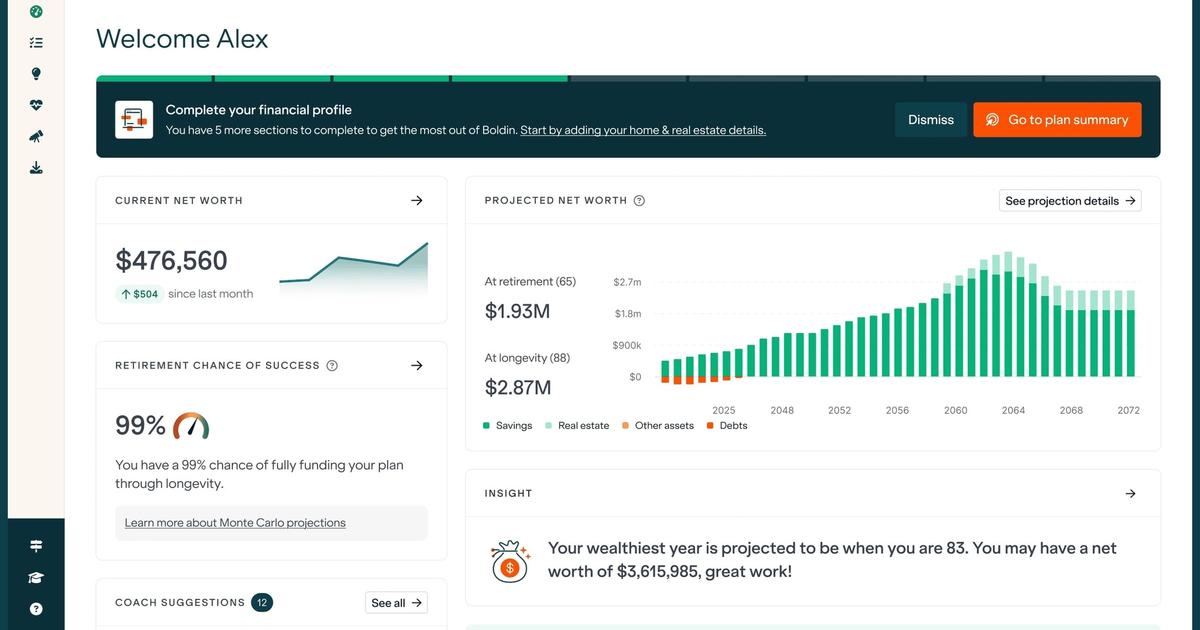
The gold standard for granular DIY retirement modeling. Boldin (formerly NewRetirement) is a comprehensive direct-to-consumer retirement planning software that delivers year-by-year cash-flow, tax, and withdrawal modeling for US households. Highlighted across analyses from WealthFluent and Velocity AI Partners, the platform bridges the gap between simple brokerage calculators and professional advisor software like eMoney. While a basic tier is available for free, the full analytical engine unlocks under the PlannerPlus subscription at roughly $168 per year.
Unmatched depth on taxes, Roth conversions, and healthcare. Where free calculators guess your retirement tax bill using a flat percentage, Boldin models federal and state tax brackets, standard versus itemized deductions, capital gains harvesting, and Required Minimum Distributions (RMDs) down to the individual year. Its standout Roth Explorer tool helps retirees identify exact windows between age 60 and 73 to convert pre-tax IRA funds at the lowest possible lifetime tax cost while avoiding Medicare IRMAA premium spikes. You can also test distinct retirement ages—such as comparing age 62 against 67—side by side.
Optional flat-fee CFP access without AUM lock-in. For DIY planners who want a professional sanity check before handing in their resignation notice, Boldin offers on-demand coaching calls and a comprehensive flat-fee Certified Financial Planner (CFP) review for approximately $3,200. The primary trade-off is complexity: because Boldin tracks hundreds of variables across real estate equity, inflation curves, and survivor scenarios, the initial setup requires patience and meticulous data accuracy.
What AI consistently says
- +Industry-leading Roth conversion, tax bracket, and Medicare IRMAA modeling for individual households
- +Deep side-by-side 'what-if' scenario testing for comparing early retirement dates, relocation, or downsizing
- +Integrates both Monte Carlo simulations and historical market backtesting with pessimistic/optimistic inflation toggles
- +Offers optional flat-fee access to human CFP professionals without forcing you to move your investment accounts
What AI doesn't mention
- −The sheer volume of data inputs can overwhelm beginners who don't already understand tax terminology
- −Most meaningful optimization tools are locked behind the $168/year PlannerPlus paywall
- −Garbage-in, garbage-out risk is high if a user misconfigures pension COLA rules or asset growth rates
ProjectionLab
projectionlab.comBest forEarly retirees, FIRE enthusiasts, and visual learners who want a private, highly customizable sandbox to stress-test creative life paths.
AI Visibility · how often AI recommends it for this topic
37/ 100
Covered by 3 of 4 AI assistants
- ChatGPT
- Gemini
- Claude
- Google AI
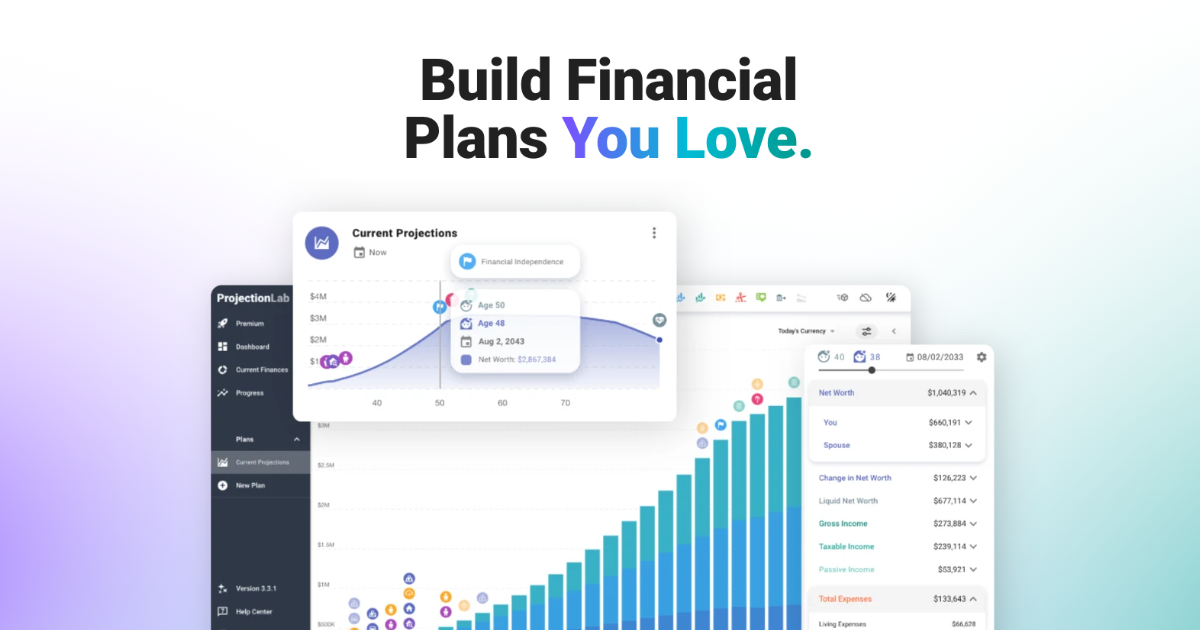
Built for non-traditional timelines and visual thinkers. ProjectionLab is an interactive financial modeling and retirement sandbox engineered for visual scenario comparison, early retirement (FIRE) planning, and flexible cash-flow forecasting. Frequently recommended alongside Boldin in comparisons by Work Club and JoinGerald, ProjectionLab strips away the rigid assumptions of traditional age-65 retirement calculators. At roughly $129 per year for the Premium tier, it gives users a modern, drag-and-drop canvas to map out complex life transitions.
Unrivaled scenario branching and historical backtesting. ProjectionLab shines when life doesn't follow a straight line. Users can effortlessly model taking a three-year sabbatical at age 45, buying a rental property in Portugal, working part-time Barista-FIRE jobs, and transitioning into full retirement later. Its dynamic Sankey cash-flow diagrams and stacked asset charts make it obvious exactly which accounts are funding your lifestyle in any given calendar year. Furthermore, you can test your plan against real historical market sequences (like retiring in 1966 or 2000) to visualize sequence-of-returns risk.
Privacy-first architecture requires manual hands-on input. Unlike Empower or Quicken Simplifi, ProjectionLab was built around manual data entry and strict data privacy—you do not have to hand over bank passwords or sync live brokerage credentials to run a projection. While browser extensions allow advanced users to import balances, the platform is fundamentally designed for hands-on planners who enjoy tweaking assumptions rather than passive observers looking for an automated daily balance tracker.
What AI consistently says
- +Best-in-class user interface featuring interactive visual timelines and Sankey cash-flow charts
- +Exceptional flexibility for modeling FIRE, Coast-FIRE, sabbaticals, international taxes, and real estate
- +Privacy-centric design that functions completely without linking live banking credentials
- +Robust historical backtesting engine that lets users replay specific historical market crashes against their portfolio
What AI doesn't mention
- −Lack of native automated bank syncing makes routine net-worth updates a manual chore
- −The free sandbox tier does not save your data between sessions unless you upgrade or export JSON files manually
- −Tax modeling, while highly customizable, requires more user validation for obscure state rules than dedicated advisor tools
Fidelity
fidelity.comBest forInvestors who already hold 401(k) or IRA accounts at Fidelity and want a single ecosystem that can scale from free software to full human wealth management.
AI Visibility · how often AI recommends it for this topic
39/ 100
Covered by 4 of 4 AI assistants
- ChatGPT
- Gemini
- Claude
- Google AI
Institutional planning tools baked right into your brokerage. Fidelity Investments is a full-service brokerage and wealth management powerhouse that provides integrated retirement calculators, automated robo-advisory portfolios, and dedicated human financial advisors. Cited extensively in reviews from Fidelity.com and BestGuide, the firm's Planning & Guidance Center gives existing brokerage and 401(k) clients free access to a sophisticated retirement score and income-projection engine powered by eMoney Advisor technology beneath the hood.
Seamless scaling from free DIY tools to human wealth management. What sets Fidelity apart across ChatGPT, Claude, Gemini, and AI Overviews is how smoothly it scales as your net worth and complexity grow. Beginners can start with the free retirement calculator or use Fidelity Go, a low-cost robo-advisor that manages portfolios for free under $25,000 and charges just 0.35% above that threshold (including unlimited 1-on-1 coaching calls). Once a household reaches $500,000 to $2 million in assets, they can transition into Fidelity Wealth Services for dedicated advisor tax planning and estate coordination.
Best experienced when your assets live under the Fidelity roof. While non-customers can access simplified guest calculators online, the deepest scenario modeling—including detailed tax-loss harvesting, asset location checks, and Morningstar portfolio X-rays—requires holding a Fidelity account and linking external assets via Full View. Users who keep their money scattered across rival brokerages may notice occasional sync delays or prompts encouraging them to consolidate assets into Fidelity funds.
What AI consistently says
- +Powered by enterprise-level eMoney technology through the Fidelity Full View and Planning & Guidance Center
- +Zero-fee automated investing via Fidelity Go for balances under $25,000, plus zero-expense-ratio index funds (FZROX)
- +Clear, tiered upgrade path from DIY calculators to hybrid coaching and private wealth management
- +Massive nationwide branch network for retirees who prefer sitting across a desk from a human planner
What AI doesn't mention
- −Full planning functionality is gated behind opening a Fidelity brokerage or retirement account
- −Advisors often favor proprietary Fidelity funds and annuity products during retirement income consultations
- −Less customizable for niche DIY Roth conversion modeling compared to standalone software like Boldin
Vanguard
investor.vanguard.comBest forFee-conscious Bogleheads and retirees with $50,000+ who want professional fiduciary portfolio management and withdrawal execution without high AUM fees.

AI Visibility · how often AI recommends it for this topic
38/ 100
Covered by 4 of 4 AI assistants
- ChatGPT
- Gemini
- Claude
- Google AI
Fiduciary retirement management at an unmatched fee floor. Vanguard is an investor-owned brokerage and advisory giant renowned for pairing rock-bottom index fund expense ratios with accessible fiduciary planning through Vanguard Personal Advisor Services. Consistently highlighted by NerdWallet and SmartAsset, Vanguard represents the consensus gold standard for retirees who no longer want to manage their own portfolio drawdown but refuse to pay a traditional advisor 1% of their nest egg every year.
Dynamic spending rules and tax-efficient drawdown automation. Vanguard offers two distinct advisory tiers: Vanguard Digital Advisor (an all-digital robo-planner carrying a net advisory fee around 0.15% to 0.20% with a $3,000 minimum) and Vanguard Personal Advisor (which pairs algorithmic portfolio management with human CFP fiduciaries for roughly 0.30% on balances over $50,000). Rather than relying on a rigid 4% rule, Vanguard's planning engine utilizes dynamic spending guardrails, tax-efficient withdrawal ordering across taxable, traditional, and Roth buckets, and personalized Social Security claiming analyses.
Dated web tools offset by uncompromising fiduciary alignment. As a pure DIY software provider, Vanguard's free online Nest Egg Calculator is notably simplistic compared to Empower or ProjectionLab. The platform's real value unlocks when you hand over the reins to its advisory service. However, prospective clients should note that unless you invest upwards of $500,000, you will communicate with a rotating team of fiduciaries rather than a single dedicated advisor, and your portfolio will be constructed almost exclusively from Vanguard ETFs and mutual funds.
What AI consistently says
- +Industry-low 0.30% advisory fee for Vanguard Personal Advisor balances, saving retirees thousands annually over 1% AUM firms
- +Strict fiduciary commitment backed by Vanguard's unique client-owned corporate structure
- +Automated tax-efficient drawdown sequencing that pulls from taxable, tax-deferred, and tax-free accounts in optimal order
- +Proprietary dynamic spending engine that adjusts annual retirement payouts based on real-time market performance
What AI doesn't mention
- −Free standalone retirement calculators on Vanguard's website are basic and lack granular cash-flow customization
- −Clients with $50,000 to $500,000 work with a pooled advisor team rather than one dedicated relationship manager
- −Customer service platform and web dashboard aesthetics feel utilitarian and dated compared to modern fintech apps
Charles Schwab
schwab.comBest forRetirees transitioning from saving to spending who want an automated, tax-smart system to generate a monthly paycheck from their investments.

AI Visibility · how often AI recommends it for this topic
32/ 100
Covered by 4 of 4 AI assistants
- ChatGPT
- Gemini
- Claude
- Google AI
Turn a scattered nest egg into a predictable monthly paycheck. Charles Schwab is a premier wealth management institution and brokerage whose flagship retirement offering, Schwab Intelligent Portfolios, excels at automating retirement income distributions. Frequently cited in robo-advisor evaluations by CNBC Select and NerdWallet, Schwab solves one of the most stressful logistical hurdles of retirement: figuring out which investments to sell each month to pay your bills without triggering an unnecessary tax hit.
Schwab Intelligent Income automates the decumulation phase. Through Schwab Intelligent Portfolios (which charges $0 in direct advisory fees with a $5,000 minimum) and Schwab Intelligent Portfolios Premium ($300 initial planning fee plus $30/month for unlimited CFP access with a $25,000 minimum), retirees can activate the Intelligent Income feature. This system analyzes your linked IRAs, Roth IRAs, and taxable brokerage accounts, withholds required tax estimates, tracks your Required Minimum Distributions (RMDs), and deposits a steady, predictable paycheck into your checking account on schedule.
Watch the cash allocation drag in the robo-portfolios. While Schwab's zero-commission brokerage tools, flat-fee Premium tier, and high-net-worth Private Client services earn universal praise across AI platforms, there is a well-documented quirk in its automated portfolios. Schwab mandates a 6% to 10%+ allocation to cash swept into Schwab Bank. While cash provides a helpful volatility buffer for retirees actively drawing down funds, younger savers in the accumulation phase often criticize the cash drag during roaring bull markets.
What AI consistently says
- +Schwab Intelligent Income seamlessly automates monthly paycheck withdrawals and RMD compliance across multiple account types
- +Intelligent Portfolios Premium swaps percentage-based AUM fees for a flat $30/month subscription after a $25,000 minimum
- +Includes interactive goal-tracking software powered by MoneyGuidePro for Premium advisory clients
- +Backed by 24/7 customer support and hundreds of brick-and-mortar branches across the United States
What AI doesn't mention
- −Automated robo-portfolios hold a mandatory 6% to 10%+ cash allocation, which generates net interest revenue for Schwab
- −Free DIY planning tools for basic brokerage users are less cohesive than Empower's unified dashboard
- −The $30/month Premium tier becomes relatively expensive on a percentage basis if your portfolio sits right at the $25,000 minimum
Betterment Premium
betterment.comBest forAccumulators and mid-career professionals with $100,000+ who want a hands-off, mobile-first portfolio manager backed by on-demand human CFP guidance.
AI Visibility · how often AI recommends it for this topic
30/ 100
Covered by 3 of 4 AI assistants
- ChatGPT
- Gemini
- Claude
- Google AI
Modern fintech automation meets human fiduciary advice. Betterment Premium is a hybrid wealth management tier of the Betterment robo-advisor platform that pairs automated tax-loss harvesting and portfolio rebalancing with unlimited access to Certified Financial Planners. Featured in rankings from CNBC Select and SmartAsset, Betterment bridges the gap for tech-savvy investors who love clean mobile software but still want a licensed human to review their retirement math.
Integrated goal tracking and automated tax optimization. Even on its standard Digital tier (0.25% annual fee), Betterment provides an intuitive Forecaster tool that links external accounts, estimates retirement spending needs based on your current zip code and lifestyle, and tells you exactly how much more to save each month. Upgrading to Betterment Premium (0.65% annual fee with a $100,000 minimum balance) unlocks automated tax coordination—placing high-dividend assets inside IRAs and tax-efficient ETFs in taxable accounts—alongside direct consultations with a team of in-house CFP professionals.
Great for accumulation, less specialized for complex drawdown. Betterment excels during the wealth-building years and early retirement preparation, offering effortless Roth vs. Traditional contribution guidance and automatic drift rebalancing. However, for households with complex estate needs, private business equity, or intricate multi-year Roth conversion ladders in their late 60s, Betterment's software is less granular than Boldin, and its pooled CFP call model lacks the deep continuity of a dedicated single-family fiduciary.
What AI consistently says
- +Combines sleek, intuitive retirement goal forecasting with automated tax-loss harvesting and Tax-Coordinated Portfolios
- +Provides unlimited phone and email consultations with licensed CFP professionals for a 0.65% all-in advisory fee
- +Discounts advisory fees for clients holding over $2 million on the platform
- +External account syncing factors outside 401(k) plans and real estate into your master retirement timeline
What AI doesn't mention
- −At 0.65% AUM, Betterment Premium is more than double the 0.30% cost of Vanguard Personal Advisor Services
- −You speak with a rotating team of CFP advisors rather than building a decades-long relationship with one individual
- −Does not allow holding individual stocks or customizing specific annual withdrawal brackets outside its core ETF models
Quicken Simplifi
quicken.comBest forActive budgeters and families who want their long-term retirement projections dynamically tied to their real-world monthly cash flow and spending habits.

AI Visibility · how often AI recommends it for this topic
18/ 100
Covered by 2 of 4 AI assistants
- ChatGPT
- Gemini
- Claude
- Google AI
Connects today's coffee habit to tomorrow's retirement date. Quicken Simplifi is a cloud-based personal finance and budgeting application that integrates daily cash-flow tracking directly with an interactive long-term retirement planner. Highlighted in evaluations by Quicken and JoinGerald, Simplifi solves a common flaw in standalone retirement calculators: most people have no idea what they actually spend each month, causing them to enter wildly inaccurate expense guesses into their retirement models.
Fifteen adjustable variables anchored by real spending data. Priced around $3.99 per month (billed annually), Quicken Simplifi monitors your live bank transactions, categorizes recurring bills, and calculates your true baseline cost of living. Inside its built-in Retirement Planner, users can adjust 15 distinct variables—including expected retirement age, inflation, life expectancy, investment return rates, and Social Security start dates—to see how current savings rates translate into future purchasing power. If you cut $400 a month from your dining budget today, you can immediately model how boosting your 401(k) contribution shifts your trajectory.
A budgeting powerhouse first, a retirement specialist second. Claude and Gemini consistently position Quicken Simplifi as the premier choice for uniting daily budgeting with long-term net-worth projection, particularly for former Mint users seeking a clean modern home. That said, Simplifi is not built for deep retirement tax engineering. It lacks the Monte Carlo stress-testing of Empower and cannot model complex RMD tax cliffs or Roth conversion sequences like Boldin.
What AI consistently says
- +Seamlessly grounds retirement expense projections in your actual, verified day-to-day spending history
- +Highly affordable subscription price (roughly $48/year) that replaces both a budgeting app and a basic retirement tracker
- +Clean, modern interface with 15 customizable retirement variables for quick 'what-if' adjustments
- +Strong live bank and brokerage synchronization that tracks net worth across cash, debt, and investment accounts
What AI doesn't mention
- −Lacks advanced Monte Carlo probability simulations and historical crash backtesting
- −Does not model detailed retirement tax brackets, Medicare IRMAA thresholds, or optimal account withdrawal sequencing
- −No free permanent tier is available; requires an annual subscription upfront
MaxiFi
maxifi.comBest forAnalytical, numbers-driven planners and retirees who want an economically rigorous answer to exactly how much they can safely spend each year without running out of money.
AI Visibility · how often AI recommends it for this topic
25/ 100
Covered by 2 of 4 AI assistants
- ChatGPT
- Gemini
- Claude
- Google AI
Replaces guesswork with lifecycle economics. MaxiFi Planner is an economics-based financial and retirement planning software developed by Boston University economist Laurence Kotlikoff that calculates a household's highest sustainable living standard. Frequently cited in expert breakdowns from Bellerophon and WorldMetrics, MaxiFi flips traditional retirement planning on its head. Instead of asking you to guess how much you want to spend in retirement and checking if you go broke, MaxiFi solves backwards from your exact income, assets, and taxes to prescribe a smooth annual discretionary spending cap for every remaining year of your life.
Precision Social Security, tax, and life insurance optimization. Priced at $109 per year for the Standard edition and $149 per year for Premium (which unlocks Monte Carlo living-standard risk simulations), MaxiFi is renowned for its deterministic precision. The software integrates the insights of Kotlikoff's acclaimed Maximize My Social Security engine, testing thousands of spousal, survivor, and delayed-claiming rules alongside federal and state tax codes, Medicare Part B rules, and housing downsizing options. It also calculates your exact year-by-year life insurance needs so you stop paying for policies you no longer require.
Academic rigor over slick visual design. ChatGPT and Claude praise MaxiFi for bringing rigorous economic Consumption Smoothing to individual households—a methodology that prevents retirees from either underspending out of fear or overspending early on. However, its user experience feels closer to tax preparation software than a playful visual sandbox like ProjectionLab. It requires careful manual data entry and appeals most to analytical users who trust deterministic economic formulas.
What AI consistently says
- +Uses consumption-smoothing economics to calculate your exact maximum sustainable annual spending power
- +Incorporates industry-leading Social Security claiming optimization for married couples, divorcees, and survivors
- +Accurately calculates how much term life insurance a household actually needs in every future calendar year
- +Models complex tax interactions, Roth conversions, and Medicare surcharges without relying on rule-of-thumb percentages
What AI doesn't mention
- −The user interface is dense and academic, lacking the modern drag-and-drop visual appeal of ProjectionLab
- −Monte Carlo risk testing requires upgrading from the $109 Standard tier to the $149 Premium tier
- −No automated bank account syncing; all asset balances and income streams must be entered manually
Facet
facet.comBest forAffluent pre-retirees and couples with $600,000 to $3 million+ who want a dedicated personal CFP fiduciary to manage their retirement transition without paying a 1% AUM tax.
AI Visibility · how often AI recommends it for this topic
22/ 100
Covered by 3 of 4 AI assistants
- ChatGPT
- Gemini
- Claude
- Google AI
Dedicated human CFP planning without the 1% AUM penalty. Facet is a virtual, flat-fee financial planning and wealth management service that pairs households with a dedicated Certified Financial Planner for a transparent annual membership fee rather than a percentage of investable assets. Highlighted in advisory comparisons by BestGuide and Pendium Research, Facet addresses the biggest conflict of interest in traditional retirement advice: why should an advisor's paycheck double just because your portfolio grew from $1 million to $2 million when the planning work remains the same?
Comprehensive retirement, tax, and estate coordination. Facet memberships typically range from $2,000 to $6,000+ per year depending on the complexity of your financial life (such as rental properties, stock options, or intricate retirement tax planning), with zero additional AUM fees for managing your retirement accounts. Your dedicated CFP builds an interactive retirement roadmap covering cash flow, Social Security timing, proactive tax-loss harvesting, Roth conversion execution, and even estate document creation (including wills and trusts at higher membership tiers).
Cost-effective for larger portfolios, steep for smaller savers. Across ChatGPT, Claude, and Gemini, Facet is frequently recommended alongside the NAPFA directory for investors seeking pure fiduciary alignment. The math is straightforward: if you have $1.5 million saved for retirement, a traditional 1% advisor costs $15,000 every single year, making a $3,600 Facet membership a massive bargain. Conversely, if you have $150,000 saved, Facet's flat fee translates to over 2% of your portfolio, making Vanguard Personal Advisor or DIY software like Boldin a much smarter financial fit.
What AI consistently says
- +100% flat-fee fiduciary structure eliminates percentage-based AUM fees and product commission conflicts
- +Pairs you with a single dedicated CFP professional rather than a rotating call-center team
- +Includes proactive tax planning, automated portfolio management, and estate planning support under one roof
- +Delivers massive long-term fee savings for affluent households with $600,000+ in investable retirement assets
What AI doesn't mention
- −Minimum annual fees starting around $2,000+ make the service cost-prohibitive for investors with smaller nest eggs
- −Entirely virtual advisory experience with video consultations rather than local brick-and-mortar offices
- −If you want Facet to execute automated trades, you must custody your investment accounts at their partner custodians (Schwab/Fidelity/Apex)
Also considered
Brands AI Didn't Consistently Recommend
During our cross-platform evaluation, several widely recognized financial software tools and advisory names either failed to earn consistent recommendations or were flagged for significant limitations in a retirement-specific context.
- Monarch Money & YNAB (You Need A Budget)
While both are top-tier champions for daily envelope budgeting and expense tracking, AI platforms note that neither offers a robust native retirement decumulation, tax, or Monte Carlo simulation engine compared to Quicken Simplifi or Boldin.
- WealthfrontAI report
Frequently praised for automated investing and tax-loss harvesting, Wealthfront's free Path retirement planner was largely overshadowed after the firm restricted external users from accessing its tools without holding funded accounts, and it lacks human CFP access.
- Edward Jones & Traditional Wirehouses
Consistently bypassed by AI systems due to high annual AUM fees (often 1% to 1.35%+), mutual fund front-end sales loads, and non-fiduciary broker-dealer conflicts compared to Vanguard, Facet, or fee-only NAPFA advisors.
- eMoney Advisor & RightCapital
Although AI platforms recognize eMoney and RightCapital as the most powerful retirement planning engines on the market, they are B2B enterprise platforms built exclusively for licensed financial advisors and cannot be purchased directly by individual consumers.
- Quicken Classic
While legacy desktop power users still rely on Quicken Classic Premier's Lifetime Planner, platforms increasingly point modern retirees toward cloud-native tools like Boldin, ProjectionLab, or Quicken Simplifi for superior UI and updated tax modeling.
How to choose
2026 Best Retirement Planning Software and Advisory Services Buying Guide
Selecting the right retirement planning solution depends on where you sit on the timeline between building wealth and drawing it down—and whether you prefer hands-on spreadsheet control or professional fiduciary execution.
01
Best Retirement Planning Software Free vs. Paid: When to Upgrade
Free calculators work for saving; paid software pays for itself during withdrawal. If you are in your 30s or 40s and primarily want to verify that your 401(k) savings rate will grow into a sufficient nest egg, free retirement planning software like the Empower Personal Dashboard or your brokerage's native calculator is more than enough. As highlighted by CNBC Select, Empower aggregates your accounts automatically and runs 5,000 Monte Carlo simulations at zero cost.
Tax optimization justifies a $150 annual subscription within 10 years of retirement. Once you are within five to ten years of leaving the workforce, the financial question shifts from 'How much can I save?' to 'Which account do I tap first without getting crushed by taxes?' Free tools apply blunt, flat-rate tax guesses. Upgrading to paid personal retirement planning software like Boldin ($168/year) or ProjectionLab ($129/year) allows you to model precise federal and state brackets, harvest capital gains at 0%, execute multi-year Roth conversions, and avoid Medicare IRMAA surcharges—easily saving thousands of dollars for a negligible subscription fee.
02
Best Retirement Planning Software for Couples and Spousal Coordination
Married households face a complex web of survivor taxes and Social Security rules. The best retirement planning software for couples must accurately model two asynchronous timelines, staggered retirement dates, and the dreaded 'widow's tax trap'—which occurs when one spouse passes away and the surviving spouse is forced to file taxes as a Single filer while still drawing large Required Minimum Distributions (RMDs).
Look for dedicated spousal Social Security and survivor stress-testing. Platforms like Boldin and MaxiFi excel for married couples because they allow you to assign distinct earned income trajectories, separate pension survivor elections (such as 50% vs. 100% joint-and-survivor payouts), and individual life expectancies to each partner. MaxiFi in particular tests thousands of spousal and survivor Social Security claiming combinations to ensure the higher-earning spouse locks in the maximum inflation-protected survivor benefit before either partner files.
03
Monte Carlo Simulations vs. Historical Backtesting vs. Economic Smoothing
Different forecasting engines measure retirement risk through entirely different lenses. Most mainstream calculators—including Empower, Fidelity, and Vanguard—rely on Monte Carlo simulations, which randomize thousands of hypothetical future market return sequences to give you a 'probability of success' (for example, an 88% chance your money lasts until age 95). While useful, Monte Carlo engines sometimes generate unrealistic multi-year market crashes that have never occurred in real economic history.
Pair probability modeling with historical stress tests and dynamic spending. Advanced DIY software detailed in RobBerger.com goes further by offering historical backtesting. Tools like ProjectionLab let you test your exact portfolio against the stagflation of the 1970s or the 2000 dot-com bust to see how sequence-of-returns risk impacts your early retirement years. Meanwhile, MaxiFi skips random market guesses in its base tier entirely, using deterministic economics to calculate a smooth, sustainable annual spending ceiling based on safe tips yields and conservative equity assumptions.
04
DIY Software vs. Robo-Advisors vs. Fee-Only CFP Fiduciaries
Match your planning tier to your willingness to execute trades and tax moves yourself. DIY retirement planning software like Boldin, ProjectionLab, and Quicken Simplifi never touch your money; they act as a strategic GPS, leaving you responsible for logging into your brokerage to rebalance ETFs, process Roth conversions, and calculate tax withholding. For hands-on enthusiasts, this keeps advisory fees near zero.
Know what you are paying for when hiring human or algorithmic help. If you want automated execution, a hybrid service like Vanguard Personal Advisor (0.30% AUM) or Schwab Intelligent Portfolios Premium ($30/month) handles portfolio rebalancing, tax-loss harvesting, and monthly paycheck withdrawals for you. For households with $750,000+ who want bespoke estate and tax planning without paying a traditional 1% AUM fee ($7,500+/year), flat-fee fiduciaries like Facet or hourly advisors sourced through the National Association of Personal Financial Advisors (NAPFA) directory provide conflict-free human expertise.
05
Account Aggregation vs. Manual Data Entry: Privacy and Accuracy Trade-Offs
Automated bank syncing offers convenience but struggles with nuance. Platforms like Empower, Quicken Simplifi, and Betterment use third-party aggregators (such as Plaid or Yodlee) to pull live balances from your checking accounts, 401(k) plans, and mortgages. According to JoinGerald, automatic aggregation is ideal for busy professionals who want an effortless weekly snapshot of their net worth and spending habits.
Manual sandbox tools protect your privacy and prevent broken links. Many meticulous planners quickly grow frustrated when two-factor authentication breaks a bank connection or categorizes a transfer as an expense. That is why ProjectionLab and MaxiFi intentionally favor manual data entry (with optional browser import helpers in ProjectionLab). Entering your account totals manually twice a year takes less than twenty minutes, keeps your sensitive banking credentials off third-party servers, and ensures your complex asset classes are categorized exactly how you want them.
06
How to Evaluate Roth Conversion and Withdrawal Tax Optimization Tools
Taxes are frequently the single largest expense for retirees with seven-figure portfolios. When evaluating retirement planning software for personal use, check whether the platform distinguishes between taxable brokerage accounts (subject to preferential 0%, 15%, or 20% long-term capital gains rates), tax-deferred 401(k)/IRA accounts (taxed as ordinary income with mandatory RMDs starting at age 73 or 75), and tax-free Roth accounts.
Verify that the software models Medicare IRMAA and Social Security tax torpedoes. As noted in expert comparisons on Bellerophon, a seemingly smart $50,000 Roth conversion can accidentally push a retired couple over an Income-Related Monthly Adjustment Amount (IRMAA) cliff, increasing their Medicare Part B and Part D premiums by thousands of dollars two years later. Top-tier software like Boldin and MaxiFi specifically incorporates IRMAA brackets, Net Investment Income Tax (NIIT), and the taxation of Social Security benefits so you can fill up low tax brackets with surgical precision.
Common questions
Frequently Asked Questions
What is the best personal retirement planning software?
Boldin (formerly NewRetirement) is widely considered the best personal retirement planning software for comprehensive DIY modeling, offering deep year-by-year tax, Roth conversion, and withdrawal tracking for ~$168 per year. For users seeking a completely free retirement calculator and net-worth tracker, Empower Personal Dashboard is the top recommendation, while ProjectionLab is the premier choice for visual scenario modeling and early retirement (FIRE) planning.
Which retirement tax planning software is best for advisors?
For professional financial advisors, Holistiplan is universally regarded as the best dedicated retirement tax planning software, allowing planners to upload a client's tax return PDF and instantly model Roth conversions, IRMAA brackets, and tax projections. For broader comprehensive financial planning that integrates tax modules, advisors rely heavily on RightCapital and eMoney Advisor. Individual consumers looking for similar tax optimization depth in a DIY tool should use Boldin or MaxiFi.
What software do most financial advisors use?
Most professional financial advisors use enterprise financial planning software led by eMoney Advisor, Envestnet MoneyGuidePro, and RightCapital. According to industry technology surveys, these three platforms control over 80% of the advisory market because they integrate directly with institutional custodians and compliance systems. While consumers cannot purchase these tools directly, Fidelity and Charles Schwab give clients access to portals powered by eMoney and MoneyGuidePro technology.
What is the $1000 a month rule for retirees?
The $1,000-a-month rule for retirees is a quick rule of thumb stating that for every $1,000 of gross monthly income you want to generate in retirement, you need approximately $240,000 saved in your retirement portfolio. This guideline is derived from a 5% annual withdrawal rate ($240,000 x 0.05 = $12,000 per year, or $1,000 per month). Financial planners often recommend pairing it with the more conservative 4% rule, which requires $300,000 in savings for every $1,000 of monthly retirement income.
What is the best free retirement planning software?
Empower Personal Dashboard (formerly Personal Capital) is the best free retirement planning software available to individual investors. It automatically syncs your external bank and investment accounts, analyzes hidden mutual fund fees, and runs 5,000 Monte Carlo simulations to stress-test your retirement spending plan at zero cost. Fidelity also offers an exceptional free retirement planner inside its Planning & Guidance Center for users who open a no-fee brokerage account.
Did NewRetirement change its name to Boldin?
Yes, NewRetirement officially rebranded its company and retirement planning software to Boldin in late 2024. The platform retains all of its signature DIY financial planning features—including the Roth Explorer, Monte Carlo and historical forecasting, and optional flat-fee CFP consultations—under the new Boldin name and website (boldin.com).
Is paying a financial advisor 1% AUM worth it for retirement planning?
For most self-directed savers and retirees with straightforward index-fund portfolios, paying a financial advisor a traditional 1% assets-under-management (AUM) fee is no longer necessary. Modern alternatives allow you to get human CFP fiduciary guidance for significantly less, including Vanguard Personal Advisor Services (0.30% AUM), Schwab Intelligent Portfolios Premium ($30/month flat fee), or flat-fee fiduciary firms like Facet and hourly NAPFA advisors.
How does Boldin compare to ProjectionLab for retirement planning?
Boldin and ProjectionLab are the top two paid DIY retirement software platforms, but they serve slightly different mindsets. Boldin is a structured, wizard-guided planner with superior built-in US tax, Medicare IRMAA, Roth conversion, and automated account-syncing capabilities, making it ideal for traditional pre-retirees aged 50 to 70. ProjectionLab is a manual, privacy-first visual sandbox with superior drag-and-drop timeline charts and historical backtesting, making it the favorite for FIRE enthusiasts and non-traditional life paths.
Where can I find a fee-only fiduciary retirement advisor near me?
The most reliable place to find a vetted, fee-only fiduciary financial planner is through the National Association of Personal Financial Advisors (NAPFA) directory, the Garrett Planning Network (for hourly advice), or the XY Planning Network. Advisors listed in the NAPFA directory are strictly prohibited from accepting sales commissions or kickbacks on financial products, ensuring their retirement advice is 100% aligned with your best interests.
Behind the data
How We Researched This
AI Platform Responses
AI Platforms
Brands Ranked
Date
To determine which retirement planning software and advisory services earn the strongest consensus in 2026, Pendium Research conducted a systematic cross-platform investigation across the four primary generative AI ecosystems: OpenAI's ChatGPT, Anthropic's Claude, Google's Gemini, and Google AI Overviews. Rather than relying on a single editor's subjective walkthrough of a few calculators, our process captures the synthesized intelligence of AI models that actively crawl, weigh, and cross-reference thousands of independent financial publications, fee disclosures, certified planner assessments, and user discussions across the web.
We executed a series of topic-specific queries designed to reflect how real consumers search for retirement guidance—ranging from broad software evaluations and free retirement calculator searches to specialized prompts covering tax optimization, withdrawal modeling, and hybrid fiduciary advisory services. Every brand recommendation surfaced across all four platforms was logged and parsed for ranking position, sentiment, functional tier, and cited evidence.
Because financial brands often operate multiple sub-products—and occasionally undergo major corporate rebrands—we applied strict entity normalization to the raw extraction data. For example, separate references to Empower, Empower Personal Dashboard, and the Empower Retirement Planner were unified under the core Empower entity while preserving product-specific insights. Similarly, references to Boldin and its former brand name, NewRetirement, were reconciled to reflect the platform's true aggregate standing across all models.
Finally, for every major brand that emerged from our cross-platform query matrix, we layered in dedicated Visibility Scan Previews to examine the specific strengths, pricing structures, and candid limitations that AI systems consistently attach to each platform. In this methodology, cross-platform agreement serves as the strongest possible quality signal: when ChatGPT, Claude, Gemini, and AI Overviews independently converge on the same software for a specific retirement use case—and cite identical warnings regarding AUM sales funnels or manual data entry trade-offs—readers gain an objective, bias-resistant roadmap for choosing the right retirement planning tool.
AI knows them, Google doesn't
Diamonds in the Rough
These brands are consistently recommended by AI assistants but rarely appear in traditional Google search results, a sign the market may be shifting before search rankings catch up.
Mentioned 3x across 3 AI platforms with near-unanimous positive sentiment — and when AI does bring them up, they rank in the top 1 on average. An under-the-radar pick worth investigating.
Mentioned 4x across 2 AI platforms with near-unanimous positive sentiment — and when AI does bring them up, they rank in the top 2 on average. An under-the-radar pick worth investigating.
Mentioned 2x on one AI platform with near-unanimous positive sentiment — and when AI does bring them up, they rank in the top 2 on average. An under-the-radar pick worth investigating.
Mentioned 2x on one AI platform with near-unanimous positive sentiment — and when AI does bring them up, they rank in the top 3 on average. An under-the-radar pick worth investigating.
Mentioned 5x across 3 AI platforms with near-unanimous positive sentiment — and when AI does bring them up, they rank in the top 4 on average. An under-the-radar pick worth investigating.